
#10 - “Who Moved My Hand”
Dear Reader,
I have spent the past weeks pitching my company to venture capital investors. If you have never done this, it’s pretty straightforward. You get thirty to sixty minutes in a zoom call, you walk strangers through the story and fundamentals of your business, and at the end they decide whether they believe in you enough to write a check with a lot of zeros. The stakes are high, everyone in the room knows it, and everyone in the room pretends they are not.
Somewhere in the middle of this process I read a book that changed how I sit in these meetings. It is called What Every BODY Is Saying, written by Joe Navarro, a man who spent twenty-five years at the FBI catching spies by watching them. The book is a field guide to nonverbal behavior. It teaches you that the body answers questions before the mouth does, and that certain movements are almost impossible to suppress because they are not produced by the part of the brain that knows it is being watched.
Once you have read Navarro, you cannot unsee it. An investor asks about our revenue growth, I give the number, and his hand wanders to his neck. A partner leans back and interlaces her fingers behind her head the moment we show the slide about market size. Another one keeps nodding along, saying interesting, very interesting, while his eyes say otherwise. I started adjusting the pitch based on what the bodies were telling me instead of the words, doubling down on slides that produced leaning in, cutting the ones that produced lip compression and collar touching. The pitch got sharper within weeks. The bodies were better feedback than anything anyone said out loud.
But that is not what this letter is about. What this letter is about started when I turned the method on myself.
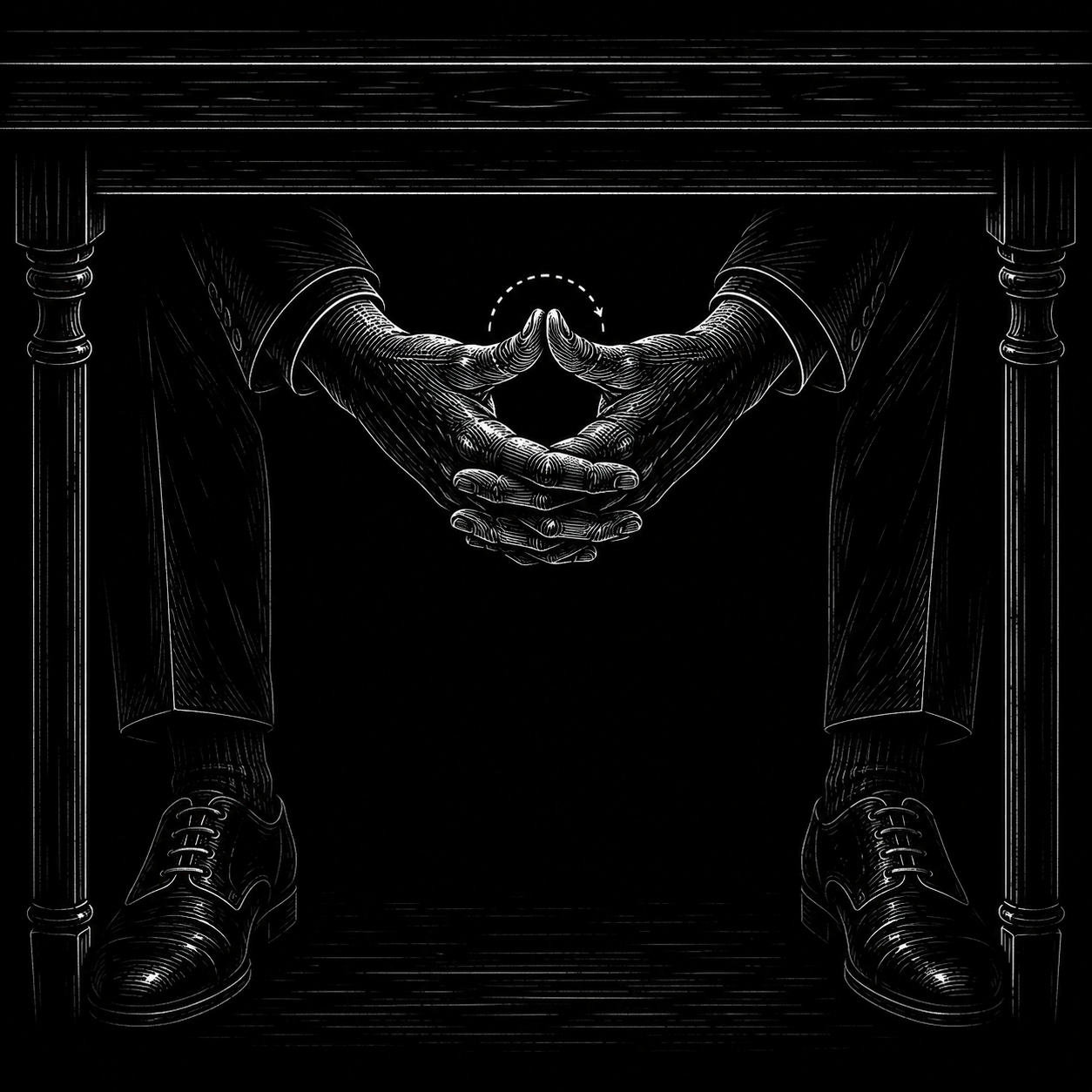
Because at some point in one of these meetings, after a question I did not love, I caught my own thumb rubbing slow circles into the palm of my other hand under the table. A textbook pacifying gesture. Navarro describes it in chapter four. The limbic brain registers discomfort and dispatches a small act of self-soothing, the adult version of a child stroking its own hair. Here is the thing though. I had not decided to do it and had not noticed starting it. By the time I became aware of the movement, it had been running for a while, and the awareness felt less like catching myself in an act and more like being informed of one, the way you are informed of decisions made in a meeting you were not invited to.
So who moved my hand?
Something in me had evaluated the question, concluded it was a threat, and initiated a response, all before the part of me that writes these letters heard anything about it. That something was not asking for permission. Hence the question arose in me: If the truest emotional reactions of my body are automatic, produced by machinery I neither control nor consciously access, then what exactly is my conscious experience doing? Am I feeling my emotions, or am I reading a report about them, delivered late, by a system that owes me no explanation?
🜏
This question has a history. The Enlightenment had left Europe with a flattering self-portrait. Man was the rational animal. Reason sat at the top, the passions below, and the task of a civilized life was to keep the hierarchy intact. Kant had given this picture its most rigorous form, Descartes had given it its metaphysical foundation, and the new sciences seemed to confirm it. The universe was a mechanism, the mind was its mirror, and both could be understood by the disciplined application of thought.
The first doubts about this appeared in German literature.
In 1774, a twenty-four-year-old lawyer named Johann Wolfgang Goethe published a short novel called The Sorrows of Young Werther. It is the story of a sensitive young man who falls in love with a woman he cannot have and is destroyed by the experience. Read today, it feels almost quaint. Read in its time, it was an earthquake. Werther is intelligent, educated, articulate, and none of it helps him. Something rises in him that argument cannot touch, and the novel follows, in letters, the process of a rational mind being overwhelmed by forces it can describe but not command. Young men across Europe dressed like Werther, spoke like Werther, and in some documented cases died like Werther. The book was banned in several cities, which of course only confirmed its diagnosis. Something in the human being did not answer to reason, and everyone had apparently been waiting for permission to admit it.
Goethe himself spent the rest of his long life circling this discovery. Faust, the work he carried for sixty years, contains the line that could serve as the epigraph for this entire letter: two souls dwell, alas, in my breast. Not two opinions. Two souls. Goethe was reporting an architecture, the felt experience of containing something that has its own wants and its own direction and that shares your name without sharing your intentions.
Next came Friedrich Schelling (around 1800), who was probably the first to use the word unconscious, das Unbewusste, in something like its modern sense. For Schelling, nature was a single productive force, working its way up through matter and life toward consciousness. The human mind was the force, to become momentarily able to look at itself. Which meant that beneath every conscious thought lay the whole dark, striving history of nature, present and active, like the mass of an iceberg beneath the visible tip.
The decisive figure, who turned intuition into system, was Arthur Schopenhauer. His central claim, published in 1818 and ignored for decades, was as simple as it was insulting. The intellect is an instrument, a late and superficial development, sitting on top of something stronger that Schopenhauer called the Will. The intellect is not the master. The Will does not think. The Will wants. It wants blindly, endlessly, in every organism and arguably in every stone, and what we experience as our reasoning mind is essentially a press office the Will maintains for public relations purposes. We do not want things because we have reasons. We have reasons because we want things, and the wanting comes first, from a place consciousness cannot reach.
If that sounds familiar, it should. It is Navarro's limbic system, described a hundred and fifty years early, without the neurology. It is the thing that moved my hand in the investor meeting. Schopenhauer would have found nothing surprising in that story. Of course something else moved your hand, he would say. Something else moves everything. The only unusual part is that you noticed.
There is a detail in Schopenhauer's biography that connects this letter to an earlier one. He was among the first European philosophers to read the Upanishads, in a Latin translation of a Persian translation, and he kept them on his nightstand for the rest of his life, calling them the consolation of his existence. The Hindu texts I wrote about in the sixth issue of this newsletter, the ones that describe the surface self as a kind of illusion floating on something vaster, entered Western philosophy here, through Schopenhauer, disguised as pessimism. The West did not discover the unconscious entirely on its own.
What the Romantics and Schopenhauer lacked was method. That changed in Vienna, in the last years of the nineteenth century, with a neurologist who had wanted to be a scientist of the brain and became, well let’s find out...
🜏
Sigmund Freud began with hysteria. Patients, mostly women, arrived with symptoms that made no anatomical sense. Paralyzed hands without nerve damage, coughs without a cause, pains that wandered. The medicine of the day filed them under malingering. Freud, working with his colleague Josef Breuer, took a different route and induced the patients to talk, freely and without censorship, and when the talking reached a certain buried memory, the symptom sometimes disappeared. The body had been saying something the person could not say. Cure the silence and you cure the cough.
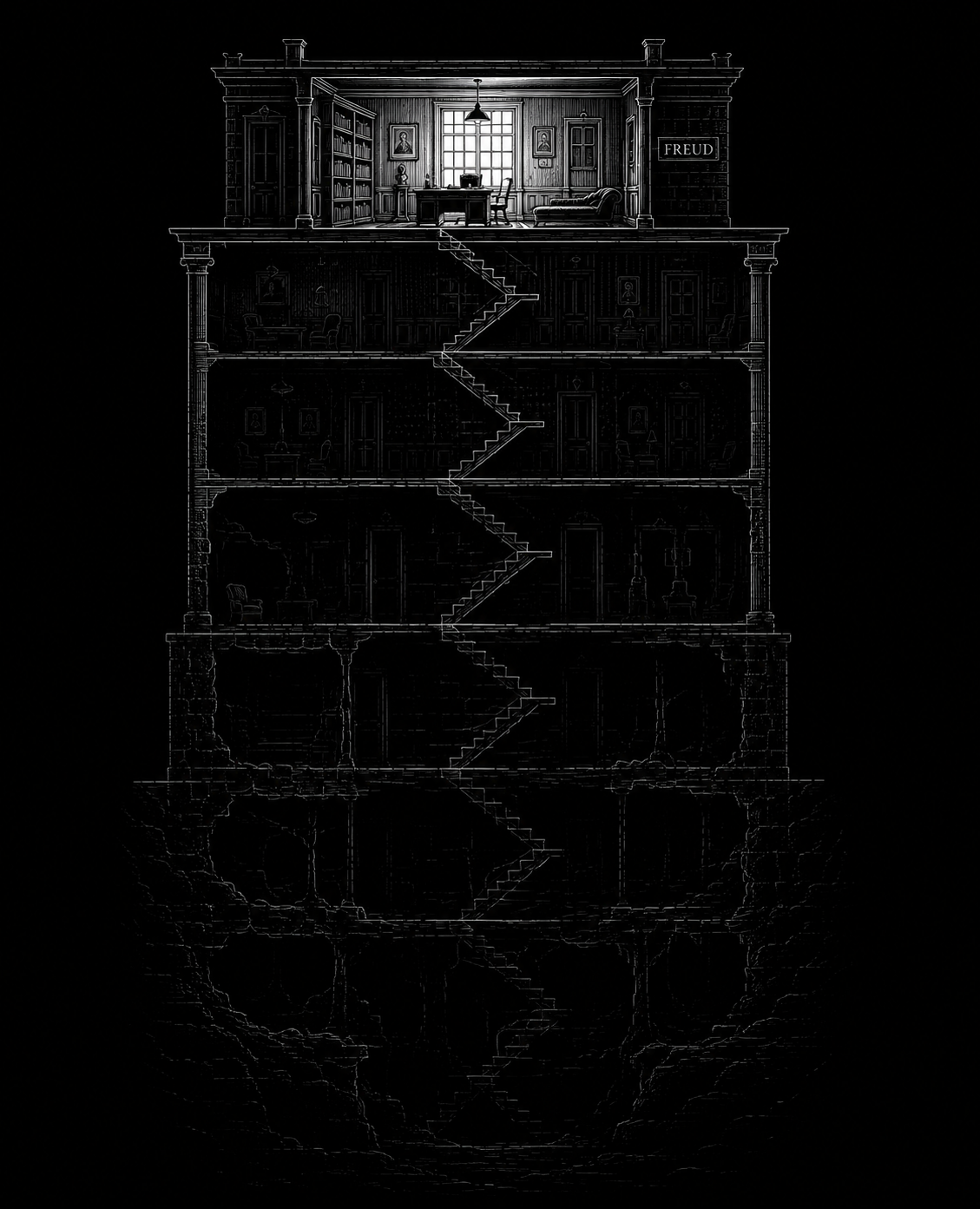
From this observation Freud built the system that made him famous and eventually notorious. The mind, in his picture, is mostly submerged. Consciousness is a narrow, well-lit office at the top of a building whose basement levels extend far underground, and everything down there stays active. Wishes, fears, and memories were exiled to the basement precisely because the office could not tolerate them, and they spend their exile pressing upward, disguising themselves to get past the censor. They surface in dreams, in slips of the tongue, in jokes, in symptoms. Freud's radical claim was that all of this carries meaning, that every psychological accident is a message from below, wearing a costume.
He also wrote, in a line that reads like a mission statement for Navarro's entire career, that no mortal can keep a secret. If his lips are silent, he chatters with his fingertips. Betrayal oozes out of him at every pore. An FBI agent watching a suspect's feet under an interrogation table is doing applied Freud, whether he knows it or not.
Honesty requires saying that much of Freud's specific architecture has collapsed. The Oedipus complex, the tidy stages of development, the interpretive certainty about what every dream symbol means, most of this failed as science, and the failures were consequential. His central claim, though, has aged in the opposite direction. That the majority of mental life runs outside awareness, that our reasons are often constructed after the fact, that the self systematically hides things from itself: modern psychology confirms all of this with methods Freud never had. He missed badly on the details and still pointed the whole century in the right direction, which for a pioneer is the better way around.
Freud gave the unconscious a structure. His most gifted student gave it a population, and then the two men could no longer share a continent. Carl Gustav Jung broke with Freud over a disagreement that sounds technical until you ponder its consequences. For Freud, the unconscious was personal, a basement filled by your own biography. Jung, sitting with thousands of patients, kept finding contents that biography could not explain. Images and figures that recurred across patients, across cultures, across centuries, as if beneath the personal basement lay a deeper floor that all humans share. He called it the collective unconscious, and its recurring figures he called archetypes. The wise old man, the great mother, the trickster, the hero. And the one most relevant to this letter, the shadow: everything you have decided you are not, which accumulates instead of disappearing, and which contains, Jung insisted, along with your worst material, a great deal of your unlived strength.
Readers of the third issue may recognize the shape of that idea in a much older costume. The Egyptians had a god for exactly this. I will leave the connection there rather than force it, but Jung himself would have refused to call it a coincidence. He considered nothing a coincidence, which was both his genius and his weakness.
What none of these men had, from Goethe to Jung, was a way to watch the unconscious operate in real time, in an ordinary person, at the resolution of seconds. Another century passed before someone wrote a book exploring this capability, and philosophy had nothing to do with it. The man who built it spent his career catching spies.
🜏
Joe Navarro was born in Cuba, came to the United States as a child after the revolution, and learned English slowly enough that he spent his early years doing what immigrant children everywhere do: reading bodies instead of words. Faces, postures, hands. What people actually meant, as opposed to what the incomprehensible sounds coming out of their mouths claimed. He got so good at it that the FBI eventually hired him for exactly this skill, and he spent twenty-five years in counterintelligence, watching spies, assessing suspects, and cataloguing, across thousands of hours of observation, which movements of the human body mean what.
What Every BODY Is Saying is the field manual he wrote afterwards. It presents itself as a practical book about reading other people, and underneath that surface, without ever using the vocabulary, it turned out to be the most concrete document about the unconscious I have ever read, because it describes, behavior by behavior, the machinery that Goethe intuited, Schopenhauer systematized, and Freud theorized, operating in real time in every conference room on earth.
Navarro's framework rests on a division of labor in the brain. The neocortex, the young, clever, verbal part, is what he calls the lying brain. It composes sentences, manages impressions, and deceives fluently, because deceiving is much of what it evolved to do. The limbic system, the ancient structure beneath it, lacks this talent entirely and reacts to the world honestly and instantly, in the currency it has used for millions of years: freeze, flee, fight, soothe. And because it is wired more directly to the body than the verbal brain is, its reactions leak into muscle before the neocortex has finished drafting the press release. The feet orient toward the exit while the mouth says how interesting. The hand flies to the neck dimple when the revenue question lands. The thumb rubs circles into the palm under the table while the face above the table performs confidence.
The detail from the book that was most surprising to me is Navarro's insistence that the most honest part of the human body is the feet. The face gets trained in mirrors from childhood and learns to lie almost as well as language does. The feet escape that education. Nobody watches them, nobody rehearses them, and so they point, lean, bounce, and freeze in direct broadcast from the limbic system. Navarro tells the story of interviewing a suspect whose words and face were perfectly cooperative while his feet, under the table, had locked around the chair legs in a full flight response. The man's body was fleeing. Only the furniture was holding him in place.
Navarro wrote all this as a practical manual, and as a practical manual I can confirm it works. My pitch got better because of it. But he leaves a philosophical door standing wide open, walks past it without a glance, and it is this door I have been unable to stop staring at since.
Navarro's entire method rests on the fact that limbic reactions arrive unchosen. That is precisely why they are reliable. You cannot decide against freezing when the threatening question comes, the way you can decide to smile. The reaction fires first, automatically, and awareness is notified afterwards, if at all. And these automatic reactions carry emotional content, which separates them from a mere reflex like a knee jerk. The freeze is fear. The pacifying hand is distress. The lean-in is desire. Which means that the truest, most honest layer of our emotional life, the layer that professional observers trust over anything we say, runs on machinery that operates below and before conscious experience.
So what is the conscious experience of an emotion actually experiencing? By the time I feel my own nervousness, my body has been broadcasting it for measurable seconds. The feeling arrives like a newspaper reporting yesterday's events. Taken seriously, Navarro's material suggests that consciousness enters the process late, receiving a summary of an emotion that something else generated, chose, and had already lived through by the time the report arrived. And if that holds for fear in a conference room, it is worth asking how much of what I call my inner life consists of the events themselves, and how much consists of reading reports about events that something else in me has already lived through.
I have no answer to that question. Schopenhauer would say the reports are all we ever get. Freud would say the reports can at least be improved through analysis. There is a third position, and I heard it around a campfire in Canada rather than in any of the books, from the friend I wrote about last month. The first reaction, he told me, arrives on its own and always will. He knew this better than anyone I have met, having spent a lifetime with reactions installed in him by an event no child should witness. But he had stopped locating himself in the first reaction. The first reaction is the machinery. What comes after, the half-second afterwards, the question of what to do now that the wave has already risen, that is where he lives. That is the only place, perhaps, where anyone lives.
Navarro's spies could never suppress their tells, and neither can I, and neither can you. The first reaction will keep arriving on its own schedule. What observation changes is who shows up for the second one.
Until then, watch your feet. They are saying something.
- Transmission Sent -