
#11 - “A Good Prisoner”
Dear Reader,
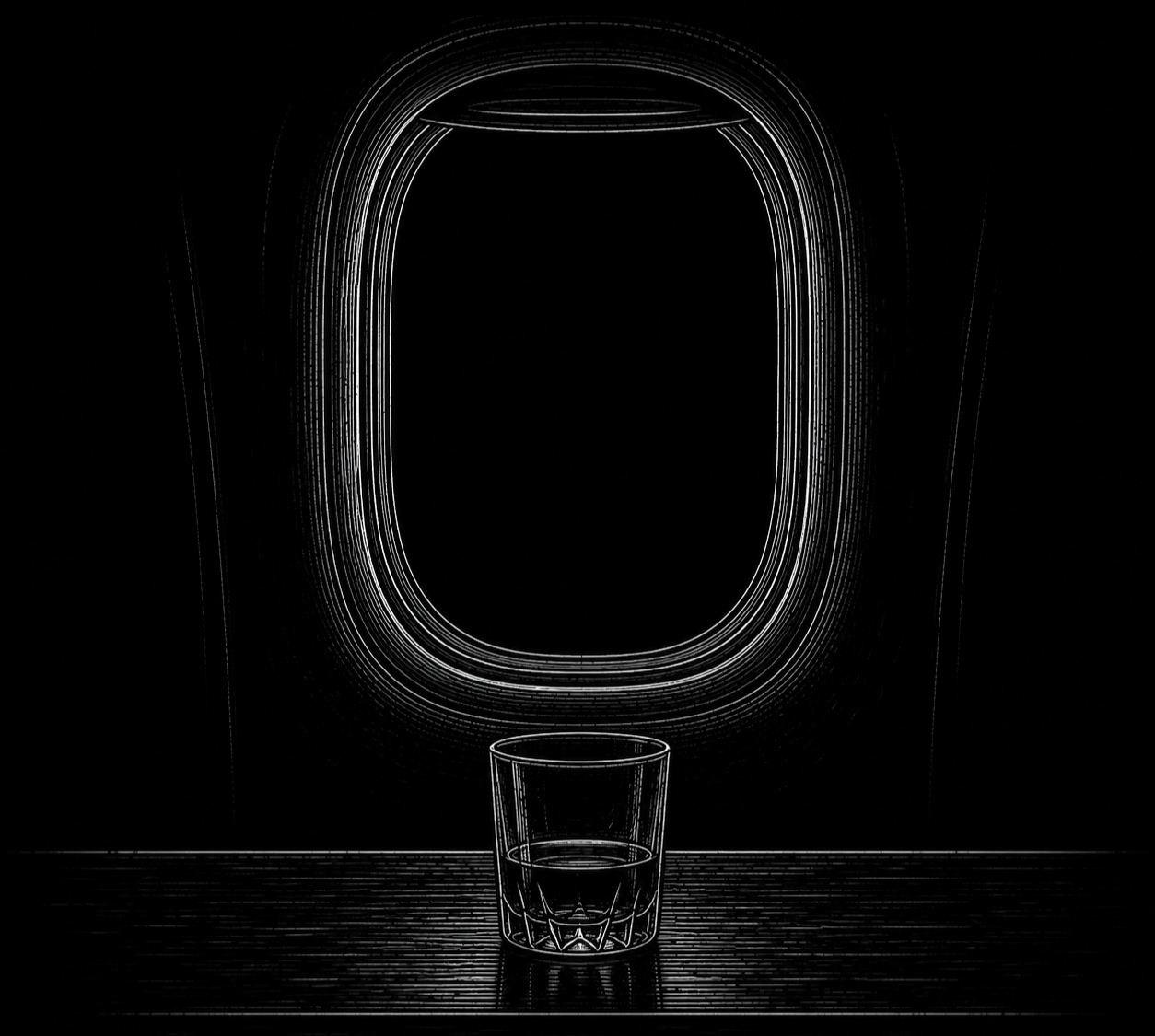
I am not standing at Fisch Gosch in List on Sylt, drinking Jever from the bottle. But I am standing at the business class bar of an A380 on its way to Asia, sipping a cocktail. I am wearing the standard preppy uniform, boat shoes, chinos, a dress shirt, my hair gelled back, and if we were outside I would also be wearing a Barbour wax jacket, with some Bret Easton Ellis novel in the side pocket, probably. I am in my mid-twenties. I have been everywhere in the world, eaten in countless starred restaurants, gone diving in exotic countries, jumped out of airplanes, and experienced more or less every erotic and every substance-induced peak there is, or put myself in actual danger on purpose. Beyond that, my life consists almost entirely of intoxication, parties and Tinder. I know that because of my privileges, the professional world stands open to me. I regularly behave like an enormous asshole. Like a punk with money. Outwardly I claim conservative values while behaving like a sixty-eighter on crack. With diminishing returns I chase the next peak, trying to quench an unquenchable thirst for ever more intense experiences. But with every new peak, the next one feels more like another one of those. The faster I spin in circles, the faster I race toward the edge.
The edge turns out to be the locked psychiatric ward of the Schwabing hospital in Munich, where I check myself in because of suicidal thoughts.
From there it is a years-long road of self-reflection, humility, meditation and psychotherapy, along which I learn to feel again: to tell feelings apart beyond good and bad, to let them in, to give them a place. It takes a lot of digging through the past. The search for a connection to myself. Learning to see myself, and to feel compassion for myself, especially for little Niklas, who went through things in his childhood that no child should go through. And to draw from that compassion an empathy for other people and other living beings. All the way to a reasonably functional, caring adult, and to the inner lesson that the misanthropy, the disgust and the dark shadows end with me and will not be passed on to the next generation.
Hopefully not.
🜏
It took me almost fifteen years to discover that the young man at the business class bar had a philosophical literature waiting for him. I found the door into it, through a book about a café.
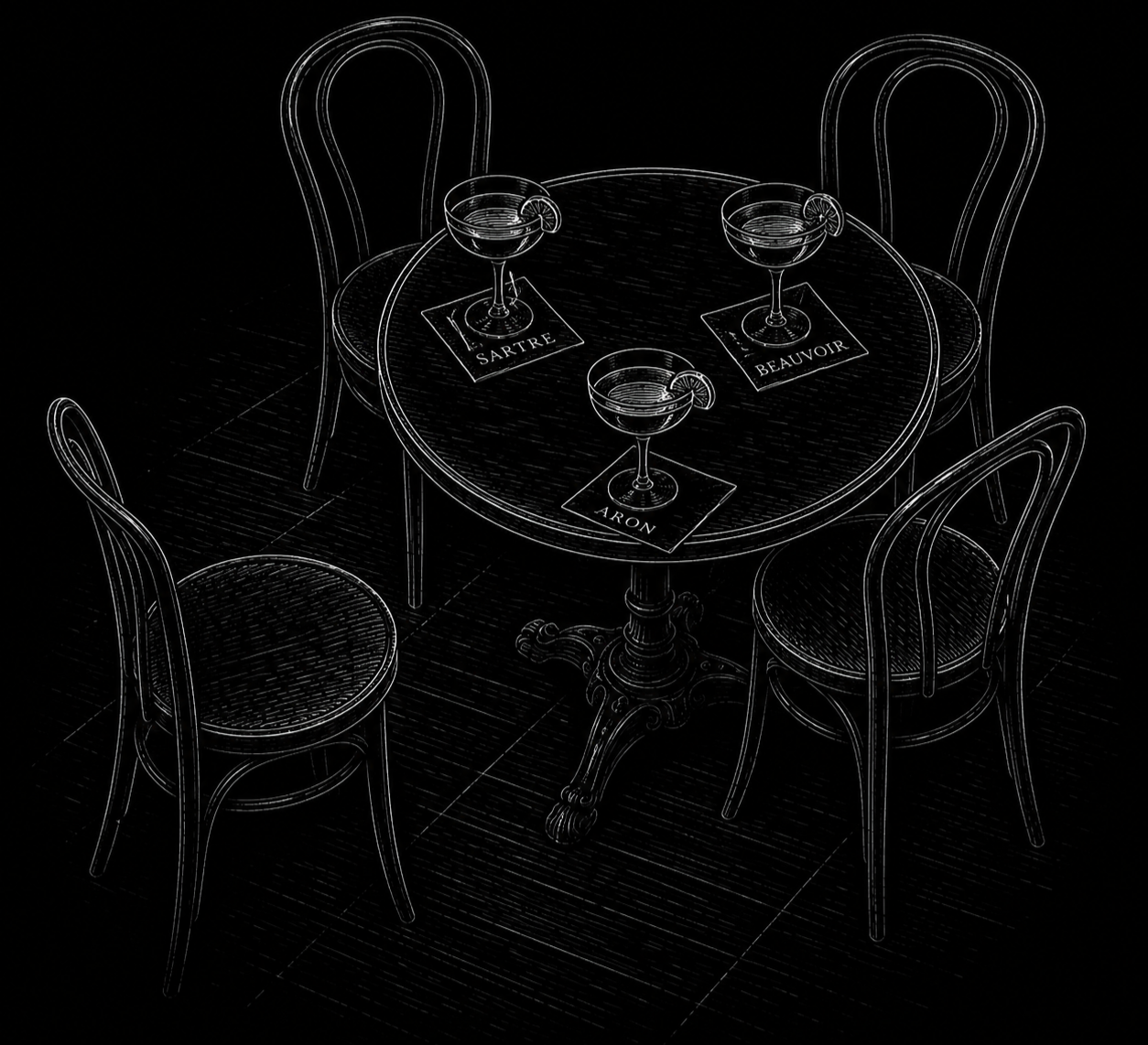
Sarah Bakewell's "At the Existentialist Café". Paris, around the turn of the year 1932 to 1933. Three young philosophers sit in the Bec-de-Gaz bar on the Rue du Montparnasse, drinking the house specialty, apricot cocktails. Jean-Paul Sartre is twenty-seven, teaching school in Le Havre and privately convinced he is a genius nobody has noticed yet. Simone de Beauvoir is his partner and intellectual equal, though the century will need a few more decades to concede the second part. Raymond Aron, an old school friend of Sartre's, is visiting from Berlin, where he has been studying a new philosophical method called phenomenology.
At some point Aron points at his glass and says the sentence around which Bakewell builds her book. You see, he tells Sartre, if you are a phenomenologist, you can talk about this cocktail and make philosophy out of it.
Beauvoir reports that Sartre turned pale. For years he had been looking for a philosophy that began with lived experience rather than centuries of abstraction about substance and category, and now his school friend was telling him the Germans had already built one. The next day Sartre bought the only book on the method he could find in Paris. Within the year he was in Berlin, learning it at the source.
The source was Edmund Husserl, a mathematician turned philosopher whose slogan was: back to the things themselves. Husserl had grown tired of philosophy asking what reality might exist behind our experience of it. He proposed putting that question in brackets and describing instead what actually appears, exactly as it appears. The apricot on the tongue. The cool weight of the glass. A melody stretching across time, each note still carrying the last and already leaning toward the next. His central discovery was that consciousness never floats free. It is always consciousness of something, aimed at something, about something. You are never simply aware. You are aware of the bar, the person across the table, the ache in your lower back, the thought about the ache. Consciousness is a beam, and Husserl wanted to map everything it touches, including the touching.
Readers of last month's letter may recognize the house, though we have entered through the opposite door. The researchers of the unconscious asked what happens beneath experience, before we are consulted. The phenomenologists asked what experience looks like from the inside, moment by moment. Both questions had become urgent for the same reason: the Cartesian picture of a transparent mind watching itself had collapsed, and something was to replace it.
Husserl's most gifted student developed the method further. He is also the figure in this story I have the most complicated feelings about. Martin Heidegger asked what conscious experience rests on and answered that, before we ever observe the world, we are already thrown into and busy with it. His great theme was how easily that busyness can swallow a life. In "Being and Time" he calls one mode of existence das Man. Translators render it as "the they" (even though I would rather translate it as “one does”). Every German speaker already knows it from the inside because our language uses it constantly. Man trägt das. Man macht das so. Man fährt im Sommer nach Sylt. One wears this. One does it this way. One goes to Sylt in the summer. Heidegger's claim was that most of us, most of the time, are not living our own lives at all. We perform a template that "one" provides, dress ourselves in opinions that "one" holds, hurry toward goals that "one" pursues. The performance can run for decades before anyone notices that nobody is home.
I read those pages with the A380 bar in my mind and felt personally caught across ninety years. My boat shoes, gelled hair, Barbour jacket with the Bret Easton Ellis novel in the pocket. None of it was mine. It was simply what one wore in law school and especially student fraternities. I had assembled an entire person out of das Man and called him Niklas.
Unfortunately for his great philosophy, in 1933 the philosopher of authentic existence joined the Nazi party, took over the rectorate of Freiburg University under the new regime, and gave speeches in its service. He paid his party dues until 1945, quietly removed the dedication to Husserl, his Jewish teacher, from a wartime edition of "Being and Time", and after the war never produced anything resembling an apology. Bakewell walks through this without flinching, and her conclusion seems right to me: the work and the failure belong together. A man who wrote eight hundred pages about authenticity failed the most obvious authenticity test of his century. Understanding the diagnosis offered him no immunity to the disease. That may be the most existentialist lesson in the story, taught by Heidegger without the intent of doing so.
Sartre came back from Berlin and did what he tended to do with an idea: pushed it until it became uncomfortable. His formula was existence precedes essence, which he explained with the example of a paper knife. Somebody decides what the knife is for, draws it, and only then has it made, so its purpose exists before the object does. With human beings, Sartre argued, the order is reversed: we arrive without a plan, a fixed nature or a manufacturer to complain to, and what we become emerges afterwards, through what we do. This is why he called us condemned to be free. None of us asked to be here, but being here still leaves us responsible for the next move.
Sartre thought we spend much of our lives trying to wriggle out of this through what he called mauvaise foi, bad faith. His famous example is a Paris waiter who is slightly too much of a waiter, his movements too quick, his politeness too exact, the whole performance pushed half a step beyond what the job requires. He acts as though being a waiter is not something he does but something he is. Here’s an invitation to look at your own costumes. I had chosen the boat shoes, the Asia flights, Rimowa luggage, rooftop parties and the rest of the catalogue, then persuaded myself that this was who I was. Admitting that I had chosen any of it would also have meant admitting that I could choose differently.
Sartre put the same problem into a novel in 1938, whose narrator, living in a provincial town, begins to feel physically sick at the bare fact that things exist, himself included. The book is called "La Nausée" in French and "Der Ekel" in German, “Nausea” in English, even though I would find the literal German translation, which means something like “The disgust” much more fitting. Being disgusted is exactly how I used to feel looking at normal people.
Fifty-seven years later, Christian Kracht would give that disgust money, boat shoes and a Barbour jacket, and send it south through Germany.
🜏
Christian Kracht was twenty-eight when Faserland appeared in 1995, and German literary criticism did not know what had hit it. The book was short, cold, and full of brand names, narrated by a rich young man without a name, a job, or an interior life, and large parts of the establishment read it as a celebration of exactly the emptiness it described. It took about a decade for the more careful reading to win: that this was the saddest German novel of its generation, wearing the costume of the shallowest one, and that the costume was the point.
The plot, to the extent that there is one, is a route. The narrator starts on Sylt (Germany’s Martha’s Vinyard), standing at a fish stall in List, drinking a Jever from the bottle. Readers who remember the opening of this letter will recognize the scene, because I stole it. From there he drifts south through the Federal Republic, Hamburg, Frankfurt, Heidelberg, Munich, Lake Constance, always by plane or taxi or first class carriage, always with money, attending parties he despises, meeting friends he cannot stand, leaving every place the moment anything threatens to actually happen. He wears the Barbour jacket. He notices what everyone else is wearing. And he is disgusted, almost without pause, by nearly everything he sees: the smokers, the bodies, the accents, the interiors, the whole country passing by the window. The word ekelhaft runs through the book like a pulse.
Remember Sartre's novel’s title translation to German language. Roquentin, Sartre's hero of 1938, is overcome by nausea at the raw fact of existence, at the naked, unjustifiable thereness of a chestnut root. Kracht's narrator has the same affliction in a later, wealthier stage. Existence disgusts him too, wherever it shows itself without packaging: in ugliness, in age, in need, in sincerity. What does not disgust him is the packaging. Brands are clean. Surfaces are safe. The Barbour jacket never sweats, never wants anything, never dies. Consumption, in Faserland, is the medication a man takes against the nausea of being alive, and the novel is the protocol of the dose no longer working.
Sartre would have had a name for the underlying condition within a paragraph. Here is a man who has outsourced the entire project of being someone. His opinions arrive with his social class, his itinerary follows the season, his taste is a copy of a copy, and all of it runs on the machinery Heidegger called das Man. One wears this. One summers there. One finds that sort of person dreadful. The narrator performs the template flawlessly and pays the full price for it, which is that nobody is performing him. By the definition this letter arrived at earlier, consciousness as an activity rather than a possession, Faserland is the portrait of a consciousness on strike.
Kracht's formal trick is that he never says any of this. Sartre gave his nauseated man a diary and four hundred pages of introspection. Kracht denies his narrator an inside altogether. The book is all surface, deliberately, and the inside shows itself only where it leaks. The narrator watches a friend fall apart at his own lakeside party and responds by slipping away before morning. He keeps starting to tell us childhood memories and swerves off them the way you swerve around something on the road at night. Once, late in the book, he allows himself a single gentle daydream, a quiet life in the mountains with Isabella Rossellini, children, no parties, and it lasts about a page before the irony closes back over it like water. Every escape route from the emptiness appears in the novel exactly once, is looked at, and is left standing at the platform.
I know the mechanics of that swerve from inside. My version had more air miles and different music, but the choreography was identical. The moment a conversation turned real, I ordered the next round. The moment a relationship wanted something, I booked a flight. The moment a feeling announced itself that could not be filed under fun, I found a party, a substance, a country, a body, anything with enough surface to skate on. I read Faserland at twenty as a how-to. I read it again last month, at almost forty, with the ward in Schwabing behind me, and I had to keep putting it down, because I now recognize what I was looking at. The narrator is not a satire of people I used to know. He is a photograph of a person I used to be, taken by someone who understood that this person could only be photographed from outside, because inside there was nobody available to sit for the portrait.
The book ends in Zurich. The narrator crosses the border, looks for Thomas Mann's grave in the dark, cannot find it, and then pays a boatman to row him out onto the lake at night. The last word of the novel, in German, is "Schon bald." Soon. Then the water, and nothing further. Whether he goes under or merely crosses is left open, and Kracht has never resolved it, and the whole reception history of the book lives in that unwritten next page.
I have read that ending described as a homage, as a threat, as a joke. To me it reads as an honest report on where the route actually leads, delivered by a writer too disciplined to pretend he knew what came after. I happen to know one version of what comes after, because I lived the chapter Kracht declined to write. If the boat comes back, it does not land anywhere scenic. In my case it landed at the locked ward of a Munich hospital, which is simply what the lake looks like when it has an intake procedure.
Kracht himself, it turns out, was not done with the question either. Six years later he published a second novel about a man with no self of his own, and this time he removed the safety of the open ending. He did not send him onto a lake. He sent him into a labor camp.
🜏
Kracht published 1979 in 2001. It initially looks like an exotic adventure novel, although its nameless narrator is familiar from Faserland: close to wealth, attentive to surfaces and almost entirely without a will of his own. This time he works as an interior decorator, arranging beautiful rooms in which other people live, and travels to Tehran with his partner Christopher during the final days of the Shah. Christopher is dying and has become cruel, while the two men continue attending parties in the hills above a city already beginning to burn. After Christopher's death, the narrator does what he has always done and follows the nearest person with a strong opinion, because he has never developed enough of his own direction to resist one.
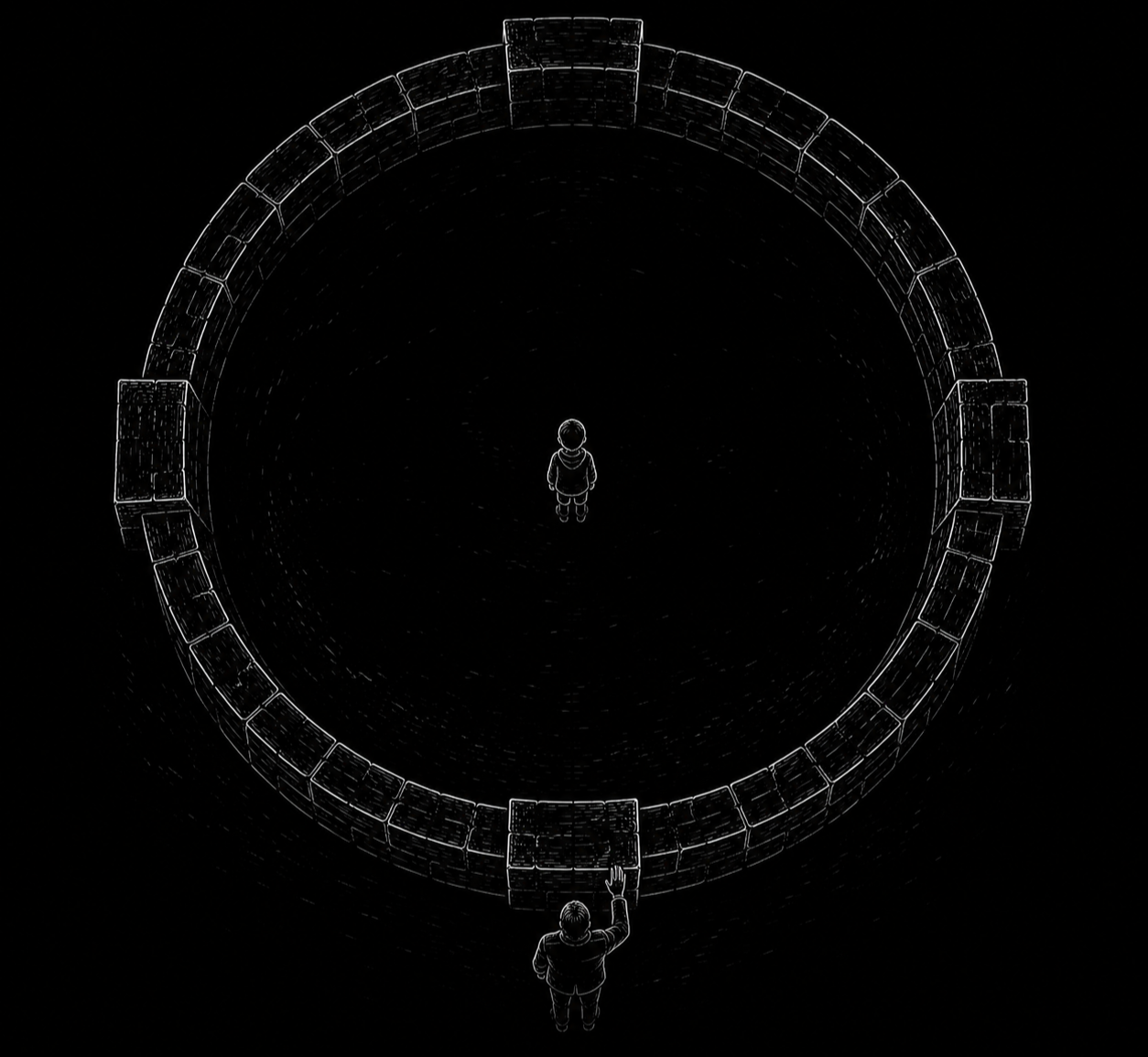
The person he follows is a Romanian acquaintance who recommends a pilgrimage around Mount Kailash in Tibet, and the narrator accepts the suggestion with roughly the same involvement with which he might accept a restaurant recommendation. He walks around the holy mountain without sharing the belief of the other pilgrims, is arrested by a Chinese patrol and disappears into a re-education camp, where malnutrition, indoctrination and self-criticism gradually remove what little was there before. Kracht's narrator embraces the process, attends the sessions eagerly and denounces himself with enthusiasm. Kracht reports this in the same flat tone with which Faserland described jackets and bars, ending with the narrator's satisfied statement: "Ich war ein guter Gefangener", I was a good prisoner.
Taken together, the two novels make a bleak argument. Faserland follows a man who avoids the work of becoming someone and leaves him on the water before we learn where that avoidance leads. 1979 continues the movement until an institution supplies the identity he never built for himself. The habits are recognizably the same even though the surroundings have changed. A man who obeyed the mild authority of brands, seasons and what one does also obeys the camp, only now the instructions are explicit. The final sentence is disturbing because the narrator experiences it as success: after a lifetime of uncertainty, he has finally been told exactly what he is and how to be good at it.
Sartre had described the underlying mechanism sixty years earlier: a person who refuses responsibility for their freedom does not reach neutral ground, but becomes dependent on whatever role or structure is prepared to decide for them. His waiter still exaggerates a part he could, at least in principle, recognize as a performance. Kracht's narrator has gone further. He attends the sessions, speaks in complete sentences and appears to function, yet there is no remaining distance between the person and the role from which he might notice what is happening. Nothing dramatic marks the change, which is part of what makes it frightening.
The comparison becomes dangerous here, because a fictional re-education camp cannot be placed casually beside testimony from Auschwitz. Viktor Frankl, a Viennese psychiatrist deported in 1942, wrote "Man's Search for Meaning" during the nine days after his liberation and described from experience the systematic removal of name, profession, hair, possessions and nearly everything else a person might have treated as an identity. He also recorded, without pretending that it was common or sufficient to save anyone, that some prisoners remained capable of an inner decision. A man walking to forced labour could keep the image of his wife before him. A prisoner offered bread in exchange for tobacco could still decide what kind of person would make that exchange. Frankl called this the last human freedom, the possibility of choosing one's attitude when almost every other choice has been taken away.
Frankl was not offering a sentimental story about heroism. The decisions he described were small, private and repeatedly necessary, and in most cases they did nothing to preserve the body. What they preserved was the capacity to choose at all. This is where his testimony and Kracht's novel point in opposite directions: Frankl describes people trying to maintain an inner life inside a machinery designed to destroy it, while Kracht imagines a man entering a less total machinery with relief because he had never learned to inhabit himself before. The distinction is not that one man is cleverer or naturally braver, but that one still has an inner position from which a choice can be made.
Readers of last month's letter may recognize the argument. I wrote then that the first reaction is largely machinery and that whatever freedom we have appears in the short interval before the second, when someone can notice what happened and decide whether to continue it. Frankl describes that capacity under circumstances in which it should barely have survived. The narrator of 1979 hardly possesses it under circumstances that leave him comparatively free. The young man at the A380 bar, with gelled hair and a personality assembled from a catalogue, was much closer to the second condition than he knew. If anyone had tried to explain this to him, he would probably have ordered another drink. To my own memory that actually happened a few times lol.
What separates my story from Kracht's endings is not a heroic decision. I did not choose my way out from a position of strength. I collapsed, and the ward in Schwabing was simply where the performance could no longer continue. Choice came later in small and mostly unphotogenic forms, in therapy rooms, on meditation cushions and during conversations I would have escaped at twenty-five. It still comes that way. If Sartre is right that consciousness is an activity, mine had to be learned again after the collapse, awkwardly and without any guarantee that it would become automatic.
This might have remained only a philosophical reading of Kracht's novels if Kracht himself had not returned to them in 2018. For twenty-three years he had allowed their coldness, evasions and missing interiors to stand without explanation. Then, during a lecture in Frankfurt, he disclosed something that changed how the books could be read.
🜏
Kracht had been invited to deliver the Frankfurt Poetics Lectures, where German-language writers are expected to explain something about how their work is made. His audience probably expected another performance from an author who had spent his public life behaving like an extension of his narrators, appearing in carefully chosen clothes and answering questions with so much irony that nobody could locate the person underneath. A few minutes into the first lecture, in the same calm tone he might have used to discuss narrative technique, he said that a priest at his Canadian boarding school had sexually abused him when he was twelve. He added that he had never spoken about it publicly, suggested that the information might alter how the novels were read, and continued with the lecture while the room tried to understand what had happened.
German critics spent the following weeks rereading the novels, as Kracht had known they would, and much of what had seemed merely cold or evasive began to look different. His narrators approach childhood memories and turn away before they become specific. Intimacy produces flight, while surfaces remain trustworthy because a jacket or a hotel room cannot reach back. Even the irony for which Kracht was famous became harder to treat as a purely aesthetic choice. It could also be understood as a form of distance first built by a twelve-year-old and maintained so consistently that readers had mistaken the defence for the personality.
This reading needs restraint, and Kracht warned against the cheap version of it himself. A trauma does not explain an entire body of work, and using the lecture as a decoder ring would reduce both the novels and the experience behind them. It nevertheless becomes difficult to read the coldness as emptiness for its own sake once one knows that distance may also have served a practical purpose: keeping the room closed.
I recognize that closed room because I was twelve too. In my case the person was a much older woman, and after an unrelated suicide in my family I was sent to boarding school to deal with everything that just happened to me alone. For decades I kept what had happened under a heading that allowed me not to examine it. I am still deciding how much of it belongs in public, but the connection belongs here: I recognize Kracht's distance because I constructed something similar at the same age. The brands, flights, substances, conservative clothes and punk-with-money performance were not evidence that nothing existed underneath. They helped protect what was underneath. The young man at the A380 bar was defended rather than merely shallow, and the distinction matters because behind the defence there was still a twelve-year-old waiting to be noticed.
This is also where Sartre's account of freedom becomes too severe. If we are only what we make of ourselves, the person living behind such defences appears to have chosen badly and should simply choose again. Anyone who has lived that way knows the defence was not built by an adult making a philosophical error, but by a child using the tools available during a real emergency. Its effectiveness becomes the later problem, because it continues excluding life after the danger has passed. Sartre is right that change eventually has to occur from inside and through repeated action, but he says too little about the compassion required for the child who built the structure. Condemning the defence only gives it another reason to remain. Understanding why it was necessary is what can make its removal possible.
Sartre came closer in the sentence toward which this letter has been moving: freedom is what you do with what has been done to you. It does not deny the damage or imagine an unburdened person choosing from nowhere, but begins with what has already happened and leaves open the question of what follows. The freedom lies less in one decisive act than in the continuing work, which is why it can be present one morning and difficult to find the next. Kracht's narrators show lives in which that work never begins, while Frankl records that it can survive circumstances designed to make it impossible. Most of us live less dramatically somewhere between those positions.
Ten issues ago I began this series by asking what consciousness is, and the existentialists end this part of the inquiry by asking what it does. Their answer is that it chooses, projects and makes something from the situation in which it finds itself, unless it avoids those tasks by allowing convention to live in its place. By that standard the young man at the A380 bar was barely conscious in the sense that now matters to me. The activity began in the locked ward, involuntarily and without anything that felt like a beginning at the time.
- Transmission Sent -