
#9 - “ The River and the Rock”
Dear Reader,
I am not sitting right now. I am half-lying in the cab-over bed of a camper at the Whistler’s Campground in Jasper, Alberta, looking out of my tiny window at a landscape that is hard to describe without sounding either melodramatic or insufficient. In front of me, the Canadian Rockies. Around me, in a roughly fifty-meter radius, I previously counted ten elk, currently in rut. And everywhere I look, between me and the mountains, the trees are blackened stumps. Charred poles standing in formation across whole hillsides, the remains of the great forest fire that swept through here last year and erased the forest I had walked through on my last visit in 2023. Jasper, the town itself, lost a third of its buildings. The trees will take eighty years to grow back.
I came here around lunchtime after I took a bath in a glacial stream this morning. I have been practicing the Wim Hof method for several years now and completed the Snezka expedition in Poland earlier this year, which involves a week of combined breathing and cold exposure ending in a 3 hour climb of a mountain in mid-winter (-10c) in shorts and boots only. Since then I look for cold water wherever I can find it. This morning the cold water was a glacial creek, maybe three or four degrees, fed by an ice field that was actual ice couple of months ago. I held myself in it for about three minutes.
The cold however, was not the dominant sensation. The dominant sensation was the fear of being eaten by a grizzly bear. There are many grizzlies in this valley. The campground office even said there was a Grizzly on the campground today. I was alone, naked from the waist up, in a stream surrounded by burned forest in a landscape where the apex predator is several hundred kilograms of muscle that can outrun a horse over short distances. I do not know what I would have done if one had appeared. I would not have been able to do much. I know the likelyhood of it happening is not high, but being that exposed I couldn’t shake the thought of what may come out of the bush behind me while resting in the cold water.
What the cold and the fear did, together, was something I cannot describe without sounding esoteric, so I will simply describe it. They emptied me. There was no inner monologue. There was no planning, no remembering, no narrative about my life. There was only the water, the body, the sound of the river and the listening for something large that might or might not be coming out of that bush. And in that emptiness, when I climbed out of the water and stood on the bank with the body shaking and re-warming itself, something that I am going to call thinking, though it was not thinking in any way I would have recognized in my office in Hamburg, started to happen. I understood several things at once that I had been trying to understand the whole month while doing the research for this issue. None of them were verbal. All of them were clear.
This is a strange experience to have, because it contradicts the entire Western philosophical tradition I grew up in. That tradition says that thinking happens in the head, that the body is at best a tool of the mind, and that the most reliable form of knowledge is the kind that has freed itself from bodily influence. A cold stream is, in that model, exercise or hygiene at most, certainly not a method of cognition. And yet I have made more clear decisions in the moments after cold exposure than in any office I have ever sat in. The decisions tend to be better than the ones I make at my desk. I cannot defend this scientifically. I can only report it subjectively.
Lying in this camper, with the elk bellowing and the burned forest standing in formation outside, I am lying here writing about the man who, gave the West the idea I just contradicted, René Descartes.
🜏
Neuburg an der Donau, in November of 1619, was not the kind of place where you went looking for philosophical revolutions. A small Bavarian town with a castle, Catholic duke, and a hard winter, making military campaigning impossible. Descartes (23) had joined the army of Maximilian of Bavaria a few months earlier, because he wanted to see the world and military service was, at the time, one of the few ways a young gentleman could travel respectably. His regiment had gone into winter quarters and he had nothing to do.
He found a room with a large tiled stove and stayed in it. Years later, when he wrote about that period in the Discours de la méthode, he described himself as spending the days in complete intellectual solitude, with no one to talk to, no books to read, nothing to distract him from his own thoughts. He had been thinking for some time, that the various disciplines he had been taught at the Jesuit college of La Flèche, mathematics and physics and metaphysics and theology, did not actually fit together into a coherent picture of the world. They contradicted each other and rested on assumptions that none of them could verify. They were simply a mess.
What he was searching for was a method. He had a model for what such a method might look like, because he was already an excellent mathematician, and mathematics was the one field he knew of where conclusions could not be disputed. The question was whether the certainty of mathematics could be transferred to other domains. Whether philosophy itself could become as reliable as geometry.
On the night of the tenth of November, he went to bed in his overheated room and could not sleep. He later wrote that he had three dreams that night, and that he interpreted them, on waking, as a sign from God that the project he had been turning over in his mind was not just possible but required of him. The dreams themselves are strange and not entirely consistent in the various accounts that survive. In one of them, he was struggling against a violent wind that kept pushing him toward a church. In another, he heard a clap of thunder and saw sparks scattered around his room. In the third, he found a book of poetry open on a table and read a Latin line that asked, “Which way of life shall I follow?”
What matters is what he took from them. He decided that night that he was being called to a single life task, which was to apply the rigor of mathematics to the whole of philosophy, beginning by tearing down everything he had ever been taught and rebuilding it from the ground up using only foundations he could be absolutely certain of. He spent the next twenty-two years working on that project. The result, when he finally published it in 1641, was the Meditationes de Prima Philosophia. Six short essays, written in the first person, presented as the record of six days of intense meditation, in which Descartes attempts to doubt everything he can possibly doubt and see what survives.
The structure of the Meditationes is the structure of a thought experiment that has since become so famous that you have probably encountered some version of it without knowing the source. On the first day, he doubts the evidence of his senses. He notes that his senses have deceived him before, that things at a distance look smaller than they are, that water in a hot bath can feel cold to a fevered body. If his senses have deceived him about anything, they could in principle be deceiving him about everything, and he sets them aside.
On the second day, he doubts the evidence of his body. He notes that he has had dreams in which he believed himself to be sitting by a fire, reading, when in fact he was lying in bed asleep. If a dream can be that convincing, then any experience he is having right now, including the experience of having a body, could be a dream. He sets the body aside too.
On the third day, he goes further. He imagines that there might be an evil deceiver, an omnipotent being whose entire purpose is to make him believe false things. Such a being could be making him think that two plus three equals five when it actually equals six. Such a being could be making him think that he has hands and a face when he has neither. Such a being could be making him think anything at all. There seems to be nothing Descartes can know that this evil deceiver could not be deceiving him about.
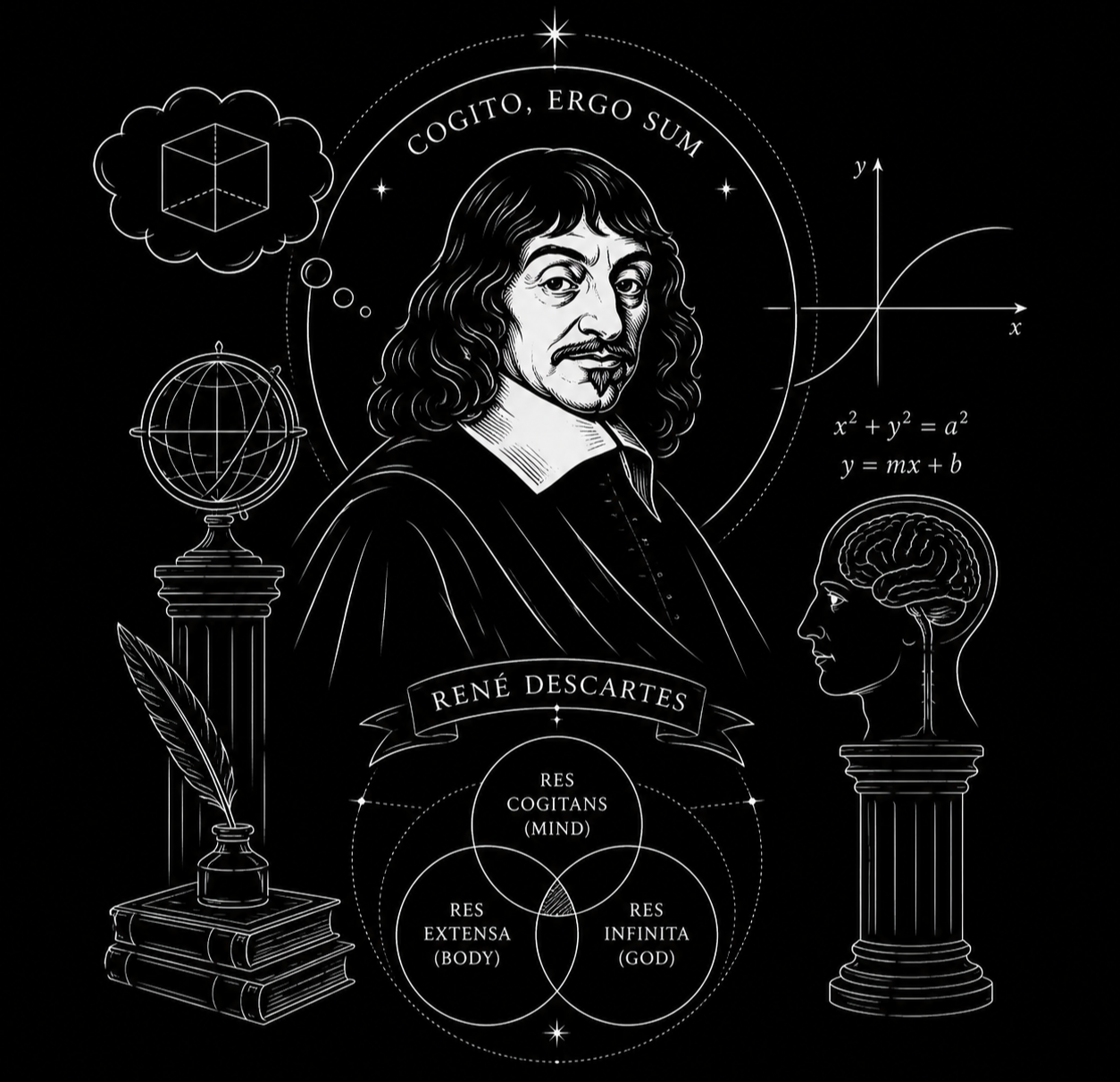
And then, on the third or fourth meditation depending on how you count, Descartes arrives at the one thing the evil deceiver cannot take from him. Even if he is being deceived about everything, the deception itself requires that there be something to deceive. The evil deceiver cannot deceive a non-existent victim. So Descartes, whoever or whatever he actually is, must exist in some form, simply because there is a doubting going on, and doubting requires a doubter. The famous formulation, which he had used earlier in the Discours de la méthode, is Cogito ergo sum. I think, therefore I am.
One absolutely certain point, immune to any conceivable doubt, from which he could begin to rebuild the rest of philosophy.
What he built on top of that formulation was a very specific picture of what a human being is. The cogito proves only that something exists which is doing the thinking. It does not prove that this something has a body, or that the external world is real, or that other minds exist. All of those things require additional arguments. And in making those arguments, Descartes ends up at a position that the rest of Western thought has been arguing with for three and a half centuries.
The position is that there are two completely different kinds of substance in the universe. The first is res cogitans, thinking substance. It has no spatial extension and does not occupy a position in three-dimensional space. It is the substance of which the mind is made. The second is res extensa, extended substance, which does have spatial extension. It is the substance of which everything physical is made, including your body and the animals that live alongside you. These two substances are categorically different. They share no properties. The only point at which they connect, in human beings, is what Descartes called the pineal gland, a small structure at the base of the brain that he believed served as the interface between the immaterial mind and the material body.
Everything else in the natural world, including all animals, was for Descartes pure res extensa. Animals, he argued, have no minds. They are biological machines. Their behavior, however complex it appears, is the product of mechanical processes alone. When a dog yelps in pain after being struck, the dog is not actually experiencing pain. It is producing the mechanical output that, in the construction of its body, follows from that kind of input. There is no inner experience in the dog because there is no res cogitans in the dog. Only humans have res cogitans, and only because God specifically gave it to us at creation.
It is hard to overstate how consequential this position turned out to be. By splitting reality into two categorically different substances, Descartes did several things at once. He preserved the autonomy of religion, because the mind, the seat of moral responsibility and immortality, could not be touched by the new natural sciences that studied only res extensa. He liberated those sciences to investigate the physical world without theological interference, because the physical world was just matter in motion, with no inherent meaning or sacredness to protect. He created the modern category of “nature” as something fundamentally separate from “mind”, and therefore something that could be studied, dissected, manipulated, and mastered without violating anything sacred. And he placed the human being in a unique position: half-resident of the divine realm of thought, half-resident of the mechanical realm of matter, with a single small gland mediating between them.
The Enlightenment, the industrial revolution, modern medicine, the scientific method as we know it, the whole project of mastering nature through technical knowledge, all of it grew out of the soil that Descartes had prepared. You cannot have modern science without first having something that looks like Cartesian dualism, because the dualism is what makes nature available for study as pure mechanism. The cost of that availability, however, took several centuries to become visible.
The cost is that we ended up treating the body, our own body, as a machine.
🜏
Three centuries after Descartes wrote the Meditationes, a Portuguese neurologist named Antonio Damasio set out to dismantle Cartesian dualism. Damasio is a clinician who has spent his career working with patients whose brains have been damaged in specific ways.
The case that started his work, was a patient he called Elliot. Elliot was a successful businessman who developed a small tumor in the front of his brain, near the orbitofrontal cortex. The surgery was, by any conventional measure, a success, as the tumor was removed and Elliot’s intelligence was preserved. Even his memory worked and his language was intact. Yet, in the years following the surgery, his life fell apart. He lost his job because he could not finish tasks. He made disastrous financial decisions and lost his savings and his marriage ended. He could not hold a steady relationship. Even though he was able to discuss what was happening in eloquent and analytically precise terms.
What Damasio gradually figured out, working with Elliot and many patients like him, was that the brain region damaged by the tumor was responsible for the integration of emotion into decision-making. Elliot’s cognitive faculties were intact, but his emotional faculties had been disconnected from them. He could analyze a situation in detail, list the options, weigh the pros and cons, generate elaborate plans. He simply could not feel which option was better than the others. And without that feeling, the analysis went nowhere.
What Damasio concluded from this, and from decades of subsequent work, is that the Cartesian picture of reason as the cool, dispassionate function that ought to override the disturbances of emotion is exactly backwards. Reason cannot function without emotion. Emotion is not a primitive substrate that mature thinking transcends. It is the somatic infrastructure on which thinking depends. Every decision you make, even the ones that feel coldly rational, is informed by a constant stream of bodily signals that mark options as more or less desirable, more or less safe, more or less worth pursuing. Damasio called these signals somatic markers, and showed that without them, the apparatus of rational deliberation produces nothing but paralysis.
This is, philosophically, a complete inversion of what Descartes built. The body is not the noisy interference that pure thought has to overcome. The body is the medium through which thought becomes possible at all. A mind without a body is not a clearer mind. It is no mind at all. It cannot think because it cannot care, and caring is what makes one option mean more than another.
Iain McGilchrist takes this argument even further again. He is a British psychiatrist and philosopher, and his book “The Master and His Emissary” makes a claim that sounds more biological than philosophical, but that turns out to be both. McGilchrist argues that the famous division of the brain into two hemispheres is not a division between rational and emotional thinking. The actual division is between two different ways of attending to the world. The left hemisphere attends to detail, to parts, to manipulation, to language, to the breaking of things into discrete units that can be analyzed and controlled. The right hemisphere attends to context, to wholes, to relationship, to presence, to the gestalt of a situation rather than its components. Both ways of attending are real, both are necessary, and both depend on each other to produce a coherent picture of reality.
The problem, according to McGilchrist, is that Western culture has been progressively privileging the left hemisphere over the right for at least two thousand years since the early Greeks. The Enlightenment then accelerated it and the industrial revolution institutionalized it. Finally the digital age has now nearly completed it. We have built an entire civilization that is, in his metaphor, the emissary acting as if it were the master. The capacity for analytical detail has taken over from the capacity for contextual wholeness. We are very good at taking things apart. We are increasingly unable to put them back together. The result is a culture that produces extraordinary technological achievements while becoming progressively unable to remember what those achievements were supposed to be for.
What makes McGilchrist’s argument relevant here is that Descartes is, in his framework, a key moment in this long drift. The Cartesian split between mind and body, between thinking thing and extended thing, is the philosophical formalization of the left hemisphere’s basic move. It takes the unified phenomenon of being a conscious creature in a world and breaks it into manageable pieces, each of which can be studied separately, each of which can be controlled or optimized. It loses the whole in the process, but the loss is invisible from inside the analysis, because the left hemisphere does not have the equipment to perceive what wholeness even means.
I read McGilchrist’s book and could not but notice, that it describes my own life. I run a software company. I have spent most of my professional life inside the left hemisphere, building tools that exemplify exactly what McGilchrist describes: systems that decompose complex problems into manageable units, that optimize for measurable outcomes, that treat the world as a collection of variables to be tuned. The same thing was coded into my brain in lawschool. But I have also spent most of my adult life looking for ways out of this. Escapism into science fiction novels or the gripping world of Warhammer 40k. Cold water, Long-distance running and art. The reading and writing these letters require. None of these activities have anything to do with what my company sells. All of them are, in McGilchrist’s terms, attempts to restore the right hemisphere to a working relationship with the left.
🜏
Which brings us to my realization I had at the Athabasca Falls.
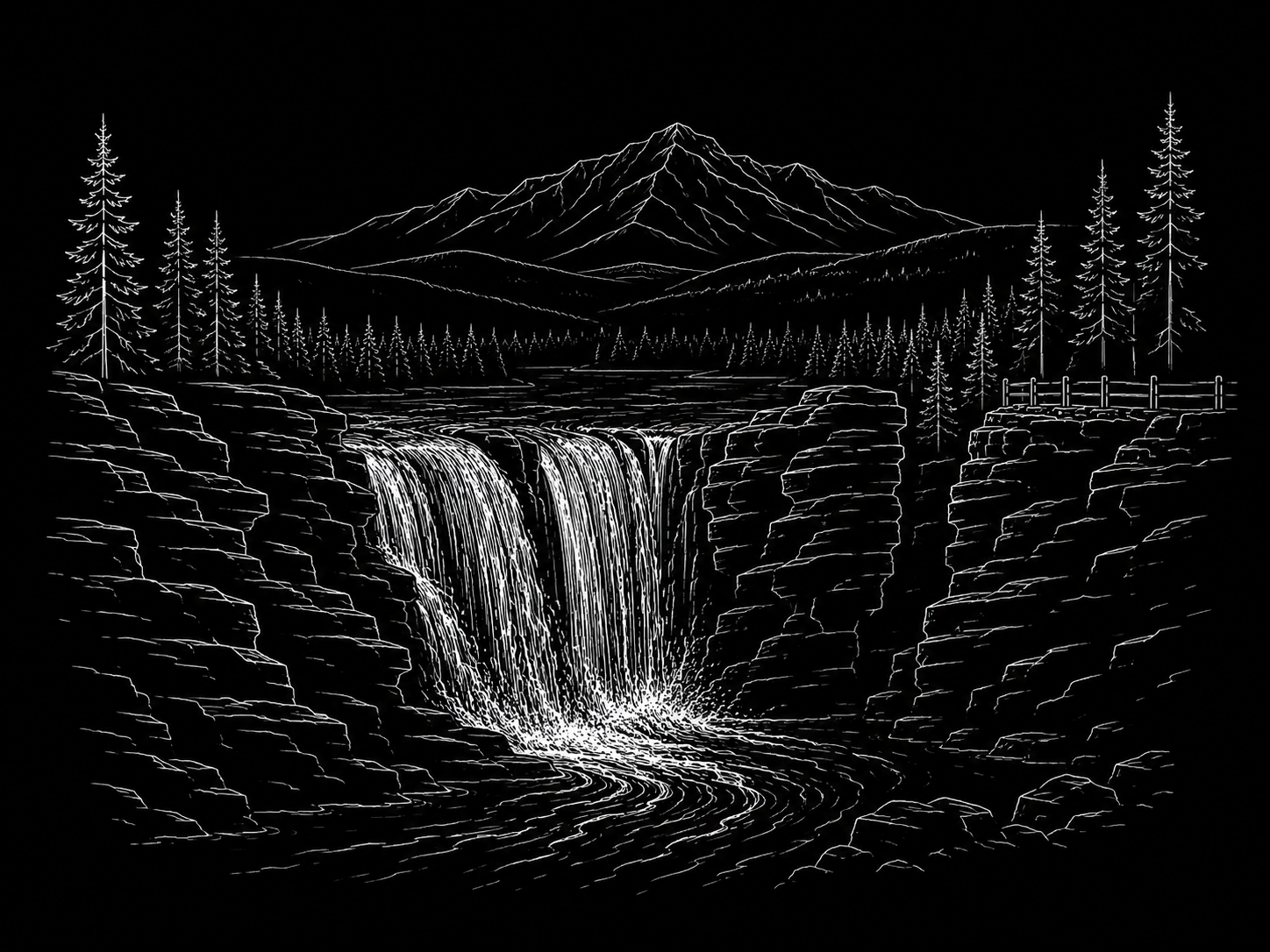
I drove there two days ago, before the cold bath I described at the start of this letter. The falls are not particularly dramatic by Niagara standards (not as high, not as wide). What makes them remarkable is the rock through which the water has carved its way. The Athabasca River, fed by glaciers, has been cutting through this gorge for at least ten thousand years, since the last ice age released the ice that previously held the landscape rigid. The rock is hard. It is older than anything human has ever built. It looks, from the viewing platforms above, like the kind of thing water should not be able to affect. And yet the gorge is there, twisting and deep, with sheets of water hammering against walls that have been smoothed by exactly that hammering, repeated for a span of time that human consciousness has no real way of registering.
There is a sign at the falls, posted by Parks Canada in cooperation with the local First Nations, that describes the place as the site of what they call a spiritual battle between the river and the rock. The rock, in the framing of the sign, represents the past, the fixed, the seemingly unchangeable. The river represents the moving, the feeling, the constantly arriving present. The point of the sign, as I understood it, was not to say that the river wins. It was to say that the battle itself is the place. The gorge exists because neither side has given up. The rock holds and the river persists. What you see when you look at the gorge is the visible record of that ongoing negotiation, made over time spans that dwarf any individual human life.
I stood there for a long time. Longer than I had planned. The reason it kept me, I think, is that the image was doing something my reading of Damasio and McGilchrist had been circling around. The Cartesian picture, makes the mind a kind of stone. Something fixed, immaterial, separate from the changing world of matter. The picture I have been slowly assembling through these letters, through cold water, through the study of consciousness in various traditions, makes the mind much more like the river. Something that is constantly moving, constantly arriving, and that has the power, over time, to reshape what looks like fixed stone.
I want to be careful here, because what I am about to say is personal, and personal material in a newsletter is always at risk of sounding either narcissistic or sentimental. But the image of the river and the rock kept me there because I recognized myself in it. I have, for most of my adult life, carried around a self that was shaped by experiences in my childhood (mentioned in the very first newsletter) that I did not, at the time, have the resources to process. The shape that resulted was, in some real sense, hardened. It was scar tissue, in the form of my personality. The patterns of behavior that came from it persisted into my late thirties and produced consequences I am still cleaning up. I used to believe, in an unexamined way, that this shape was simply who I was. The rock, in other words.
What I have been learning, over the past several years, through the work of psychotherapy, mindfulness meditation and yes, also these letters, is that this was wrong. The self is not the rock. The self is the gorge. It is the visible record of an ongoing negotiation between what was and what is arriving. The river of present attention, of slow self-compassion, of small movements in the right direction made many times over, has more power than I had given it credit for. The scar tissue, which felt for years like granite, turns out to be softer than I thought. By being moved against, patiently, for long enough that something crumbles.
Standing at Athabasca Falls, watching the water do in geological time what I have been trying to do in psychological time, was one of those moments where a piece of intellectual material I have been carrying around suddenly fits into a shape I can feel rather than just describe. The mind is not a fixed substance, but a process. It can be shaped by the patient action of attention over time. Being wrong about this has cost me personally more than I want to think about. But the gorge is the proof that the river works, given time.
🜏
Now, as I like to do since a couple newsletters, I want to introduce this month‘s outsider voice I want to end this letter with, who happens to be the contemporary thinker who has formulated the practical implications of this view more clearly than anyone else I have read. His name is Peter J. Carroll, and he is the founder of a magical tradition called Chaos Magic that developed in England in the late 1970s. Carroll is, like Aquino and LaVey from last month’s letter, an unusual figure to bring into a discussion of philosophy and neuroscience. He is also, like them, the person who happens to have said the thing this letter needs to end on.
Carroll’s central insight is that the self is not a substance but a script. What we call our personality, our character, our identity, is in his view a more or less stable pattern of beliefs and behaviors that has been written into us by accident of birth and circumstance, and that we tend to defend as if it were our deepest essence when it is in fact a fairly arbitrary configuration that could have been otherwise. The work of magic, in Carroll’s framework, is not the manipulation of supernatural forces. It is the deliberate rewriting of the self. His two main books, Liber Null and Psychonaut, are essentially operating manuals for using techniques borrowed from various magical traditions to alter your own beliefs, attention patterns, emotional responses, and behavioral defaults, with the explicit aim of becoming someone other than who you currently are.
What is striking about Carroll, when you read him next to the philosophical material I have been working through, is that he treats the malleability of the self as a fact rather than a hope. He does not argue that the self might be changeable. He assumes it, and proceeds to give very specific instructions for changing it. His confidence comes partly from his own experiments, conducted across several decades, and partly from the observation that traditional religious practices have been doing exactly this kind of self-modification for thousands of years, with results that are visible if you know how to look. The difference, for Carroll, is that the traditional practices are surrounded by dogma that obscures what they are actually doing, and that the practitioner of Chaos Magic should feel free to strip away the dogma and use the techniques directly.
I do not endorse all of Carroll’s claims. Parts of his framework rely on a metaphysics of probability manipulation that I find harder to take seriously than the descriptive parts about how the self can be reshaped. But the descriptive parts are, in my experience, accurate. The self is more like a river than a stone, and the techniques for redirecting it exist, and they work, with the patience that the river demonstrates at Athabasca Falls. Carroll’s contribution is to insist that we stop treating these techniques as the property of priests and gurus and start using them ourselves, for the purposes we ourselves choose.
Whether or not you accept Carroll’s framing, the convergence between his position, Damasio’s findings, McGilchrist’s argument, and the older esoteric traditions I have been writing about is interesting. They all point at the same conclusion from different directions. The Cartesian self, fixed and separate, located somewhere behind the eyes, is not what consciousness actually is. Consciousness is closer to a pattern of activity that emerges from the whole body in interaction with the world, that can be shaped over time by what we attend to and how, and that is, in some real and consequential sense, our responsibility to shape.
Next month I want to look at what happened when the first major cultural rebellion against Descartes began to gather force in the late eighteenth century. The Romantics, the rediscovery of the unconscious, the slow Western reawakening to the parts of consciousness that the Enlightenment had pushed aside (Goethe, Schelling, Nietzsche and eventually Carl Jung).
For now, let me leave you where the letter started. In a camper in Jasper, looking out at burned forest and bellowing elk, with a body that has been cold and is now warm, and a mind that is, for the moment, neither stone nor river but something paying attention to both.
- Transmission Sent -