
#8 - “The Substance and the Anomaly”
Dear Reader,
this is the eighth and final letter in what has, without me planning it that way, turned into a religious phase of this project. From next month onwards I want to move into modern psychology and the question of how consciousness is being explained once we stop asking the mystic and start asking the scientist. But first I owe you a bridge, and a piece of honesty that I have been postponing for the past seven months.
Einstein, asked late in life whether he believed in God, famously said that he believed in Spinoza's God. Not in a man in the sky who answers prayers, but in an immanent intelligence woven through the structure of reality itself, which the human mind can occasionally glimpse and which leaves a kind of awe behind when you realize it. I believe he was identifying the only spiritual position that an honest scientist of his stature could hold.
Spinoza is the natural endpoint of my long arc. The Hindu mystics dissolving Atman into Brahman, Buddhists denying that there was ever a separate self to begin with, the Taoists describing the river that contains us, the Sufis annihilating themselves in the fire of the Beloved, the Kabbalists tracing every fragment of light back to a primordial divine source. All of them, in different vocabularies and from different starting points, arrive at something close to what Spinoza formalised philosophically: the self is not a separate thing, it is a temporary configuration of the one substance, and wisdom consists in seeing this clearly enough to stop resisting it.
What I have not yet written about in any serious way, despite having had eight months to do so, is the line of thought that goes in the opposite direction. That says the self is not a temporary configuration of anything. It is a genuine anomaly. An isolated intelligence that exists in some real sense outside or against the flow of the universal substance, and whose task is not to dissolve back into the source but to cultivate, strengthen, and consciously become more itself.
This letter will not be a synthesis of all the doctrines I have written about so far. The doctrines remain genuinely incompatible, and I would not want to flatten them into one. But the practical residue of serious spiritual work seems to point in the same direction across traditions, and that direction is something close to what the first article of the German constitution states without any spiritual vocabulary at all: that the dignity of the human person is inviolable.
This letter, then, will go through Spinoza first, then turn toward the older Norse mythology as a counter-example, then trace the line into modern left-hand-path thought, and end with a small literary detour. Let me begin with Spinoza.
🜏
Spinoza was excommunicated from the Amsterdam Jewish community in 1656, at the age of twenty-three, with what is still considered one of the harshest writs of cherem ever issued. The text of the excommunication asks God to curse him "by day and by night", forbids any Jewish person from speaking to him, reading his writings, or coming within four cubits of him, and ends with a list of biblical curses. Nobody knows exactly what Spinoza had said or written by that age to provoke this. He had not yet published anything.
He spent the rest of his life grinding lenses for microscopes and telescopes, lived modestly, refused a professorship in Heidelberg because he wanted to keep his freedom of thought, and produced what is arguably the most rigorously argued philosophical system in the Western tradition. The Ethics was published in 1677, the year of his death, by friends who had been keeping the manuscript safe and knew that publishing it during his lifetime would have caused him too much trouble.
What he had figured out, and what the Amsterdam rabbinical council had probably already gotten wind of, was the following. If God is infinite, then nothing can exist outside of God, because anything outside would be a limit on God's infinitude and would therefore make God not infinite. And if nothing exists outside of God, then everything that exists must exist inside God, which means everything that exists is in some real sense God.
The technical term Spinoza used was Deus sive Natura, God or Nature, with the "or" being not a choice between two options but an identification of two words pointing at the same thing. The God of the Hebrew Bible, the creator who exists before and outside his creation, simply could not exist for Spinoza, because the very concept contained a logical contradiction. There is only one substance. We are temporary modifications of it. So is the chair you are sitting on. So is the wind outside your window. So is whatever you think your thoughts are made of.
Spinoza is not really doing something new. He is taking what the Hindu mystics, the Buddhist analysts of the mind, the Taoist sages, the Sufi poets and the Christian contemplatives had all been pointing at, and giving it the formal philosophical treatment that European rationalism demanded. Atman is Brahman becomes the single substance expressing itself through infinite attributes. Wu Wei becomes the recognition that resistance to the natural order is both pointless and a category error. The Christian mystic emptying himself to make room for God becomes the rational mind grasping that there was never any separation to begin with, only the illusion of one.
Spinoza represents the cleanest possible philosophical formulation of the position that the self, is not a thing in any meaningful sense. It is a wave on the surface of the one substance, briefly distinguishable, ultimately not separate. To live well, for Spinoza, was to understand this clearly enough that you stopped behaving as though you were separate. He called this the intellectual love of God, amor Dei intellectualis, and described it as the highest state a human being could reach.
What Einstein loved about this formulation, I think, was that it preserved the religious instinct, the sense of awe and humility before something infinitely vast, while removing everything in religion that an empirical scientist would have to consider superstition. There is no personal deity hearing your prayers. There is no afterlife waiting to reward or punish you. There is only the structure of reality itself, intelligible to the human mind in fragments, and the strange fact that anything exists at all rather than nothing. Einstein's God was Spinoza's God, and it was the only god he could honestly affirm without lying to himself.
I am drawn to this position. I want to be clear about that, because what comes next is going to sound like I am dismissing it. I am not. I believe that most of what you experience as your personal agency is the visible tip of processes you don’t recognize as such.
When I read Spinoza carefully, with all the admiration that he deserves, something in me refuses the final move. Not because I think he is wrong, but because his picture leaves something out that I cannot dismiss as illusion. The very fact that there is a part of me asking these questions, does not feel like a wave on the surface of the one substance.
Spinoza would tell me, that this feeling of standing apart is itself a confusion. It is the inadequate idea of the imagination, not the adequate idea of reason. If I thought clearly enough, the sense of separation would dissolve and I would see myself as I am, which is a finite mode of an infinite substance that has no center and no edge.
He may well be right. But there is another line of thought, much older than him and now mostly forgotten outside specialist circles, that takes the opposite view. It says that the sense of standing apart is not a confusion. It is the most important fact about being human. The work of a conscious life is not to dissolve that sense, but to deepen it. To become more separate, not less. To cultivate the isolated intelligence into something so distinct, so fully itself, that it can stand in genuine confrontation with the rest of reality and ask the questions that the rest of reality cannot ask of itself.
To find the first clear expression of this view, we have to go north.
🜏
Disclaimer: The Norse cosmology survived only in fragments. The Eddas, our two main written sources, were compiled in Iceland in the thirteenth century by Christians who were trying to preserve a tradition they no longer believed in, using a literary form that was already alien to it. Everything we know about pre-Christian Germanic religion has come down to us through that filter. What we have is therefore not the thing itself, but the memory of the thing, written down by people who had reasons both to preserve it and to distort it.
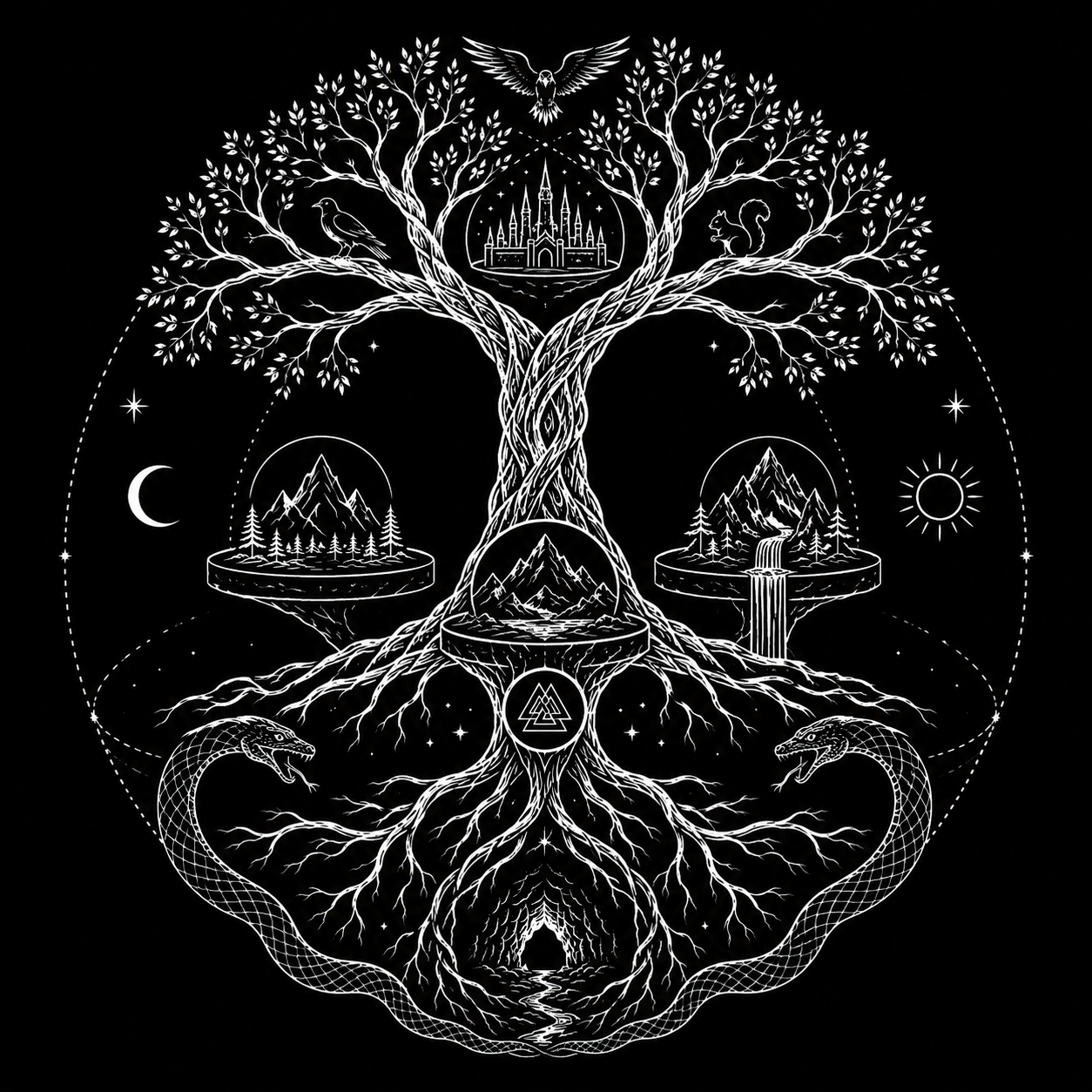
Anyway, at the center of the Norse cosmos stands Yggdrasil, the world tree, an enormous ash whose roots and branches connect nine worlds. Asgard, the realm of the gods, sits in the upper branches. Midgard, the world of humans, hangs in the middle. Niflheim, the world of the dead, lies among the roots. The tree is alive in the way that real trees are alive, which means it is also slowly dying.
The gods of this cosmos come in two families, the Aesir and the Vanir, who fought a war in the distant past and eventually made peace by exchanging hostages. The Aesir, led by Odin, are the war gods, the sky gods, the gods of kingship and wisdom and battle. The Vanir, associated with Freyja and Freyr, are the older fertility gods, tied to the earth and the cycles of nature. The Norse pantheon is not a hierarchy descending from a single creator. It is the messy result of a historical compromise between two divine populations, neither of which originally belonged to the other.
What makes the Norse picture genuinely unusual, though, is not the cosmology or the pantheon. It is the relationship between the gods and the universe they inhabit. The gods are not eternal. They will die. The whole thing ends at Ragnarök, when the wolf Fenrir breaks free, the world tree burns, and the gods go to war against giants knowing they will lose. Odin will be eaten. Thor will fall to the serpent. The cosmos itself collapses. A new world rises afterwards, but the gods who built the old one do not see it.
The Norse gods know all of this in advance. Odin in particular knows it. Most of his behavior in the surviving texts makes sense only if you accept that he is acting in full awareness of how his own story ends. He is preparing for a war he will lose, gathering einherjar, the souls of fallen warriors, into Valhalla, training them for a battle that is guaranteed to be a defeat. His wisdom does not allow him to escape his fate. It only allows him to face it consciously.
The structure of the cosmos is not benevolent. It is not even neutral in the way that Spinoza's substance is neutral. It is actively bound by something older and more impersonal than the gods themselves. The Norns (The three sisters Urd, Verdandi, and Skuld), sit at the foot of Yggdrasil, by the well of Urd, and spin the threads that determine what was, what is becoming, and what shall come to be. Even Odin is bound by what they weave. The gods of the Norse cosmos are not the authors of their world. They are characters in a story that someone else is writing.
There is no benevolent creator. There is no meaning baked into the structure of things. There is only the tree, the wolves, the spinning sisters, the inevitability of Ragnarök, and a couple of gods who know they will lose and have decided to act anyway. The closest modern parallel I can think of is the existentialist position that we are radically free precisely because there is nothing to ground our freedom in, but the Norse version is grimmer than that, because the freedom itself is bounded by fate. You are not even free to escape your story. You are only free in how you walk through it.
Within this framework, the figure of Odin becomes the model for a particular kind of consciousness. He is the god of wisdom, but his wisdom is not the wisdom of the contemplative. It is the wisdom of someone who has paid for what he knows, repeatedly and at considerable cost. The two most important episodes in his mythological biography are both stories of self-mutilation in exchange for knowledge that no one was going to give him for free.
The first is at the well of Mimir. The well sits beneath one of the roots of Yggdrasil and contains all the wisdom of the cosmos. Mimir, the giant who guards it, drinks from it daily and is the wisest being in the nine worlds. Odin comes to him asking to drink. Mimir tells him there is a price. Odin asks what the price is. The price is one of his eyes. Odin pulls out his own eye, drops it into the well, and drinks.
The second text comes from the Hávamál, the Sayings of the High One, which is presented as Odin's own first-person account of how he obtained the knowledge of runes, the system of writing and magic that gives those who master it power over reality. He describes what he did in the kind of plain language that makes the strangeness more disturbing.
I know that I hung on a windy tree nine long nights, wounded with a spear, dedicated to Odin, myself to myself, on that tree of which no man knows from where its roots run.
Read that again, because it is the key to the whole Norse position. Odin hangs himself, on the world tree, for nine nights, pierced by his own spear, as a sacrifice to himself. There is no priest officiating. There is no other god accepting the offering. The dedication is from Odin to Odin. The seeker and the divinity being sought are the same entity, and the only way to receive the runes is for that entity to wound itself, in solitude, for long enough that something gives.
There is no transcendent God who receives the sacrifice. There is no community of believers witnessing it. There is no afterlife guaranteed in exchange. There is only the seeker, the tree, and the willingness to hang there until the runes appear. The transformation is self-inflicted and self-redeemed.
This is the opposite of pantheism. The seeker is not dissolving into the universe. He is standing apart from the universe, against it in some sense, and forcing it to yield up its knowledge through an act of will so extreme that it borders on the suicidal. The Norse universe does not give knowledge to those who become one with it. It gives knowledge to those who refuse to become one with it long enough, and with enough resolve, to extract what they want from it.
I want to be careful not to romanticize this. The Norse worldview, taken straight, is bleak. It produces a particular kind of person, and that kind of person has historically not always been a benign presence in the world. The same warrior ethic that made Odin the patron of skalds and seekers also made him the patron of berserkers and oath-bound death squads. Any framework that takes the isolated will as its highest principle is risking to attract the kind of people who use that principle as license. The Norse tradition has, for understandable historical reasons, been thoroughly contaminated by twentieth-century misuse, and anyone writing about it now has to acknowledge that contamination openly rather than pretend it does not exist.
What survives in the texts themselves, though, when you read past the appropriations, is something philosophically distinct from anything else in the religious record. A view of consciousness as a kind of pact with the impersonal forces of the cosmos. A view of wisdom as something that has to be paid for, in pain, by the seeker himself, with no intermediary. A view of the self as an anomaly that is interesting precisely because it stands apart from the rest of reality and refuses, against considerable pressure, to be reabsorbed.
This view did not die with the conversion of Scandinavia. It went underground, traveled through medieval Hermetic circles, surfaced in the magical revivals of the Renaissance, fed into Romantic literature in the nineteenth century, and eventually crystallized in two American movements of the twentieth century that took the philosophical core of the Norse position, stripped away the specific deities, and reformulated it for a world that no longer believed in literal gods of any kind.
Those two movements are where this letter turns next.
🜏
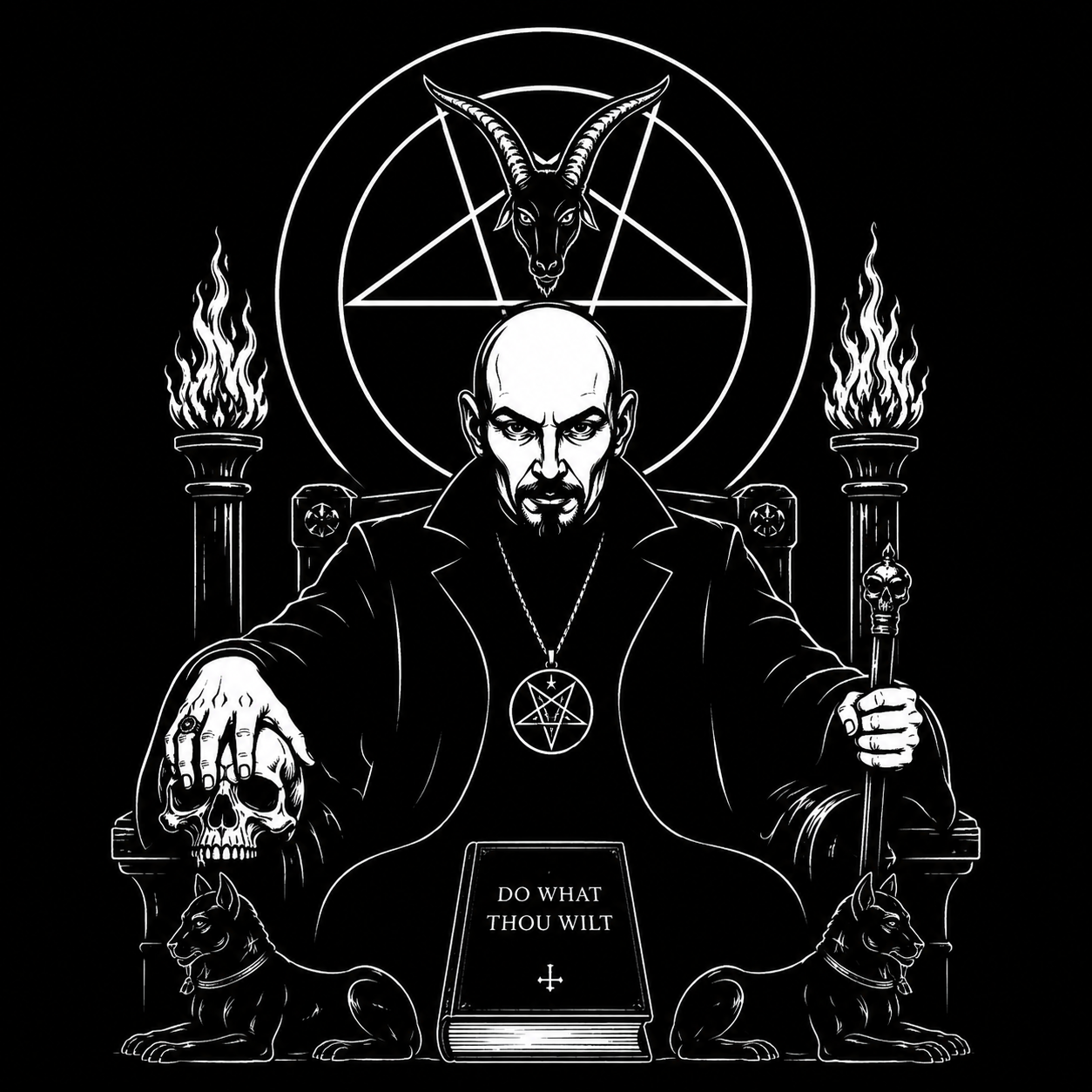
Anton Szandor LaVey founded the Church of Satan in San Francisco on Walpurgisnacht of 1966. He lived in a black house in the Richmond District, claimed to have been a carnival worker and a police photographer, and possessed what every successful religious founder seems to need, which is an unembarrassed flair for showmanship. The Church performed weddings and funerals, attracted Hollywood celebrities, gave LaVey an FBI file, and generated the kind of moral panic (satanic panic) that the American 1960s produced in industrial quantities. The Satanic Bible appeared in 1969 and has not been out of print since.
If you read it, which most people who have opinions about it have not, you discover a framework that does not match the cultural rumor at all. There is no devil worship in the Satanic Bible. LaVey was an atheist. Satan, in his framework, is not a being. Satan is a symbol, an archetype, a literary device for everything that traditional Christianity called sin and that LaVey wanted to reclaim as human virtue. Indulgence instead of abstinence. Vital existence instead of spiritual pipe dreams. Kindness to those who deserve it instead of universal love wasted on ingrates. The Nine Satanic Statements that open the book read like a manifesto for what an honest secular humanism might look like if it stopped trying to make itself palatable to people who already disagreed with it.
The genuine philosophical content of LaVey's Satanism is closer to Ayn Rand and Friedrich Nietzsche than to anything occult. The aesthetics are the aesthetics of the carnival sideshow, deliberately provocative, designed to drive away the timid and to draw in those who could see the joke. But underneath the theatrical robes and the inverted pentagrams, the position itself is straightforward. The individual self is the only thing of genuine value. Religions that ask you to subordinate that self to a higher power are confidence tricks. The proper response to mortality is not to seek salvation but to live with maximal intensity, to develop your capacities, to refuse the moral frameworks that diminish you, and to die having actually lived.
LaVey's Church drew a particular kind of person. Some of them were drawn to the spectacle and stayed for the philosophy. Others were drawn to the philosophy and tolerated the spectacle. By the early 1970s, the more serious philosophical members had started to feel that LaVey's theatrical instincts were getting in the way of the actual ideas. The split came in 1975.
The person who led the split was Dr. Michael Aquino, who at that point held the IV° rank of Magister Templi in the Church of Satan and was, in his day job, a US Army psychological operations officer (he would later retire as a lieutenant colonel). Aquino was an academic by temperament, eventually completing a doctorate in political science, and his issue with LaVey was not stylistic but ontological. LaVey said Satan was a symbol. Aquino had become convinced, through his own ritual practice, that the symbol was pointing at something real. At the North Solstice of 1975, on the night of June 21–22, Aquino performed a working in which he reported a direct communication from the entity that LaVey had been symbolically invoking for nine years. The entity dictated a text that Aquino transcribed and later published as "The Book of Coming Forth by Night."
What is interesting about the text is not the supernatural claim, which a reader is free to take or leave, but the philosophical content. The entity that contacted Aquino identified itself not as Satan, the Hebrew adversary, but as Set, the Egyptian god whose name, in the Setian account, had been adopted by the Hebrew tradition and inverted into the figure of Satan over the centuries. (This etymological claim is Temple doctrine rather than mainstream scholarly consensus, but it is internally coherent and worth taking seriously on its own terms.) Set, you may remember from the third issue of this newsletter, was the Egyptian deity associated with the desert, with isolation, with the principle that stands apart from Ma'at, the cosmic order that everything else in the Egyptian universe is supposed to participate in. Set is not straightforwardly evil in the older Egyptian texts. Set is the necessary counter-principle, the consciousness that exists in tension with the natural order rather than in harmony with it.
Aquino's claim, which became the founding premise of the Temple of Set, was that this principle was not merely symbolic. There was, in the structure of reality, something corresponding to what the Egyptians had called Set, what the Norse had approached through Odin's self-mutilation, and what the Western magical tradition had been pointing at for centuries under various names. That something was the principle of isolate intelligence. The fact that within an otherwise natural universe, governed by natural laws and ultimately reducible to Spinoza's single substance, there exist nodes of consciousness that are genuinely separate. Not illusions of separation, as the Eastern traditions claim, but real anomalies. Selves that exist outside the natural flow and look back at it.
The Setian framework takes this seriously as an ontological claim. The human psyche, or more precisely a part of it, is not a configuration of the natural substance. It is a genuinely separate thing, a "mindstar" in the Temple's vocabulary, capable of self-directed evolution if its possessor decides to undertake that work. The framework calls this work Xeper, an ancient Egyptian word that means roughly "I have come into being" and that is used in the present continuous sense: I am becoming, I am self-creating, I am consciously bringing into existence the self that I will be tomorrow.
Most religious frameworks ask the practitioner to align with something larger. Submit to God. Dissolve into Brahman. Move with the Tao. Empty yourself for the Beloved. The Setian framework asks the opposite. It asks the practitioner to recognize that they are already separate, to stop pretending that they are not, to take responsibility for the fact of their own consciousness as a kind of cosmic anomaly, and to develop that anomaly into something more than it currently is. The work is not about getting back to the source. It is about leaving the source further behind, deliberately, with full awareness of what that costs and what it makes possible.
The aesthetics of the Temple of Set are different from LaVey's. There is no carnival showmanship. The membership is small, screened through a recognition process that requires demonstrated philosophical seriousness, and largely composed of academics, amd professionals in technical fields. The Temple publishes its own materials, holds international conclaves, and operates internal degrees of initiation that map roughly to stages of philosophical development. It is, in practice, more like a small philosophical society with a ritual practice than anything that resembles popular images of satanism.
I want to acknowledge here that the words "satanism" and "Temple of Set" do not produce neutral reactions in most readers, no matter how carefully the actual content is described. The cultural associations are powerful and largely independent of the philosophical reality. Anyone who has spent time inside the tradition will tell you that explaining it to outsiders is a Sisyphean exercise, because the explanation has to first overcome a wall of received imagery before it can even begin to address the actual ideas. I am not going to pretend that wall does not exist, or that the choice to use the inherited terminology was wise. Aquino chose to keep the Setian and satanic vocabulary partly out of historical accuracy and partly, I suspect, as a deliberate filter. Anyone unwilling to look past the words is probably not the kind of person the Temple wants in any case.
What matters for the argument of this newsletter is the philosophical position the Temple holds, not the costume it wears. That position is the clearest contemporary expression of the alternative that has been running underground through Western thought since the Norse material, surfacing in fragments in the medieval Hermeticists, the Renaissance magi, the Romantic poets and the nineteenth-century occult revivalists, and finally crystallizing into a coherent twentieth-century framework. The position says: the self is real, separateness is not an illusion, the work of consciousness is to become more itself rather than less, and the cosmic substrate is something to be engaged with from a position of standing apart, not dissolved into.
Whether this is true is a question I am not in a position to answer. And here comes the confession I have been reluctant to share for the past 7 months: This framework is what I currently find most convincing, and I can say honestly that the framework has been productive for me so far. Things have happened in my life that the framework predicted and that the alternative frameworks I had previously tried did not predict. This is not proof of anything, because individual experience is the worst possible epistemic foundation for metaphysical claims. But it is the reason I keep returning to it, and the reason I felt I owed you the disclosure I made in the opening.
What I want to do in the final section of this letter is something that surprised me when it occurred to me, and that I have been turning over in my head for the past week. I want to suggest that the apparent opposition between the pantheist position and the isolate intelligence position, which has structured most of this newsletter, might be less absolute than it appears. Not because the doctrines secretly agree, because they do not. But because the actual practice required by both, the genuine work that both demand of anyone who takes them seriously, points at something that is identical regardless of which doctrinal vocabulary you happen to use.
To make that case, I want to bring in one final witness, who is not a philosopher or a mystic or a magician, but a librarian from Buenos Aires who happened to write two pages that may be the most precise expression of what these traditions have all been trying to describe.
His name was Jorge Luis Borges.
🜏
Borges published "Borges y yo" in 1960. It runs two pages. It's written in the first person, and it is, from start to finish, one man trying to figure out his relationship with himself. Not in any therapeutic sense, but in a stranger, more disorienting one. There's no plot, no setting. Just a narrator walking through Buenos Aires, noticing that things happen to him and also, somehow, to someone else. Someone who shares his body and his name, but who is not, in any sense he can quite pin down, the same person.
That someone else is Borges. The famous one. The writer whose books end up on university syllabi, whose photograph turns up in literary magazines. The narrator encounters this Borges the way you'd encounter a stranger: in the post, in critical reviews, in dictionaries of biography. The narrator himself - the I doing all the describing - doesn't write. He walks. He looks at the iron fences of old houses. He drinks coffee. He reads Stevenson. And then Borges takes those small pleasures and makes literature out of them, and in doing so, turns the man who actually had them into someone he no longer recognizes.
Spinoza appears in the middle of the essay, by name. The narrator notes that Spinoza understood that all things long to persist in their being, the stone in being a stone, the tiger in being a tiger. The narrator says that he himself wishes to persist in being his I, not in being Borges, but he is losing that battle. Everything he experiences gets absorbed into Borges. The man who walks the streets disappears into the author who writes about walking the streets. The lived life becomes the literary one. The individual self dissolves into the public substance.
The last line of the essay is one sentence long. Borges writes that he does not know which of the two of them is writing this page.
I have been thinking about that sentence for a week now. Because what Borges has done in those two pages is something that nobody else in any tradition I have read this year has quite managed to do. He has held both positions simultaneously, without resolving them, without choosing between them, without pretending the tension goes away. The Spinozistic position is there. The self is being absorbed into something larger, and the narrator can feel it happening, and he cannot stop it. The position I have been associating with the Norse and Setian traditions is also there. There is an I that persists, that wishes to persist, that knows itself as separate from the substance into which it is being pulled. Neither position wins. The essay ends in genuine uncertainty about which of the two is doing the writing, and that uncertainty is presented not as a problem to be solved but as the most honest description Borges can give of what it is like to be conscious.
I think this is closer to the truth than any of the systematic positions I have been laying out over the past eight months. Not because Borges has the right answer, but because he refuses to pretend that there is one. The reading I have been doing has not produced certainty. It has produced something more like Borges' uncertainty, more articulated, more historically informed, but still fundamentally an uncertainty. I do not know if Spinoza is right. I do not know if the Setian framework I personally find most useful corresponds to anything real. I know that both positions, when taken seriously and lived from, produce a recognizable kind of person, and that the kinds of person they produce are not as different from each other as the doctrinal differences would suggest.
Which brings me to the closing observation I want to leave you with.
When I read the history of religion honestly, I am forced to notice that the great cruelties of religious history have almost never been committed by the people who took the practice most seriously. The Inquisition was not staffed by mystics. The wars of religion were not started by people who had spent years in contemplative silence. The atrocities committed in the name of every major tradition were committed by people who had inherited the vocabulary without doing the work. The serious practitioners, in every tradition I can find, tended to produce something else entirely. They produced people who treated other selves with care, who acted from awe rather than from fear, who recognized that the work of being conscious was hard enough in their own case that they had no business demanding it from anyone else.
This is the only generalization I am willing to make across the traditions. Not that the doctrines agree. They do not. The Hindu mystic and the Setian magus are saying ontologically incompatible things about the nature of the self, and no amount of well-meaning interfaith synthesis is going to make those things compatible. But the practice required by both, the actual daily work of taking consciousness seriously, produces a person who has arrived at something close to what the German Constitution, which I as a German lawyer hold very dear, states in its very first sentence without any spiritual vocabulary at all. The dignity of the human person is inviolable. Article one. The foundation on which a country that had to rebuild its moral order from rubble decided to build.
I find it interesting that a constitutional document drafted in a country recovering from the catastrophic failure of every traditional source of moral authority arrived at exactly the same conclusion that every serious spiritual tradition I have read also arrives at, stripped of metaphysics. The dignity of the person. The inviolability of the self. The recognition that this person in front of you, whoever they are, possesses something that you do not have the right to violate. This is not a doctrine. It is the practical residue of doctrine, what remains standing once the theological scaffolding has been removed. And it is, as far as I can tell, what serious spiritual practice in any tradition tends to deposit in the practitioner over time.
So when I tell you that the Setian framework is the contemporary expression of these ideas that I personally find most useful, I am not asking you to share my conclusion. I am telling you what I currently believe in the same spirit in which I would have told you, last year, what I was currently reading. The framework will probably change. If it does not change in the next ten years, that will be a sign that I have stopped doing the work the framework asks of me. The whole point of Xeper, the continuous self-becoming that the Setian tradition takes as its central principle, is that the person who arrives at a fixed answer has stopped being a person and become a fossil. I have no intention of becoming a fossil. I expect to write a newsletter ten years from now that argues against several things I have argued for in this one, and I expect to look back at this letter with the same affectionate embarrassment with which I currently look at things I wrote in my twenties.
What I will not change is the practice. The reading, the questioning, the willingness to think about positions that contradict each other and not collapse them into false synthesis. That is what these eight months have given me, and that is what I think the religious phase of this project has been arguing for all along. The doctrines are interesting. The practice is what matters.
Next month I want to step out of the religious vocabulary entirely and look at what happened when the West decided to take the questions seriously without the religious framing. Descartes, Spinoza, William James, Carl Jung et al.
For now, this is where I want to leave you. Eight months of reading the traditions, ending with the admission that no tradition holds the final answer, and that the work of holding the question open is itself the practice.
Borges did not know which of the two of them was writing his page. I do not know either. But one of us, the one with the longing to persist, the one Spinoza described, the one the Setian framework calls the mindstar, has written what you have just read. And whichever of us that is, that is the one I am trying, slowly and imperfectly, to become.
Until next month.
- Transmission Sent -