
#7 - “Knowledge Is Not Understanding”
Dear Reader,
I’m slightly embarrassed to open with a scene from The Matrix today. How cliché when writing about consciousness. However, the scene where Morpheus is sitting across from Neo in a dim room with the rain hitting the windows, leans forward and says: “There's a difference between knowing the path and walking the path,” is just too on point for setting the scene in this month’s issue.
For six months I have been writing about consciousness. If you’ve followed the thread from the beginning, you could follow me learning about the early Greeks, the priests of Egypt, Hindu sages, etc., etc. This month I read about the Western mystics. Eckhart, Rumi, Luria and, as my wild card, a guy named George Gurdjieff, whom I had planned to read for a long time now.
After last month's exploration of Eastern traditions, where everything seemed to converge into one, I expected the Western mystics to be familiar territory. Religions I grew up around, even if I never belonged to any of them. I assumed that reading their mystical traditions would feel more familiar to me because of my Western heritage.
It did not. The book that broke the expectation was Evelyn Underhill's Practical Mysticism. What I found most helpful was her definition of what mysticism actually is. Mysticism, for her, is the art of union with Reality. Mysticism is the practice of stepping out of the world we have built around ourselves with words, habits and assumptions, and making direct contact with whatever is actually there.
That definition would have been signed by every mystic I read last month (Hindus, Buddhists and Taoists). They all agree that something stands between us and reality, and that the work of consciousness is to let it fall away. Underhill walks through the Christian, Islamic, and Jewish traditions in her book and shows that their mystics arrive at the same insight. But if East and West agree on the diagnosis, why do they disagree so radically on the cure?
Last month I ended with the suspicion that all these traditions might be writing the same book in different languages. This month I saw that this is only half true. Because the Western Religions keep the self and god in the equation. And in the refusal to dissolve either one, they are simultaneously stating that the goal is not to disappear into the source, but to meet it. Which also means that you are not part of said source, but something different.
🜏
The three Western mystics I picked belonged to traditions that have spent most of history fighting each other.
Meister Eckhart was a Dominican preacher in the Rhineland in the early 1300s, brought before the Inquisition near the end of his life for writings that were too close to heresy. Rumi was a Persian poet and Sufi master in 13th-century Anatolia, who gave us much of the most influential mystical poetry ever written and even today is often quoted on instagram alongside landscape pictures. Isaac Luria was a Kabbalist who lived in Safed, in the 16th century, whose vision of how the universe came into being still shapes Jewish mystical thought today.
Eckhart wrote that there is a place in the soul that is not created. He called it the "ground" of the soul, sometimes the spark, or the castle. His point was that there is something inside the human being that is not made by God. It is something more like a piece of God left inside the human, untouched by time, untouched by sin, untouched even by the soul's own activities. And the entire purpose of the spiritual life, for Eckhart, is to find this ground and let God meet himself there.
This sounds, on first reading, almost identical to Atman. The deep self that turns out to be identical with the divine. But Eckhart never collapses the two completely. The soul is not God. The ground of the soul is the place where God can dwell, where God can be born again in each human being. Eckhart's most provocative phrase, the one that probably contributed most to his trouble with the Inquisition, was that "God's ground and the soul's ground are one ground." But that "one ground" is a meeting place, not an erasure. Two things meet there and don’t dissolve into a single thing.
Rumi, in contrast, speaks of fana, the annihilation of the self in the divine. Of the lover and the Beloved, with God as the Beloved who draws the soul toward union. Rumi's poetry draws images of dissolving, drowning, burning. A drop merging with the ocean. A moth burning in the candle. On the surface, this looks like the most thorough self-erasure in any of the traditions I have read.
But Rumi does not actually mean what the imagery suggests. Fana is followed by baqa, which means subsistence, or remaining. The self is annihilated only to be restored, transformed, on a higher level. The drop that merges with the ocean does not stop being itself. It becomes ocean while still being drop. The moth that burns in the candle becomes flame without ceasing to have once been moth. What Rumi describes is closer to a phase change than to disappearance. The self becomes capable of holding what it could not hold before.
Luria's vision goes in a different direction again. Luria taught that before creation, God filled all of existence completely. There was no room for anything else. For creation to happen, God had to perform an act called tzimtzum (contraction or withdrawal). God pulled himself back to make space for a universe to exist. The world was born in that empty space, the space that God deliberately left for it.
The universe exists not because God expanded into it, but because God made room. Every human being, by the same logic, exists in a space that God chose not to occupy. And the spiritual task is not to dissolve back into God, which would betray the entire point of creation, but to fill the space that was given to us with light. Luria called this tikkun (repair). The fragments of divine light scattered through the world during creation must be gathered back up by human action, attention and human work in the ordinary world.
The contrast with Eastern thought becomes obvious here. The Hindu and Buddhist traditions tend to see the everyday self as a problem to be seen through. The Kabbalistic tradition sees the everyday self as the entire point. Without the contracted space, no creation. Without the individual soul, no repair. The work of the mystic is not to escape the human condition but to honor the gift of having been given one in the first place.
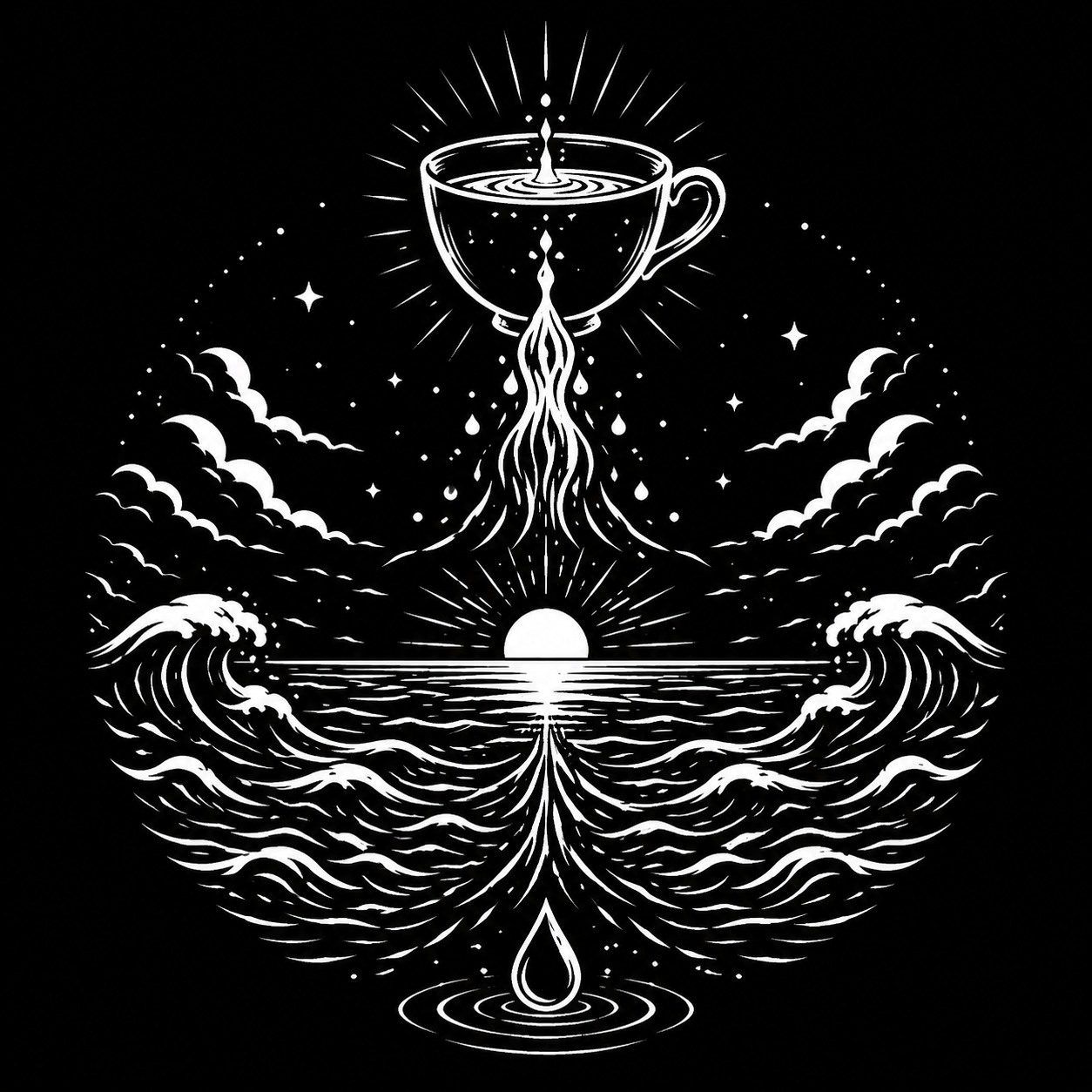
So to my understanding, the Western mystic is not trying to disappear into the divine. The Western mystic is trying to host the divine. The metaphor shifts from absorption to encounter and from dissolution to relationship. From the drop becoming ocean to the cup being filled.
This distinction changes what the spiritual life looks like in practice. If you are trying to disappear, the path leads to the cave, the monastery, the meditation cushion. If you are trying to host, the path leads back into the world and the work of building relationships around the encounter with god. Eckhart insisted that the highest mystical state was not contemplation in solitude but action in the world. Rumi, by all accounts, was a teacher and a community leader who never withdrew from public life. Luria's entire framework is built around the assumption that mysticism must produce ethical action in the everyday world, or it is not mysticism at all.
Reading this, the Western mystics look less like a different answer to the Eastern question, and more like a different question altogether. East = what is the true nature of the self, and how do we see through its illusions? West = what is the right relationship between the self and god (the source)?
🜏
I had not planned to incorporate Stephen A. Grant's Gurdjieff and the Fourth Way into this month’s issue. I picked it up, looking for something that might cleanse the palate after the rather heavy and a bit dry work of reading about the aforementioned mystics (and trying to make any sense of what I had read) and I wanted to read Gurdjieff for a long time anyway. I ended up with the book that gave the entire month some actual structure.
George Gurdjieff was an Armenian-Greek teacher who arrived in Moscow before the Russian Revolution claiming to have spent his early life travelling through Central Asia, the Middle East, and Tibet, gathering fragments of an ancient teaching that had been lost to the modern world. Whether the biography is true is debated. The teaching itself has been examined seriously enough by serious enough people that the question of his travels matters less than what he actually said.
Gurdjieff's central claim is that the human being, as we encounter it in ordinary life, is not yet a complete creature. We assume we have a unified self, a continuous will and a soul that observes our actions and chooses among them. According to Gurdjieff, that is bullshit. What we call our self is a collection of disconnected reactions, habits, and impulses, switching control from moment to moment without any central authority overseeing them. We are, in his vocabulary, machines. And the work of waking up is not to discover the soul that is already there but to build one that is not.
My regular readers should have understood by now, that I’m not afraid to read into some rather esoteric stuff to draw my conclusions here and there. Esotericism, for Gurdjieff, is not the accumulation of hidden knowledge, but the difference between knowing something and understanding it. Knowledge can be transmitted in words. Understanding cannot. Understanding requires that the knowledge changes you, that it alters your behavior, that it becomes embodied in how you actually live. A person who has read every mystical text ever written but acts the same as before has accumulated knowledge. A person who has read one paragraph that changed how they treat their own children has acquired understanding. The first is informed. The second is awake.
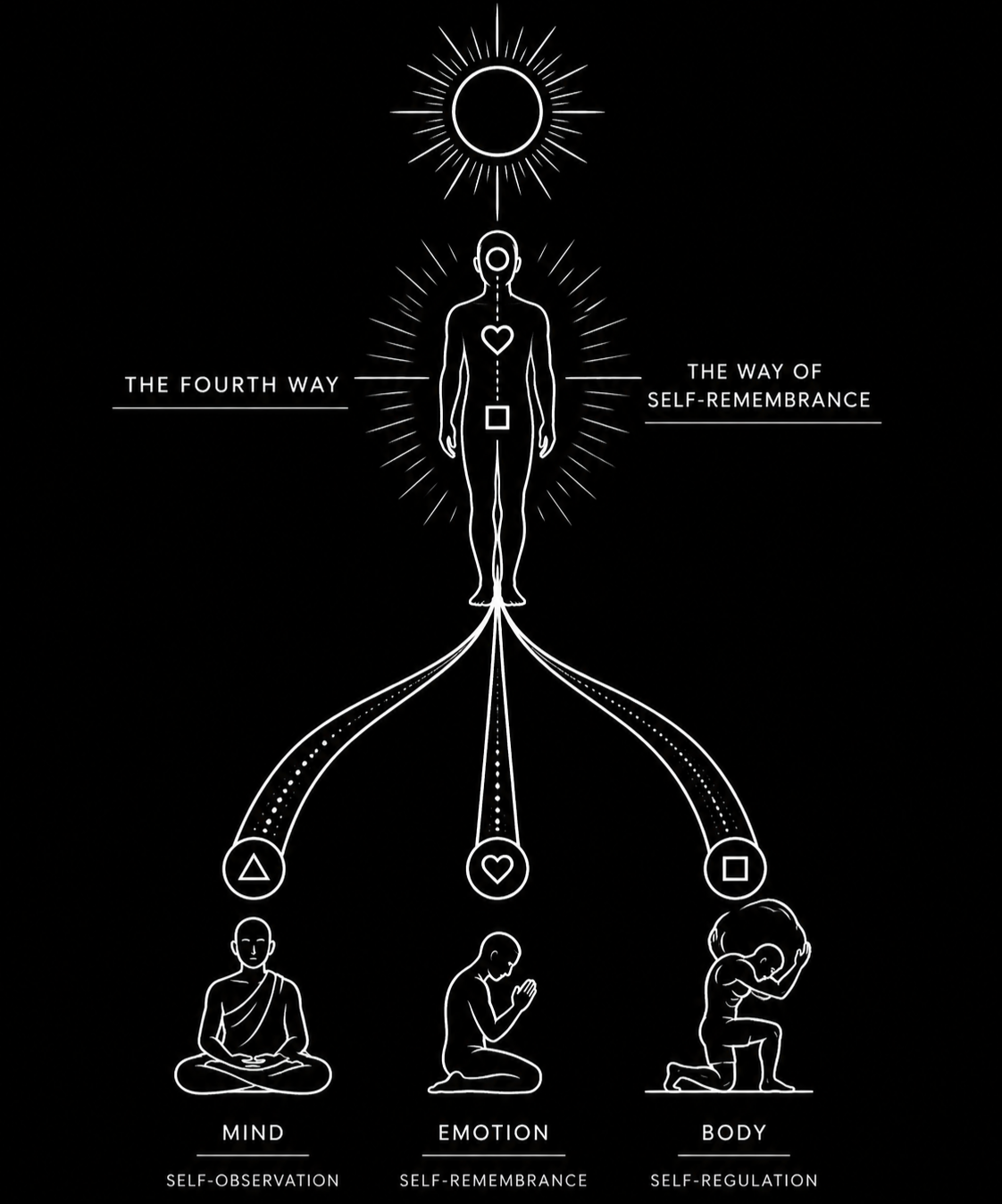
Gurdjieff called his teaching the Fourth Way to distinguish it from three other paths he saw as incomplete. The way of the fakir, who works on the body through physical discipline. The way of the monk, who works on the emotions through devotion. The way of the yogi, who works on the mind through knowledge. Each of these paths develops one aspect of the human being while leaving the others unchanged. The Fourth Way insists on working on all three simultaneously, and crucially, it insists on doing so within ordinary life. No monasteries, retreats and no special clothing. The waking up happens at the dinner table, in the office, during the argument with your partner, while you are stuck in traffic. The conditions you are trying to escape are the conditions in which the work has to be done.
Eckhart, Rumi, and Luria all assume the human is already a vessel capable of receiving the divine. The mystical work, in their framing, is to clear out what blocks the reception. Gurdjieff says the vessel itself does not yet exist. There is nothing in most human beings capable of holding a genuine encounter with the divine, because the human being is not yet a single thing, but a crowd. And the divine, cannot pour itself into a crowd.
When the Buddhists say there is no self, the response of most Western readers is intellectual. We agree, or we disagree, or we file it away as an interesting view. When Gurdjieff says you are not yet a self but you could become one, the response is probably rather an objection. To take this personal… for me this claim implies that the spiritual reading and writing and thinking I have been doing for months might, depending on what I do with it, be either the beginning of a real transformation or an elaborate way of avoiding one.
🜏
There is a scene near the end of Fight Club, when the narrator finally understands that Tyler Durden has been him all along. That the man he had been treating as a separate person, was a part of himself running in parallel to the version of him that owned an apartment full of carefully chosen furniture and read mail-order catalogues in the bathtub. The two had been operating in the same body without ever meeting. One was awake. The other was a shell, well-curated, and almost entirely absent.
The structure of that realization is something the mystics and Gurdjieff would have recognized immediately. You can spend a lifetime accumulating the right objects, the right opinions, the right vocabulary, the right reading list, and still be a crowd. Still not have a self that is awake to itself. The horror in the movie is not the violence, but the recognition that the person we believed ourselves to be was not actually there.
I have been writing these newsletters for half a year, and I told myself at the start that I was reading this stuff to gain a deeper understanding of who we are and what we might become. That phrase is in the very first newsletter. What I have been doing instead, for at least some of the time, is collecting. Each newsletter has added another layer to a stack of frameworks I can now reference in conversation, deploy in arguments, recognize in other people's writing. By Gurdjieff's definition, I have been accumulating knowledge.
The question of whether any of it has produced understanding is harder to answer. Some of it has. The Plato section, with its observation that consciousness is something we either practice or waste, changed how I noticed my own attention. The Eastern traditions softened something in me about the tightness with which I hold my own opinions. But I cannot pretend the ratio is good. For every shift in actual behavior, there are probably a dozen ideas that lodged in my head as references and nothing more.
This is the trap Gurdjieff is warning against. The teachings become a kind of intellectual entertainment, all the more dangerous because the entertainment feels like progress. You feel deeper because you can name the difference between Atman and Anatta. You feel smarter because you know a bit of Egyptian history. The risk is that the feeling replaces the thing.
I do not have a clean solution to this, and I am not going to pretend I do. What I can say is that this month forced a question that has been quietly underneath the whole project. I started writing these letters partly out of a real hunger to understand consciousness, and partly out of a need to do something productive with the reading I was already doing. The first motivation produces understanding. The second produces newsletters. Telling them apart is harder than I thought.
Next month is the last in the historical arc I planned. After that, I want to dig deeper into modern psychology, AI and also reconsider a bit what this project is actually for. Whether it continues as it has, or whether it changes shape, I do not know yet. But I would rather write less and understand more, than write more and accumulate.
That feels like the most honest place to end this month.
- Transmission Sent -