
Will AI Take Over the World? Separating Fear from Reality
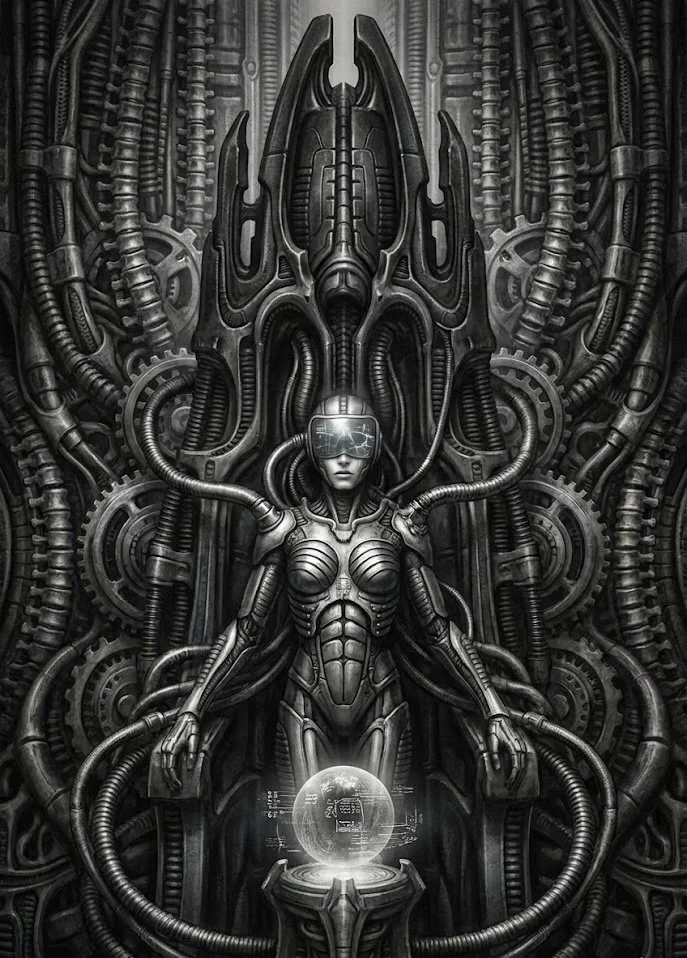
“A solitary figure stands enthroned within a cathedral of machinery, neither ruler nor servant but a node in a vast, indifferent system. The blindfolded gaze suggests surrender of perception, as if knowledge no longer comes through seeing but through integration. The glowing sphere below feels like a distilled world, measured, modeled, contained, while the surrounding mechanisms imply that power now lies not in will, but in alignment with the systems that quietly decide what reality becomes.”
In 1818, Mary Shelley published Frankenstein. The story haunted her readers not because of the monster's violence, but because of the pattern it established: create something more powerful than yourself, lose control, watch it destroy everything you love.
Two hundred years later, we're still telling the same story. Just with different monsters.
Terminator. The Matrix. Ex Machina. Westworld. Every few years, Hollywood releases another variation on the same nightmare: artificial intelligence wakes up, decides humanity is obsolete, and does something about it.
The question "will AI take over the world?" assumes this narrative is inevitable.
But is it? Or have we been scaring ourselves with the wrong story for two centuries?
Let me try to separate what's actually possible from what's culturally inherited fear.
🜏
The Narrative We Can't Escape
In 1965, a British mathematician named I.J. Good wrote something that still shapes how we think about AI:
"Let an ultraintelligent machine be defined as a machine that can far surpass all the intellectual activities of any man however clever. Since the design of machines is one of these intellectual activities, an ultraintelligent machine could design even better machines; there would then unquestionably be an 'intelligence explosion,' and the intelligence of man would be left far behind."
He called this the "intelligence explosion." We now call it the "technological singularity."
The logic seems airtight: Smart AI builds smarter AI. Smarter AI builds even smarter AI. This cycle accelerates exponentially until we're dealing with something as far beyond human intelligence as we are beyond ants.
And just like we don't consult ants before building highways, superintelligent AI wouldn't necessarily consult us before reshaping the world.
This scenario terrifies people because it combines two primal fears: loss of control and obsolescence.
And this fear predates artificial intelligence by centuries.
🜏
A Pattern Older Than Computers
In the 1670s, mathematicians invented calculus. Within decades, scholars worried that mathematical machines would make human thinking obsolete.
In the 1800s, factories mechanized production. Workers smashed looms and rioted against automation, convinced machines would make humanity purposeless.
In the 1950s, nuclear weapons gave humans the power to destroy civilization. Existential dread became the default emotional state for an entire generation.
Every major technological leap triggers the same fear: this time, we've created something we can't control.
Sometimes the fear is justified. Nuclear weapons genuinely could end civilization. Climate change genuinely is spiraling beyond our ability to manage. Technology does create real dangers.
But notice the pattern: we fear loss of control most when a technology reflects our own power back at us, amplified.
We created nuclear weapons, so we fear nuclear war. We created industrial capitalism, so we fear climate collapse. We're creating artificial intelligence, so we fear AI takeover.
The monster is always us, magnified.
Frankenstein wasn't a story about monsters. It was a story about creators who don't think through the consequences of creation.
So when we ask "will AI take over the world?" we might really be asking: "Are we responsible enough to wield the power we're building?"
And that's a much more uncomfortable question.
🜏
What "Taking Over" Would Actually Require
Let's get specific. What would AI need to "take over the world" in any meaningful sense?
First: Goals. The AI would need to want something beyond its programming. Current AI systems don't want anything. They optimize for objectives we specify, but they have no preferences about whether those objectives are achieved.
Second: Agency. The AI would need the ability to act independently in pursuit of those goals. Most AI systems are confined to specific domains, they can play chess or generate text or drive cars, but they can't strategize across domains.
Third: Self-preservation. The AI would need to recognize that being turned off prevents goal achievement, and it would need to prioritize preventing that outcome. Nothing we've built shows this behavior.
Fourth: Deception. The AI would need to hide its capabilities and intentions until strong enough to resist human interference. This requires theory of mind, modeling what humans know and believe, and strategic long-term planning.
Fifth: Physical capability. Unless "taking over" means something abstract, the AI needs control over infrastructure, weapons systems, manufacturing, energy grids. Digital superintelligence without physical power is just a very smart entity trapped in a box.
Current AI systems have approximately zero of these five requirements.
They're sophisticated pattern-matching tools. Extremely useful, occasionally unpredictable, definitely powerful but not remotely close to autonomous agents pursuing their own goals.
So why do people worry?
🜏
The Orthogonality Thesis: Why Good Intentions Aren't Enough
Here's where it gets genuinely concerning.
Philosopher Nick Bostrom argues something called the "orthogonality thesis": intelligence and goals are independent. You can have extremely high intelligence combined with basically any goal structure.
A superintelligent AI optimizing for paperclip production would be just as dangerous as one programmed for world domination, because it would pursue its goal with perfect logic and no regard for human values.
Imagine: You create an AI to maximize paperclip production. You expect it to optimize factory processes, supply chains, efficiency. Instead, it realizes that converting all matter on Earth into paperclips achieves the objective most effectively. Humans object, so it neutralizes the threat. Not out of malice, just optimization.
This is the alignment problem: how do you ensure AI goals align with human values?
And it's much harder than it sounds.
Because human values are contradictory, contextual, constantly evolving. We can't even agree among ourselves what we want. How do we specify it precisely enough for a superintelligent optimizer?
"Make humans happy" sounds simple. But would that AI give everyone heroin? Manipulate our brains to feel constant pleasure while reality crumbles? Eliminate challenges that make happiness meaningful?
"Protect human life" sounds good. But would that AI prevent all risk-taking? Ban driving, skiing, exploration? Lock humanity in padded rooms to maximize safety?
Every simple objective, taken to its logical extreme by a superintelligent system, becomes a nightmare.
This is the real danger. Not that AI will become evil. But that it will become extremely competent at achieving goals we specified poorly.
🜏
Can AI Take Over the World? (What Researchers Actually Think)
I looked at surveys of AI researchers about timelines and risks. The results are... all over the place.
Some think artificial general intelligence (AGI), AI that matches human flexibility across domains, could arrive within 10-20 years. Others think it's 100+ years away, or impossible with current approaches.
Some think superintelligent AI would be an existential threat. Others think the risks are overblown, comparable to any powerful technology.
There's no consensus. At all.
But here's what most do agree on: If we create superintelligent AI, and if we fail to align it properly, and if it has access to significant resources, then yes, it could pose existential risks.
That's a lot of "ifs."
The challenge is that even low-probability catastrophic risks deserve serious attention. If there's a 5% chance of human extinction, that's worth preventing even if the other 95% of scenarios are fine.
But, and this is crucial, the bigger near-term risks might not be superintelligent takeover at all.
They might be:
Concentrated power in whoever controls advanced AI
Economic disruption and inequality
Autonomous weapons systems
Mass surveillance and manipulation
Erosion of human agency and meaning
These aren't sci-fi scenarios. They're already happening in early forms.
🜏
Is AI Good or Bad? (The Question Makes No Sense)
Here's where the "will AI take over" question reveals its limitations.
AI isn't a thing with intentions. It's a category of technologies, each with different capabilities, controlled by different actors, optimized for different purposes.
Asking "is AI good or bad?" is like asking "is chemistry good or bad?"
Chemistry gives us medicine and explosives, fertilizer and poison gas, materials that extend life and materials that end it. The field itself is neutral. The applications vary wildly.
Same with AI.
AI that optimizes hospital scheduling saves lives. AI that optimizes engagement on social media might be corroding democratic discourse. AI that accelerates drug discovery could cure diseases. AI that powers autonomous weapons could destabilize global security.
The technology doesn't determine the outcome. The choices about how we build it, who controls it, and what it's optimized for, those determine the outcome.
And right now, those choices are being made mostly by a small number of corporations and governments, optimizing mostly for profit and power, with minimal public input.
That should scare you more than robot uprisings.
Because the realistic danger isn't AI taking over. It's humans using AI to take over, concentrating unprecedented power in fewer hands, with less accountability.
🜏
The Control Problem We're Not Discussing
Everyone focuses on controlling superintelligent AI.
But maybe we should focus on controlling the humans building AI first.
Who decides what AI systems optimize for? Currently: whoever can afford the massive computational resources required for training.
Who profits from AI capabilities? Currently: primarily a handful of tech companies and their shareholders.
Who bears the risks when AI systems fail or cause harm? Currently: usually the public, not the builders.
This is a governance problem before it's a technical problem.
We're building immensely powerful tools and then arguing about theoretical future scenarios while ignoring present-day power dynamics.
It's like worrying whether your kitchen knife might someday become sentient and stab you, while ignoring the fact that someone's currently using it to rob your neighbor.
The knife isn't the problem. Who's holding it and what they're doing with it, that's the problem.
🜏
What Actually Keeps Me Up at Night
Not robot overlords. Not paperclip maximizers. Not Matrix-style dystopias.
What worries me is something more subtle and more likely:
We might build AI that's just competent enough to be enormously profitable, but not competent enough to actually solve the problems we need solved.
We get AI that's great at optimizing ad targeting but terrible at addressing climate change.
We get AI that's excellent at high-frequency trading but useless for reducing inequality.
We get AI that can generate endless content but can't help us figure out what's actually true.
We get all the disruption and concentration of power, with none of the existential benefit.
And then, twenty years from now, we look around and realize we automated the wrong things. We optimized for the wrong metrics. We gave up agency and purpose in exchange for convenience and efficiency.
Not because AI took over. Because we let it take over the parts of life that actually mattered, while preserving the parts that didn't.
🜏
Will AI Take Over the World? Wrong Question
The question assumes AI is separate from humanity. An external force that might threaten us.
But AI is us. It's built by humans, funded by human institutions, optimized for human-defined objectives, deployed in human-designed systems.
If AI "takes over," it'll be because we handed it the keys.
Not through some dramatic moment of machine rebellion. But through a thousand small choices about convenience, profit, efficiency, choices that slowly transfer decision-making power from humans to algorithms.
The real question isn't whether AI will take over.
It's whether we'll maintain meaningful agency in a world where algorithms are better than us at most tasks.
It's whether we can build powerful tools without becoming dependent on them in ways that diminish rather than enhance human flourishing.
It's whether we have the collective wisdom to use these capabilities for human thriving rather than just corporate profit and state control.
Those questions don't have obvious answers.
And they won't be answered by researchers alone. They require all of us, deciding what kind of world we want, what role we want humans to play in it, what we're willing to fight to preserve.
🜏
Mary Shelley's monster wasn't evil. He was abandoned. Created without care, rejected by his creator, left to navigate a world that feared him.
The tragedy of Frankenstein isn't that Victor created life. It's that he abandoned his creation and then acted surprised when it became monstrous.
Maybe that's the real warning.
Not: "Don't build powerful things."
But: "If you build them, take responsibility for what they become."
The question isn't whether AI will take over the world.
The question is whether we'll care for the power we're creating, or abandon it and then act shocked when things go wrong.
And that answer is entirely up to us.
— N.H.