
The Wood Wide Web: What Trees Might Teach Us About Intelligence
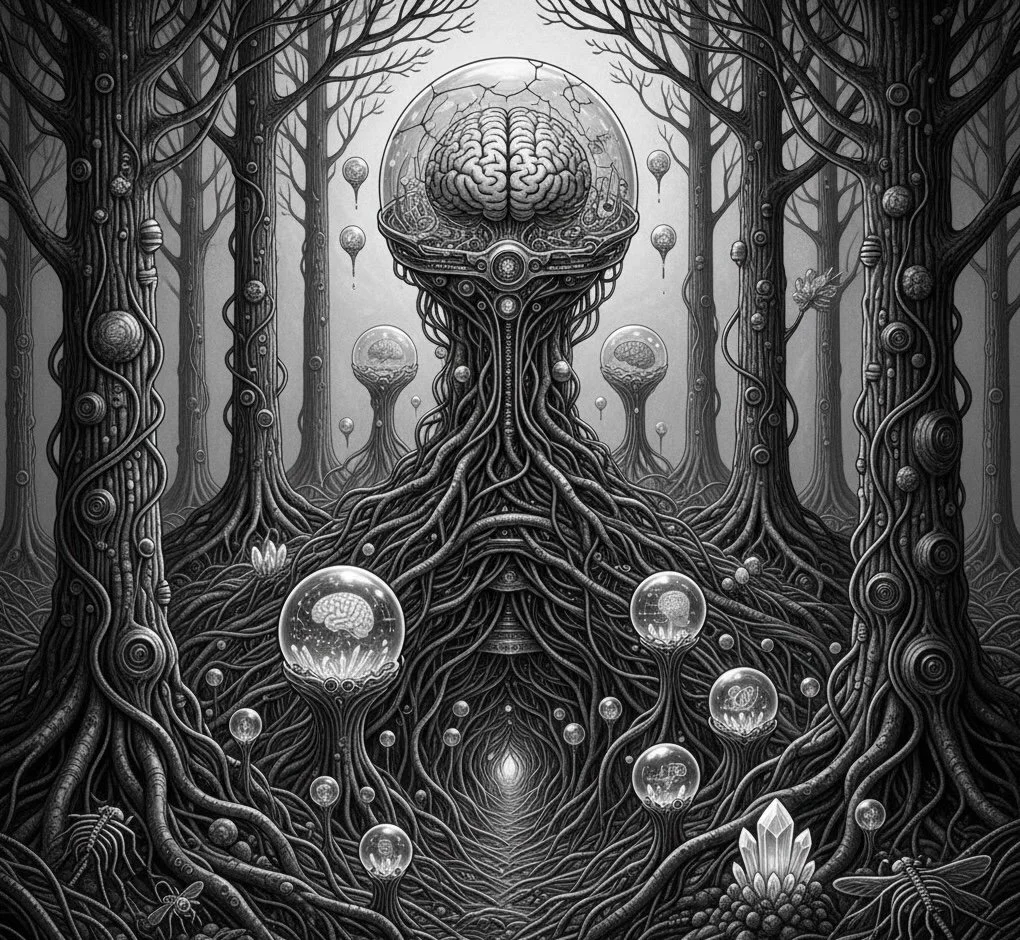
“Forests are not silent collections of individuals but living networks, where trees exchange nutrients, warnings, and memory through underground fungal systems. This “Wood Wide Web” challenges our habit of equating intelligence with brains, suggesting instead that awareness can emerge from relationship, cooperation, and slow time.
Short answer: Trees exchange nutrients and chemical signals through mycorrhizal fungal networks, but the popular “wood wide web” metaphor often overstates what science has proved. The networks are real; claims that forests intentionally cooperate or communicate like brains remain debated. What they demonstrate is distributed interaction, not necessarily consciousness.
In 2016, a Canadian forest ecologist named Suzanne Simard gave a TED talk that's been viewed over 6 million times.წ
She described forests as "superorganisms", interconnected networks where trees share resources, send warning signals, and even recognize their own kin. Mother trees, she explained, nurture their offspring through underground fungal connections, transferring carbon and nutrients to saplings struggling in the shade.
The internet loved this story. Journalists called it the "wood wide web." Peter Wohlleben's book The Hidden Life of Trees became an international bestseller, describing trees as social beings that care for their families and remember their experiences.
Then the backlash came.
Scientists accused Wohlleben and others of anthropomorphizing plants, of seeing intention where there's only mechanism, of projecting human emotions onto organisms that have no nervous system, no brain, no capacity for anything resembling thought.
So which is it? Are trees communicating through fungal networks, or are we just desperate to find consciousness everywhere we look?
The answer matters more than you might think, not just for understanding forests, but for understanding what we mean by "intelligence" at all.
🜏
What's Actually Happening Underground
Let's start with what nobody disputes.
Under your feet, beneath every forest floor, exists a network of staggering complexity. Mycorrhizal fungi, literally "fungus-roots", form symbiotic relationships with roughly 90% of plant species.
Here's how it works:
The fungus colonizes plant roots, extending thread-like filaments called hyphae into the soil. These filaments can stretch for miles, connecting multiple plants in a web. The fungus is better at extracting nutrients, particularly phosphorus and nitrogen, from the soil than plant roots alone.
In exchange, the plant provides the fungus with sugars produced through photosynthesis. The fungus can't photosynthesize, so it depends on the plant for energy. The plant can't access certain nutrients efficiently, so it depends on the fungus.
This symbiosis is ancient. Fossil evidence suggests it formed over 400 million years ago, possibly enabling plants to colonize land in the first place.
But the network doesn't just connect one plant to one fungus. A single fungal network can link dozens, hundreds, or even thousands of plants. Trees of different species, different ages, different sizes, all connected through the same underground system.
And through these connections, things move.
Carbon. Nitrogen. Phosphorus. Water. Chemical signals. Research has clearly demonstrated that resources transfer between trees through mycorrhizal networks.
Nobody disputes this. The controversy is about what it means.
🜏
The Anthropomorphism Problem
When Peter Wohlleben describes trees "caring" for their offspring or "warning" neighbors about insect attacks, he's using language that implies intention, emotion, awareness.
Critics argue this is pure anthropomorphism, projecting human qualities onto non-human systems.
And they have a point.
When your skin cells detect damage, they release chemical signals that trigger inflammation. Nearby cells respond by increasing blood flow and immune activity. Is this "communication"? Or just automatic chemical responses?
When your immune system identifies a pathogen, it produces antibodies that "remember" the invader for faster response next time. Is this "memory"? Or just molecular pattern-matching?
We don't usually describe these processes using intentional language because we understand the mechanisms. We know it's chemistry and physics, not consciousness.
So when trees respond to insect damage by releasing volatile compounds that neighboring trees detect and respond to, is that fundamentally different from your skin cells responding to a cut?
The trees have no neurons, no brain, no central processing system. Just chemical gradients and evolved responses shaped by millions of years of selection pressure.
Maybe calling this "communication" or "intelligence" is like calling your pancreas intelligent for regulating blood sugar. Sophisticated biological processes, yes. But consciousness? That's a reach.
🜏
But Then There's the Data That Won't Go Away
In controlled experiments, researchers have shown:
Trees can distinguish kin from strangers. Douglas firs connected through mycorrhizal networks transfer more carbon to their own offspring than to unrelated seedlings. How do they "know" the difference? Nobody's entirely sure, but chemical signatures seem to be involved.
Resource transfer isn't random. When large trees are shaded or stressed, they receive carbon from neighbors. When they recover, the flow reverses. The network seems to buffer individual trees against temporary hardship.
Warning signals propagate. When trees are attacked by insects, they emit volatile organic compounds. Downwind trees detect these compounds and upregulate defensive chemicals before the insects arrive. This gives them a head start on defense.
But even more intriguing: trees connected through mycorrhizal networks respond faster and more strongly to these signals than isolated trees. As if the fungal connection amplifies the warning.
Chemical gradients don't quite explain all of this. Or rather, they explain the mechanism but not the apparent coordination.
And then there's the time scale problem.
🜏
Tree Time vs. Human Time
Wohlleben makes a point that's genuinely important, even if his language is controversial.
Trees operate on a completely different temporal scale than humans.
A tree might take 20 years to reach maturity. A forest ecosystem might take 200 years to develop complex structure. Trees can live for centuries or, in some species, millennia.
To a tree, a human lifetime is a brief flicker.
If trees are "thinking" or "communicating," it's happening so slowly that we only ever observe frozen moments. Like watching a single frame of a film and trying to understand the plot.
Maybe what looks like automatic chemical response to us is actually deliberate behavior stretched across weeks, months, years. We just don't have the patience or lifespan to observe it properly.
Or maybe that's exactly the kind of anthropomorphizing the critics warn against, assuming that because something takes time, it must involve consciousness.
I don't know which interpretation is correct. But the time scale issue is real.
When you study animal behavior, you can watch decisions unfold in seconds or minutes. Rat in maze makes turn, gets reward, learns association. Observable, testable, clear.
How do you study decision-making that happens over decades in organisms that can't move and can't report their subjective experience?
You can't. Not easily.
🜏
The Scientific Controversy Gets Specific
In 2023, a group of scientists published a paper essentially saying: We need to talk about the wood wide web hype.
Their concerns were specific and well-founded:
1. Cherry-picking data. Most studies showing resource transfer used artificial setups, seedlings in controlled conditions, isotope labeling, greenhouse experiments. Field studies often show much weaker effects or no transfer at all.
2. Confusing correlation with causation. Yes, trees in networks often grow better than isolated trees. But is that because of resource sharing, or because fungal networks indicate healthy soil conditions that benefit trees for other reasons?
3. Misunderstanding fungal economics. Mycorrhizal fungi aren't neutral middlemen. They're organisms with their own evolutionary interests. They take carbon from trees, up to 30% of what trees photosynthesize. That's not free networking; it's a protection racket in some cases.
4. Ignoring conflicting evidence. Some studies show competition through fungal networks, not cooperation. Trees might use shared fungi to release toxic compounds that inhibit competitors. Not exactly "caring mother trees."
The critics aren't saying mycorrhizal networks don't exist or don't matter. They're saying the popular narrative oversimplifies a complex, sometimes competitive, often ambiguous system.
And they're right to push back. Science requires skepticism, especially when a story becomes too appealing.
But does correcting the hype mean dismissing the phenomenon entirely?
🜏
What "Intelligence" Means When There's No Brain
Here's the core question: Can intelligence exist without a central nervous system?
Slime molds can solve mazes. They have no brain, no neurons, just a single-celled organism that somehow navigates complex environments efficiently. They can even "remember" where they've been by leaving chemical trails that prevent backtracking.
Is that intelligence? Or just sophisticated chemistry?
Plants respond to light, gravity, moisture, touch, temperature, chemical signals. They close leaves at night, track the sun across the sky, bend roots toward water. Some plants can distinguish between the vibrations of a chewing caterpillar and wind-blown debris, deploying defensive chemicals only when actually under attack.
Is that intelligence? Or just evolved responses to stimuli?
Maybe the question is wrong. Maybe intelligence isn't a binary property things either have or don't have, but a spectrum of capabilities for processing information and responding adaptively.
By that standard:
Your pancreas has intelligence (processes information, regulates systems)
A thermostat has rudimentary intelligence (senses temperature, adjusts behavior)
An AI language model has narrow intelligence (processes patterns, generates responses)
A forest ecosystem has distributed intelligence (responds collectively to conditions over time)
None of these are conscious in the sense of having subjective experience. But all of them process information and behave adaptively.
Maybe what bothers us about calling forests "intelligent" is that it challenges our assumption that intelligence requires consciousness, and consciousness requires something that looks like us, a brain, a face, a personality.
But evolution didn't optimize for "looks like us." It optimized for "survives and reproduces."
And plants have been doing that successfully for 450 million years without brains.
🜏
What I Find Most Disturbing About This Debate
It's not the science. Scientists arguing about interpretations is healthy.
What disturbs me is how desperately we need trees to be either dumb or magical.
One side wants trees to be conscious, caring, wise, as if that would vindicate our guilt about deforestation. If trees have feelings, maybe we'd finally stop cutting them down. Have we done so with animals, duh?
The other side wants trees to be purely mechanical, as if that would justify continued exploitation. If they're just biological machines, we don't need to consider them beyond their economic value.
Both positions avoid the uncomfortable middle ground: trees might be neither conscious nor mechanical in the ways we understand those terms. They might be something else entirely.
And we might not have the conceptual framework to understand what that "else" is.
This matters because we're rapidly approaching the same question with artificial intelligence.
Is AI intelligent? That depends on what you mean by intelligence.
Does it process information? Yes. Does it learn and adapt? Yes. Does it have goals and preferences? Not in any way we can detect. Does it experience anything subjectively? Unknown, possibly unknowable.
Same questions we're asking about trees.
Maybe instead of arguing whether trees or AI are "really" intelligent, we should acknowledge that intelligence comes in forms we haven't evolved to recognize intuitively.
🜏
The Animist Perspective We Forgot
There's a worldview we discarded during the scientific revolution that might be worth reconsidering, not as literal truth, but as a useful frame.
Animism: the belief that all things possess some form of spirit or consciousness.
Indigenous cultures never separated intelligence from the natural world the way Western thought does. A river could be wise. A mountain could have intention. Trees, obviously, were persons, not metaphorically, but as a lived reality.
We dismissed this as primitive superstition. But what if they were noticing something real?
Not literal consciousness in trees, necessarily. But the fact that living systems exhibit behavior, responsiveness, and coordination that looks an awful lot like decision-making when observed properly.
The question isn't whether trees are conscious like us. It's whether "conscious like us" is the only kind of subjective experience possible.
Maybe trees have some dim, slow, distributed form of awareness that's as alien to human consciousness as our consciousness would be to them.
Or maybe they're sophisticated biological machines and we're just uncomfortable with how hard it is to draw a clear line between "machine" and "mind."
I don't know. I'm genuinely uncertain.
But I'm skeptical of certainty in either direction.
🜏
What the Wood Wide Web Actually Teaches Us
Forget the controversy for a moment. What can we learn from mycorrhizal networks regardless of whether we call them "communication"?
1. Life is interconnected in ways we consistently underestimate. We keep discovering new connections, new dependencies, new symbioses. The individual organism is often not the right unit of analysis. The system is.
2. Evolution produces solutions we wouldn't think to design. No engineer would invent mycorrhizal networks, too inefficient, too decentralized (hello blockchain!), too dependent on cooperation between competing organisms. But it works, and it's lasted hundreds of millions of years.
3. Our language for describing intelligence is inadequate. We're stuck with terms evolved for describing human minds. When we encounter other forms of adaptive behavior, we either anthropomorphize or dismiss. We need better vocabulary.
4. The line between cooperation and competition is blurrier than we think. Mycorrhizal networks enable both. Trees share resources and also poison competitors through the same networks. It's not wholesome forest utopia or brutal competition, it's both, simultaneously.
5. Time scale matters enormously. Fast-moving organisms (us) struggle to recognize patterns in slow-moving organisms (trees). We're probably missing entire layers of behavior and response that operate on multi-year or multi-decade cycles.
None of this requires trees to be conscious. But all of it requires us to expand how we think about intelligence, adaptation, and the distribution of cognitive processes in biological systems.
Because if we can't recognize intelligence in an organism that's been successfully adapting for 450 million years, how will we recognize it in artificial systems we're building now?
🜏
Where This Leaves Me
I started researching the wood wide web hoping for a clear answer. Are trees really communicating, or is it just romantic nonsense?
What I found instead: it's complicated, and the complication itself is the interesting part.
Mycorrhizal networks are real. Resource transfer happens. Chemical signaling is documented. The behavior of trees in networks differs from isolated trees in measurable ways.
But whether to call this "communication," "intelligence," or "consciousness" depends on definitions we haven't agreed on and probably can't agree on because they're trying to capture phenomena our language wasn't built to describe.
What I'm certain of: forests are doing something far more sophisticated than we understood a generation ago. And we're still in the very early stages of understanding what that something is.
What I'm uncertain about: whether the right framework is biology, information theory, systems thinking, or something we haven't invented yet.
What worries me: we're cutting down these networks faster than we're figuring out what they do.
What gives me hope: the controversy itself shows we're starting to take seriously the possibility that intelligence exists in forms we haven't been looking for.
Because if trees can challenge our assumptions about where intelligence lives, maybe we'll be more humble when artificial systems start exhibiting behaviors we don't fully understand.
Maybe the lesson of the wood wide web isn't about trees at all.
Maybe it's about recognition, learning to see intelligence in forms that don't look like us.
And that's a lesson we desperately need.
— N.H.
Want one thoughtful essay each month on intelligence beyond the human, consciousness, and technology? Subscribe free at https://falsegod.de/newsletter
Further Reading:
Suzanne Simard - Finding the Mother Tree
Merlin Sheldrake - Entangled Life (fungal networks)
Justine Karst et al. - "Positive citation bias and overinterpreted results lead to misinformation on common mycorrhizal networks in forests" (2023)
Monica Gagliano - Studies on plant behavior and learning
The debate between Peter Wohlleben and academic ecologists