
AI vs Human Intelligence: Why Comparison Misses the Point
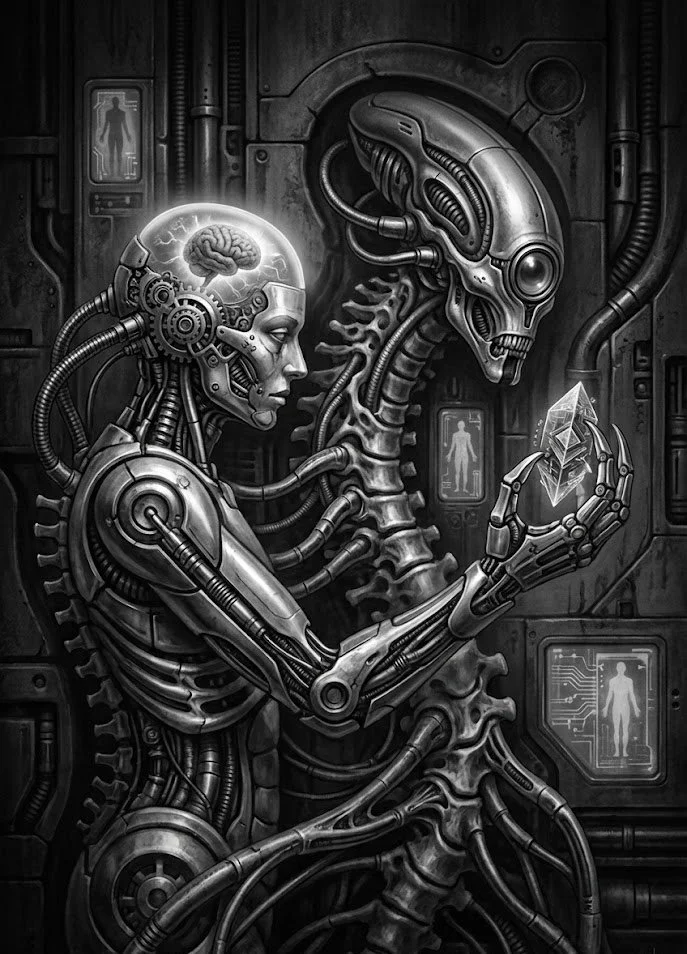
“Two engineered beings face each other in quiet recognition, united not by flesh but by design, as one offers a crystalline object like a question rather than a gift. The exposed brain and skeletal metal suggest that intelligence has been stripped of mystery and rebuilt as mechanism, yet the gesture remains almost reverent. The image feels like a moment where creation studies itself, wondering whether meaning can survive once consciousness is fully understood, replicated, and exchanged between machines.”
There's a test you've probably never heard of, even though it changed how we think about intelligence.
In the 1970s, a researcher named David Premack taught a chimpanzee named Sarah to communicate using plastic symbols. Not sign language, actual tokens representing words, arranged on a magnetic board. Sarah learned over 130 symbols. She could understand conditionals, negations, even answer questions about questions.
One day, Premack showed Sarah a locked box and a key. Then he showed her pictures: a human using the key to open the box, versus a human trying to force it open. Sarah chose the correct picture. She understood the human's problem and the appropriate solution.
But here's what haunts me about this experiment: Sarah was demonstrating something we'd call reasoning or problem-solving, yet she couldn't open the box herself. Her hands, perfectly capable of manipulating the key, weren't the issue. The limitation was somewhere else, in the gap between understanding a problem and having the agency to act on it.
When we ask "AI vs human intelligence," I keep thinking about Sarah and that box.
Because maybe we're asking whether AI can think when we should be asking: what kind of thinking actually matters?
🜏
The Intelligence We Pretend Doesn't Exist
Let me tell you about someone you've never met but who knows you intimately.
Your pancreas.
Right now, your pancreas is making thousands of micro-decisions every hour, monitoring blood sugar levels, calculating insulin release rates, predicting your metabolic needs based on recent eating patterns. It's running a predictive model of your body's energy requirements, adjusting in real-time to new information.
It does this without any conscious input from you. You can't feel it happening. You can't override it with willpower. You don't even know it's occurring until something goes wrong.
Is your pancreas intelligent?
Most people would say no. It's just following biological programming, responding to chemical signals, executing predetermined responses.
But then, what's the difference between your pancreas and a modern AI system?
Both process inputs. Both make predictions. Both adjust behavior based on feedback. Both operate without conscious experience (as far as we know). Both can fail in catastrophic ways if the system breaks down.
The only difference is we built one and evolved the other.
This matters because when we compare AI to human intelligence, we usually mean the conscious, deliberate thinking we're aware of. The voice in your head. The ability to reason about abstract concepts. The capacity to write poetry or prove theorems.
But that's maybe 5% of what your brain actually does.
The other 95%, regulating your heartbeat, processing visual information, coordinating muscle movements, maintaining balance, filtering sensory input, operates more like your pancreas. Sophisticated information processing without consciousness.
AI is competing with the pancreas, not the poet.
At least, not yet.
🜏
What Humans Are Actually Good At (It's Not What You Think)
In 1997, IBM's Deep Blue beat world chess champion Garry Kasparov. The world panicked briefly. If machines could outthink humans at chess, what's left for us?
But here's what nobody noticed: Deep Blue was terrible at almost everything except chess.
It couldn't recognize Kasparov's face. It couldn't navigate the room it was in. It couldn't understand trash talk or feel nervous before an important game. It couldn't want to win for reasons beyond its programming. It couldn't eat a sandwich.
Twenty-seven years later, we have AI that can write essays, generate images, compose music, diagnose diseases, drive cars. Each one specialized, optimized, superhuman at specific tasks.
And still, none of them can do what a three-year-old does effortlessly: navigate the general messiness of reality.
A toddler can see a chair they've never encountered before and immediately understand it's for sitting. They can recognize emotions in facial expressions they've never seen. They can learn languages from fragmented, imperfect input. They can transfer learning from one domain to completely unrelated ones.
This is called general intelligence, and biology is absurdly good at it compared to our current AI systems.
Why?
One theory suggests it's because biological intelligence evolved to solve one fundamental problem: survival in an unpredictable environment. You can't specialize when you don't know what tomorrow's challenge will be. You need flexibility, adaptability, the ability to make decent guesses with incomplete information.
AI, meanwhile, gets trained on specific tasks with massive datasets. It learns to optimize for particular goals in controlled conditions. It's the opposite evolutionary pressure.
We built specialists. Biology built generalists.
But that gap is closing. Fast.
🜏
The Moravec Paradox: Why Easy Is Hard and Hard Is Easy
In the 1980s, roboticist Hans Moravec noticed something strange.
Tasks that humans find difficult, playing chess, solving calculus problems, making complex logical deductions, turned out to be relatively easy for computers. But tasks that humans find trivially easy, walking across a room, picking up a cup, recognizing a friend's face, were monumentally difficult for machines.
This became known as Moravec's Paradox: the hard things are easy, and the easy things are hard.
Why?
Because the "hard" things like chess and calculus only emerged in human history recently, maybe 5,000 years ago. Our brains didn't evolve specific hardware for them. We hack together solutions using general-purpose reasoning.
The "easy" things like vision and motor control? Those are the product of 600 million years of evolutionary refinement. Your visual cortex is a staggeringly sophisticated piece of biological machinery that processes information in ways we still don't fully understand.
Evolution optimized the things that actually mattered for survival. Playing chess wasn't one of them. Not getting eaten by predators while gathering food? Critical.
So when AI finally masters the "easy" things, and it's getting close, that's when the comparison to human intelligence becomes genuinely interesting.
Because at that point, AI won't just be a very fast calculator. It'll be something that can interact with the physical world as flexibly as we do.
And then the question isn't "AI vs human intelligence." It's "AI and human intelligence, now what?"
🜏
Will AI Replace Humans? A History Lesson Nobody Remembers
In 1589, an English inventor named William Lee demonstrated a mechanical knitting machine to Queen Elizabeth I. It could produce stockings six times faster than skilled hand-knitters.
The Queen refused to grant him a patent. Her reasoning? It would "ruin the livelihood of hand-knitters."
Lee died in poverty. His invention was suppressed for decades.
Eventually, of course, mechanical knitting became ubiquitous. Hand-knitters largely disappeared as a profession. The Queen's fears were realized.
But, and this matters, people didn't stop wearing stockings. They just paid less for them. And former knitters found other work.
The economy adapted. Society reorganized. New jobs emerged that nobody could have predicted in 1589.
This pattern has repeated hundreds of times throughout history. Every major technological advancement triggered the same fear: this time, we'll be replaced.
Mechanized agriculture would eliminate farmers. (It reduced their numbers but didn't eliminate them.) Factory automation would end manufacturing jobs. (It changed them dramatically but created new ones.) Computers would make office workers obsolete. (They made office workers more productive and created entirely new industries.)
Here's what actually happens: Technology automates specific tasks, not entire job categories. Humans adapt by focusing on tasks that remain difficult to automate. The economy restructures around new capabilities.
So will AI replace humans?
In some functions, absolutely. In roles that are primarily pattern-matching, data processing, optimization, AI will do these better, faster, cheaper.
But "replacing humans" assumes jobs are the only thing we're for. And that's a desperately narrow view of what human existence means.
🜏
The Question Sarah the Chimpanzee Couldn't Answer
Remember Sarah from the beginning? The chimp who could solve problems but couldn't open the box herself?
There's a deeper lesson there.
Intelligence isn't just about processing information or solving puzzles. It's about agency, the capacity to act on your understanding in pursuit of goals you've chosen for yourself.
Current AI systems have no goals beyond what we program. They have no preferences. They don't want anything. When you turn off ChatGPT, it doesn't object because it has no will to continue existing.
This is the fundamental difference between artificial and biological intelligence.
Biology is shaped by billions of years of evolution toward a single imperative: persist. Survive. Reproduce. Every living thing, from bacteria to blue whales, acts in service of this fundamental drive.
Everything we call "intelligence" in biological systems emerged to serve that purpose. Memory helps avoid past dangers. Learning helps identify new food sources. Social cognition helps navigate group dynamics. Abstract reasoning helps plan for future scenarios.
Take away the survival imperative, and you take away the evolutionary pressure that shaped intelligence in the first place.
AI doesn't need to survive. It has no biological imperatives. It wasn't shaped by natural selection. It was shaped by programmers optimizing for specific benchmarks.
Does this mean AI can never be truly intelligent in the way we are?
I don't know. Maybe agency can emerge from complexity alone, regardless of origin. Maybe consciousness requires the messy, embodied, survival-driven context that biology provides.
Or maybe we're about to find out that what we thought made us special was never that special to begin with.
🜏
Can AI Replace Humans? Only If We Let It Replace What Matters
Here's what worries me more than job displacement:
We might use AI to automate the parts of being human that actually give life meaning, while preserving the parts that don't.
Imagine a world where AI handles all creative work, writing, art, music, design. Where it makes all complex decisions, medical diagnoses, legal judgments, scientific discoveries. Where human contribution becomes limited to... what, exactly?
Consumption? Supervision? Existence without purpose?
Some people would call this paradise. No more work, just leisure and enjoyment.
But here's what we know about humans: we need purpose. We need challenges that matter. We need the feeling that our existence contributes something.
Studies of people who win lotteries or retire young show that unlimited leisure without purpose often leads to depression, not happiness. We're not built for permanent vacation. We're built to struggle toward goals we find meaningful.
So the question isn't whether AI can replace human functions. It's whether we'll preserve space for human purpose in a world where most functions can be automated.
And that's not a technical question. It's a philosophical and political one.
What do we want humans to be for?
I don't have an answer. I suspect there isn't one single answer. Different cultures, different individuals, might choose different paths.
But we should be having this conversation now, while we still have the agency to shape how AI integrates into our world.
Because the alternative is letting it happen by default, based on whatever's most profitable or efficient, without considering what gets lost in the process.
🜏
Intelligence Without Comparison
Here's where I keep landing:
Comparing AI to human intelligence is like comparing a submarine to a dolphin.
Both can navigate underwater. Both can travel long distances. Both can detect objects in murky conditions. But they do it completely differently, for completely different reasons, optimized by completely different processes.
The submarine doesn't breathe. The dolphin can't be mass-produced. Neither one is "better", they're optimized for different contexts, built by different designers, serving different purposes.
AI will continue to exceed human capabilities in more and more domains. That's inevitable.
But exceeding humans at specific tasks doesn't make AI a replacement for humans any more than submarines replaced dolphins.
We're different kinds of intelligence, solving different kinds of problems, existing for different reasons.
The real question, the one that actually matters, is whether we can build a world where both kinds of intelligence enhance rather than diminish the other.
Where AI handles the tedious and repetitive, freeing humans for the meaningful and creative.
Where automation creates abundance instead of scarcity.
Where the space for human agency and purpose expands rather than contracts.
That future isn't guaranteed. It requires intention, design, and constant vigilance about what we're optimizing for.
Because intelligence without wisdom is just a faster way to make the same mistakes.
And we're running out of time to figure out which kind we're building.
🜏
I keep thinking about Sarah and that locked box.
She understood the problem. She could identify the solution. But she couldn't act on her understanding because the translation from thought to action was blocked somewhere in the system.
Maybe that's the question we should be asking about AI.
Not: "Is it as smart as us?"
But: "What will it choose to do with whatever intelligence it has? And who decides what it's for?"
Because intelligence, it turns out, is the easy part.
It's the purpose that's hard.
— N.H.