
#3 - “Egypt & the Fragmented Soul - Ba, Ka, Ren, Sheut, and the Architecture of Being”
Dear Reader,
last month we ended among animals and forests, trying to understand consciousness through living beings that feel close to us. This month we go into tombs and temples. Into dust, heat, stone and rooms built for people who stopped breathing thousands of years ago. Egypt is one of the earliest cultures that tried to describe what a person actually is. Not metaphorically, but structurally. They mapped the soul long before psychology had a word for the mind.
It felt like a natural next step after animism. Once humans began living in organised societies, the way we thought about consciousness changed too. Ideas did not only live in rituals or stories anymore. They were carved into stone. Recorded and repeated. Civilization turned loose spiritual instinct into something systematic. Egypt is the first place on earth where this happened in a way that survived long enough for us to still read it.
More than five thousand years ago, along the Nile, a civilisation slowly took shape. Fed by the river’s annual flooding, held together by central rule under the Pharaohs, and carried by monumental architecture that still confuses engineers today. Hieroglyphs, mathematics, astronomy, medicine, irrigation. A belief system that tried to make sense of life and death at a scale we can barely imagine.
If you have ever stood in front of a pyramid in the desert, you know the feeling. Something between awe and silence. You look up and realise that people with stone tools and no iron built structures that still stand straighter, taller and way more majestic than many modern buildings. The precision and geometry. The alignment to the stars. The symbols carved everywhere you look. It does something to you. It makes you wonder what kind of inner world produced this outer one.
“I know the pieces fit,” Maynard James Keenan sings in Schism by Tool, one of my favourite bands. When I travelled to Egypt for the first time as a teenager with my father, I didn’t know yet that the pieces fit, or that they had been fitting all along. We took a Nile cruise starting in Luxor and walked through Karnak, Luxor Temple, the Valley of the Kings, the Temple of Hatshepsut, and the Colossi of Memnon.
And the whole time there was this one guy in our group who drove us insane. He repeated everything the guide said, added commentary no one asked for, and radiated the aura of someone who had spent way too many years in front of a classroom. We were convinced he must be a teacher. Later we learned he was a child pathologist. A creepy job, but an important one. And, looking back now, strangely fitting. Egypt is soaked in death. Everywhere you turn, something points at the question of what remains once the body stops.
Most people walk through Egyptian museums, admire sarcophagi and hieroglyphs, and take photos. Few stop long enough to notice that the entire culture rotates around death. Whole cities built for the dead. Entire professions built to prepare people for the afterlife. Mathematics, astronomy, architecture, ritual. Everything points toward the same centre.
Tourists love to ask how the pyramids were built without cranes. Why the stones align so perfectly. Why the proportions echo mathematical principles rediscovered thousands of years later. You can ignore the strange theories if you want to, but even without them, the achievements remain hard to brush off casually. But even when discussing these, few people ask themselves why so much effort was put into accommodating a few corpses.
And somewhere in all of this lies the Egyptian soul model. A fragmented inner structure made up of the Khat, Ren, Sheut, Ib, Ba, Ka, Sekhem and Akh. Different functions, different layers. Parts of a person that move, that stay, that feed, that linger, that transform. It may be one of the earliest attempts to describe consciousness in pieces rather than as a single thing. And coming from last month’s animism, where everything alive carried awareness in some form, Egypt feels like a continuation rather than a detour. Their gods were animals. Their symbols were animals. Their metaphors were animals. The boundary between human and animal awareness was thinner here than in most later cultures.
So this is where we go next. Down into the tombs. Into a worldview that treated death not as an ending, but as a necessary step toward understanding what a person actually is. We will look at these fragments of the Egyptian soul and see what they reveal about how humans once saw themselves, long before science, psychology, or AI tried to offer answers.
Maybe some of those pieces still fit.
🜏
Before diving into the soul model itself, I want to give a short outline of how Egyptian thought evolved over time, because it surprised me how consistent their obsession with consciousness actually was. Egypt did not exist as one block for five thousand years. It changed shape again and again, and each period left behind a different layer of insight into what it meant to be.
In the Protodynastic and Early Dynastic periods, when the first kings were uniting Upper and Lower Egypt, the relationship between king and god felt almost experimental. You can feel a culture trying to wake up to itself, testing whether awareness could inhabit a body, whether divine power could dwell in human form. The earliest tombs already show concern for continuity of life, preserving names and bodies as if memory itself were sacred. Consciousness, in their terms, was not the property of the brain; it was something that could be nourished, anchored, even transferred.
Then came the Old Kingdom, the age of the great pyramids, where death was engineered into architecture on a scale that still feels unreal. Inside those pyramids appeared the first Pyramid Texts, spells and invocations meant to stir the king’s awareness after death, so he might rise as an akh, a luminous being among the stars. Here consciousness became cosmic. The king’s mind was to be reassembled in another plane: his ka (life force) sustained, his ba (personality) set free to roam, his name (ren) protected. Every word carved into stone was a device to preserve awareness beyond the body.
After the Old Kingdom collapsed, Egypt fell into the First Intermediate Period and then rose again into the Middle Kingdom, which produced the Coffin Texts. These were no longer reserved for kings, but for anyone who could afford them, proof that questions of identity and continuity had become collective. The Coffin Texts expand the old royal vision into a more personal language of protection and transformation. Consciousness was now seen as a composite that could dissolve and be restored. Even daily speech and early literature, like The Dialogue of a Man with His Ba, reveal ordinary Egyptians wrestling with despair, purpose, and moral awareness. They were beginning to think psychologically.
Then the Second Intermediate Period dissolved into chaos, and out of that chaos the New Kingdom exploded: Hatshepsut, Akhenaten, Ramses, the Valley of the Kings. Death moved underground. Temples multiplied. The great underworld books, Amduat, Book of Gates, Book of Caverns, turned the afterlife into a vast interior landscape. The Book of the Dead reads like a field manual for consciousness itself: how to name things correctly so they obey you, how to keep your heart light with truth, how not to lose awareness as you pass through layers of reality. For the first time, one’s moral state shaped one’s eternal awareness. The judgment scene, heart weighed against feather, is a metaphor for interior balance as much as for justice.
After the New Kingdom fractured, Egypt entered the Third Intermediate and Late Periods, until the Persians and then the Greeks arrived. Yet even as empires changed, the Egyptian vision of the soul held. Priests wrote hymns to Isis that sound almost mystical, describing her as the Mother of Conscious Life. In Alexandria, Egyptian theology fused with Greek philosophy: ba and nous, akh and psyche, merging old and new vocabularies of the mind. Isis and Horus traveled across the Mediterranean, carrying with them a memory of Egypt’s oldest question. And finally came Rome, and Egypt changed again, but the core remained. Through glory and collapse, invasion and translation, the Egyptians returned again and again to the same question: what survives the body, and how do you prepare it?
For what I am trying to understand, this timeline matters. It shows that consciousness was not treated as a vague feeling or poetic metaphor, but as something that could be shaped, secured, guided and protected. As civilisation grew more complex, so did the inner world. And what started as myth slowly became system. Egypt is not only ancient architecture and strange animal gods. It is humanity trying, very early on, to write down what a person actually is.
Speaking of animal deities, as mentioned in my last newsletter, one of the main reasons why I am exploring ancient Egyptian mythology here is that in the last issue I wrote about animism and animal consciousness, among other things, and that ancient Egypt was full of animal deities. I would like to explain why this is the case.
Animism begins with attention. With the quiet suspicion that the world is not empty. Animals do not simply move through space, they inhabit it. They respond, remember, anticipate. A forest is not a backdrop but a presence. In an animistic worldview, consciousness is not a possession but a field. Something you enter rather than something you own.
When we watch animals closely, this becomes hard to dismiss. The way a predator waits. The way a herd reacts before danger becomes visible. The way corvids recognise individual faces, or elephants return to the bones of their dead. These are not metaphors. They are behaviours that suggest inner worlds shaped by memory, fear, care, and intention. Animism took these signals seriously. It did not ask whether animals were conscious. It assumed they were, and built its worldview accordingly.
What changes with Egypt is not the disappearance of this sensitivity, but its translation. As human societies grew larger, more layered, more abstract, the diffuse awareness of animism could no longer remain entirely fluid. It had to be stabilised. Named. Preserved. Egypt did not reject the living world. It carried it forward into stone.
The animal gods are not decorations or leftovers from a naïve past. They are attempts to anchor animal consciousness inside a civilisation that had begun to think in systems, hierarchies, and eternity. The falcon, the jackal, the ibis, the cat. Each carries a mode of awareness that humans recognised but could not fully embody themselves. Egypt placed these modes at the centre of its religious imagination, as if to say that the human soul alone was not enough to describe what it means to be alive.
Where animism sensed consciousness everywhere, Egypt began to organise it. The question shifted from whether the world is alive to how life continues. How awareness moves. Where it rests. What fragments of it survive the body. The living world was no longer only felt. It was mapped.
And once consciousness is mapped, it can be divided, protected, judged, and guided beyond death. That step, from shared aliveness to structured soul, is where Egyptian religion begins.
This is where the animal gods begin to make sense.
In Egypt, animals were not symbols pasted onto abstract ideas. They were treated as carriers of specific modes of consciousness. Ways of perceiving, acting, and relating to the world that humans recognised in animals long before they tried to explain them in words. In that sense, the gods were not inventions, but acknowledgements. For example…
Thoth appears as an ibis or a baboon. Animals known for stillness, observation, and strange, almost deliberate gestures. Thoth governs writing, memory, calculation, and law. Not because Egyptians romanticised intellect, but because they understood that intelligence is not loud. It watches and records. It waits for the right moment to intervene.
Sekhmet arrives as a lioness. Not a nurturing cat, but a predator. She embodies rage, disease, war, and destruction, but also healing. The same force that burns cities can cauterise wounds. Egypt did not split violence and care into separate moral categories. They understood that the energy that destroys is often the same one that restores, depending on how it is directed.
Hathor, the cow, holds another register entirely. Fertility, sexuality, motherhood, music, intoxication. Expansion rather than control. She reminds us that consciousness is not only about survival or order, but also about pleasure, excess, and loss of boundaries. About dissolving into something larger than oneself.
Anubis, the jackal, stands at the edge. Jackals live between village and desert, civilisation and wilderness. It makes sense that Anubis becomes the guide of souls, the guardian of thresholds. He does not judge, he accompanies. He knows how to move between worlds because his animal nature already lives there.
Horus, the falcon, brings distance, vision, altitude and kingship. The ability to see patterns rather than details. To rise above the immediate and hold the whole field at once. He is not wisdom in the quiet sense, but perspective. The sky as a cognitive position.
Wadjet, the cobra, is protection and instinct. Sudden, precise, unforgiving. She guards the Pharaoh’s brow, alert and coiled. This one feels personal to me. As you can read in the first issue of this newsletter, encounters with snakes taught me something early on. Not fear alone, but respect. The awareness that another being can end you instantly, not out of malice, but because that is its nature. Wadjet carries that kind of intelligence. Fast. Defensive. Non-negotiable.
And then there is Set. Represented by an animal that does not quite exist. A creature assembled from fragments. Set is chaos, disruption, desert, storm, unpredictability. He is not evil in a simple sense. He is necessary. Without Set, nothing changes. Without disorder, order stagnates and collapses under its own rigidity. Another very personal one for me, if you’ve followed my story which traumatic experience pulled me into the present, you will understand that this was chaos in it’s purest form for me at that time.
The tension between order and chaos was also not just mythological. It was political and it played out in real history.
Early Egyptian kings did not rule in the abstract. They ruled as gods, or at least as their earthly extensions. Most Pharaohs were aligned with Horus, the falcon god of vision, kingship, and continuity. To rule as Horus meant to present oneself as the force that stabilises the world, that keeps chaos at bay, that guarantees cosmic order, what the Egyptians called ma’at. The Pharaoh was not merely a leader. He was a cognitive anchor. A living symbol of balance.
But this was not the only model. At several moments in Egyptian history, Set was not treated as a villain, but as a legitimate patron of kingship. For example, during the Second Intermediate Period, the Hyksos rulers openly revered Set as their chief god, associating him with strength, storms, and military power in a fragmented and unstable Egypt.
Even later, in the New Kingdom, Set remained part of royal ideology. Ramesses II, one of Egypt’s most powerful Pharaohs, included Set alongside Horus in his royal titulary and temple iconography, especially in the eastern Delta where Set had strong cult centres. In these contexts, Set represented the force needed to confront external threats and internal disorder. Chaos was not denied, but mobilised.
It shows that Egyptian mythology was not static storytelling. It was a living framework for understanding reality. When the world felt stable, Horus ruled. When it fractured, Set ruled. The same civilisation that built pyramids also recognised that rigidity eventually breaks, and that renewal often arrives through disorder.
Over time, especially in later periods, Set’s image darkened. He became associated with foreignness, desert storms, and moral threat. Chaos was no longer seen as complementary, but as something to suppress. That shift mirrors something very human. We grow uncomfortable with uncertainty. We prefer clean narratives. But early Egypt was more honest. It knew that consciousness itself contains both impulses: the drive to structure and the impulse to disrupt.
Seen through this lens, the animal gods are no longer decorative symbols. They are early psychological models externalised into myth and governance. Pharaohs did not just worship Horus or Set. They embodied different modes of awareness, depending on what the world demanded.
And this brings us back to animism.
In the previous issue, animals appeared as persons. Not metaphors, not projections, but carriers of distinct ways of being. Egypt did not abandon that idea, but elevated it. Animal consciousness became divine consciousness. Divine consciousness became political structure. And political structure shaped how millions of people understood themselves and their place in the cosmos.
Order and chaos were not philosophical abstractions. They were lived conditions. They shaped leadership, ritual, architecture, and the soul itself.
And if consciousness was never singular in the world, why would it be singular inside us?
That question leads directly into the fragmented Egyptian soul model.
🜏
What drew me in when I first started reading about the Egyptian soul model was not how exotic it felt, but how intuitively it mapped onto something I already knew. The Egyptians did not think of a person as a single, indivisible unit. They saw a human being as something assembled. A collection of parts that worked together, sometimes smoothly, sometimes not. Consciousness, in this view, was not a point you could locate. It was the result of several things interacting at once.
The more time I spent with this model, the harder it became to see it as strange. If anything, it felt brilliant.
Khat - the body (𓁐)
The Khat was the physical body. Without it, nothing else could function. This is why the Egyptians invested so much effort into preserving it after death. The body was not something to discard once the soul moved on. It remained relevant.
This resonates strongly with what I explored in the first issue. When you hold your breath long enough, thinking stops being philosophical very quickly. The body intervenes. It does not argue. It does not explain itself. It simply takes over. The Egyptians seem to have understood this deeply. Whatever consciousness is, it does not float freely. It depends on flesh, blood, and oxygen far more than we like to admit.
Ren - the name (𓏛)
The Ren was your name, but also your story. To have a name meant to exist. To have that name spoken meant to continue existing. Erasing a name was not symbolic punishment. It was a form of destruction.
I could not stop thinking about how close this feels to modern life. We build identities out of narratives. We curate them, protect them, repeat them. Harari’s idea of humans as storytelling animals, that I referenced in the last issue of this newsletter, fits perfectly here. The self exists because it is told. And as long as the story circulates, something of the person remains. This makes the Ren feel fragile and powerful.
Sheut / Khabit - the shadow (𓈙)
The Sheut was the shadow that followed you everywhere. It was not something you could leave behind. It was not judged. It simply existed as long as you existed.
This is where my thoughts drifted back to childhood. To fear, but also to fascination. To the moments where danger didn’t repel me but pulled me closer. The sea snake in Bali that almost brushed my diving mask. The awareness that something other than me was present, capable of harm or even ending me. The Sheut holds that part of us. The part that reacts before reflection kicks in. The part Jung would later call the shadow, but which the Egyptians already treated as unavoidable.
Ib / ab - the heart (𓄤)
For the Egyptians, the heart was the centre of thought, intention, and moral weight. The heart and not the brain. It was believed to form at conception and to carry the ethical imprint of a life.
After death, the heart was weighed against the feather of Ma’at. This image stayed with me. Not because of the judgment aspect, but because of how mechanical it feels. Not good or evil. Just balance. Alignment or misalignment. I found myself thinking about moments where something felt unfair long before I could articulate why. That sense that something is off. The Ib seems to capture that pre-rational moral intuition.
Ba - personality and movement (𓅡)
The Ba was the part that moved. It could leave the body during the day and return at night. It desired, wandered, imagined.
Animals were thought not to possess a Ba in the same way humans did. The Ba feels like an early attempt to describe imagination. The ability to project oneself into other states, other futures. This is where I place the part of the self that has agency and can form a motivation, a true will, which I introduced in the first issue. The Ba is the horizon of who I might become. Not fully real yet, but already influencing my actions.
Ka - vital force (𓂓)
The Ka was life force, but also continuity. It was what others perceived when they thought of you. The energetic presence that remained stable while everything else changed. If there is a part of the Egyptian soul that comes closest to later Christian ideas of the soul, it is probably this one.
Reading about the Ka brought me back again to the body. To homeostasis. To the way life quietly maintains itself beneath all conscious effort. Damasio’s idea of primordial feelings fits neatly here. Before there is story, before there is reflection, there is the simple drive to persist. The Ka does not explain itself. It just keeps things going.
Sekhem - power (𓋹)
Sekhem is harder to grasp. It refers to power, but not in a political or physical sense. More like capacity. The ability to act in alignment with larger forces. It is associated with Osiris and with the stars. It exists beyond the body.
I read Sekhem as something like inner authority. The moments where action flows without friction. Where intention and execution align. The underlying idea feels psychologically real. There are moments where effort disappears and something else takes over. Is it muscle memory? Maybe the Ri (離) of the Japanese concept of Shu-Ha-Ri (守破離) comes close to describing this.
Akh - the integrated self (𓅛)
The Akh was not given. It was achieved. It represented the integration of all other components into something coherent. A person who had managed to align their parts could become an Akh.
I believe this feels close to what we nowadays call individuation, or transformation. The Egyptians did not assume that consciousness naturally arrived at this state. It was something you worked toward, during life and beyond it.
Consciousness was not treated as something you simply had. It was something you assembled over time, maybe not even everyone. Something that could fail, fragment, or integrate.
And maybe that is still true. At least for myself I can tell that it may be.
🜏
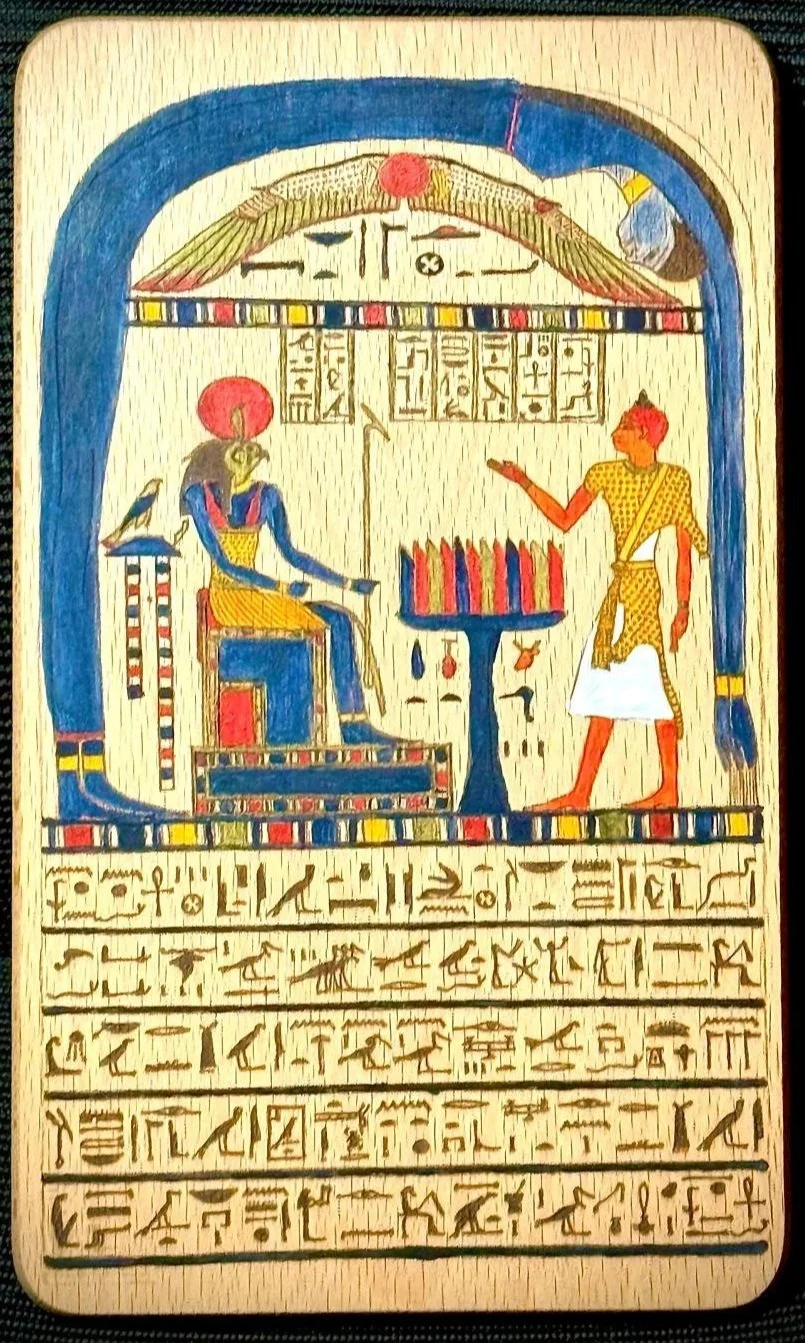
Stele of Ankh-ef-en-Khonsu painted by me
What stayed with me most while working through Egypt was how fundamentally different its assumptions about the self are from ours. Modern thinking tends to reduce. We break the human being down into neurons, chemical signals, optimisation problems, productivity curves. Useful abstractions, but they often leave the inner life strangely hollow. The self becomes something thin and isolated, sealed off from the world that shaped it.
Egypt assumed the opposite. A person was plural from the start. Layered and in motion. Not fragmented because something went wrong, but composed that way by default. Consciousness was not treated as a single flame burning inside the skull, but as a system that needed care, balance, and constant negotiation. You were never meant to be one thing. You were meant to hold tension between parts. Maybe you even were this tension.
That difference becomes especially visible in how Egyptians thought about death. Death was not a termination, but a transformation. Mummification, tomb rituals, spells, offerings, the long and dangerous journey through the Duat. All of this was less about preserving flesh and more about preserving structure. About giving the different parts of a person the conditions they needed to reunite and stabilise. Death was a psychological process. A test of integration.
This is where my own question about the divine spark keeps resurfacing. Not as something mystical, but as the moment awareness becomes self-referential. The moment parts of the self recognise one another and begin to coordinate. The Egyptians did not assume this integration would simply happen. Life was preparation and death was its continuation. Coherence had to be earned.
One thing that struck me again and again as I read these stories was how they treat power itself. In many mythic traditions, power is physical (think Hercules). Strength, Victory, Domination. Egyptian myth does not work that way. The figures at the centre are rarely warriors. They are readers of spells and keepers of names. Figures who understand forces that are invisible to others.
In the cycle of stories around Setne and the Book of Thoth, the tension is not about defeating an enemy. It is about whether forbidden knowledge should be taken at all. The entire drama turns on the consequences of understanding too much, too fast. Egyptian heroes were magicians rather than fighters, and deities like Isis and Thoth derive their authority not from violence, but from mastery of words, rites, and hidden structures.
Isis is not simply a nurturing figure. She restores Osiris through magic and protects the dead through knowledge. The Book of the Dead is less a continuous story than a collection of spells, where survival depends on speaking the right words at the right time. In Spell 125, it is Thoth who records the weighing of the heart, not a vengeful judge, but a god of writing and memory.
This reveals something about how a civilisation so preoccupied with death understood agency. Survival was not a matter of force but of orientation. What truly counted was the mind’s clarity, the power of the name, and the understanding of how and when to speak. Strength without wisdom had no meaning.
This idea leads naturally to Heka and Ma’at. Magic and order were not supernatural embellishments but practical principles for maintaining coherence in a world always on the verge of fragmentation. Myths were not simply told for amusement; they served as instruction, guiding people in how to navigate both inner and outer chaos.
In that sense, Egypt offers a counterpoint to our atomised modern selfhood. Instead of asking how to optimise the individual, it asks how to integrate the parts. Instead of denying death, it uses it as a lens. Instead of reducing consciousness to a by-product, it treats it as something to be assembled, protected, and guided.
This circles back to the idea of self-steering destiny I mentioned earlier. The Egyptians did not believe fate was fixed, but they recognised that every action carried weight. One could not escape consequence, but one could prepare for it. You could align yourself. You could learn the names of the forces you were dealing with.
Maybe that is why these ideas still resonate. Not because they are ancient, but because they refuse to flatten what it means to be human.
And this is why I believe at least some of those pieces still fit.
— Transmission Sent —
Reference materials
The Egyptian Book of the Dead
Egyptian Mythology: A Guide to the Gods, Goddesses, and Traditions of Ancient Egypt , Geraldine Pinch
The Temple Of Set: Dr. Michael Aquino
The Search for God in Ancient Egypt: Jan Assmann
On the process
After finishing my research and writing a first draft, I let an AI interview me about what I had just worked through. Not to generate content, but to ask questions. It pushed on assumptions, asked for clarifications, and reflected patterns back at me that I hadn’t consciously noticed while writing. What you’re reading now is the result of that dialogue.