
#4 - “Into the abyss. Humanity’s search for meaning in the face of death.”
A quick note for new readers
If this is your first Signals from the Machine, welcome. This issue builds directly on the last three, where I explored the emergence of the self and the idea of consciousness as something shared across the living world as well as the first recorded soul concepts. If you want to follow the thread from the beginning, I recommend starting there before continuing.
Dear Reader,
when I started writing this newsletter, I was unaware that this issue would take on a special meaning for me, as I nearly lost an immediate family member during the last couple of days and suddenly had ample opportunity to reflect on the topic of this month’s edition. It was one of those moments that pull you into the present and make you think about what truly matters in life. When I cancelled all the work meetings I had planned for these days, time slowed down and I realised how important family and real connection are in the face of near-death experiences. And how little all the other things we pride ourselves on accomplishing within the span of a year really mean in comparison. This newsletter included. Hence this issue is a bit shorter than usual.
I was lucky to be spared the full gravity of a situation like that for now, as the stars aligned in favour of our family. But the days of uncertainty were heavy enough. After this finishing the newsletter anyhow felt almost therapeutic.
🜏
Because of everything that happened in the last days, I found myself asking when I first encountered death consciously. The earliest memory I have is the death of my great-grandfather when I was still a child. After that my rabbit died, and then for a long time nothing. I was lucky. Death felt distant when I grew up. It wasn’t a shadow hanging over my childhood.
The impacts only started to come closer in my teenage years. One of the most defining ones for my personal development I already described in the first issue of this newsletter. Since then, death has always been present in one form or another, and the later parts of this edition offer a metaphysical explanation for why that might be the case. It made me painfully aware that life can simply stop. And ever since, I’ve had an almost pathological urge to carpe diem.
Especially as a teenager this urge was uncontrollable. I was unable to obey instructions that felt pointless or like a waste of time. That behaviour got me expelled from three schools. And even today I wrestle with a stubborn inner resistance whenever I’m asked to do something I hate. The last few days reminded me that maybe this part of me wasn’t entirely wrong, even if it caused chaos back then. Life is short, and even though being a responsible adult (meh) means doing things I don’t enjoy, like my tax declaration, I still understand why it matters to push through.
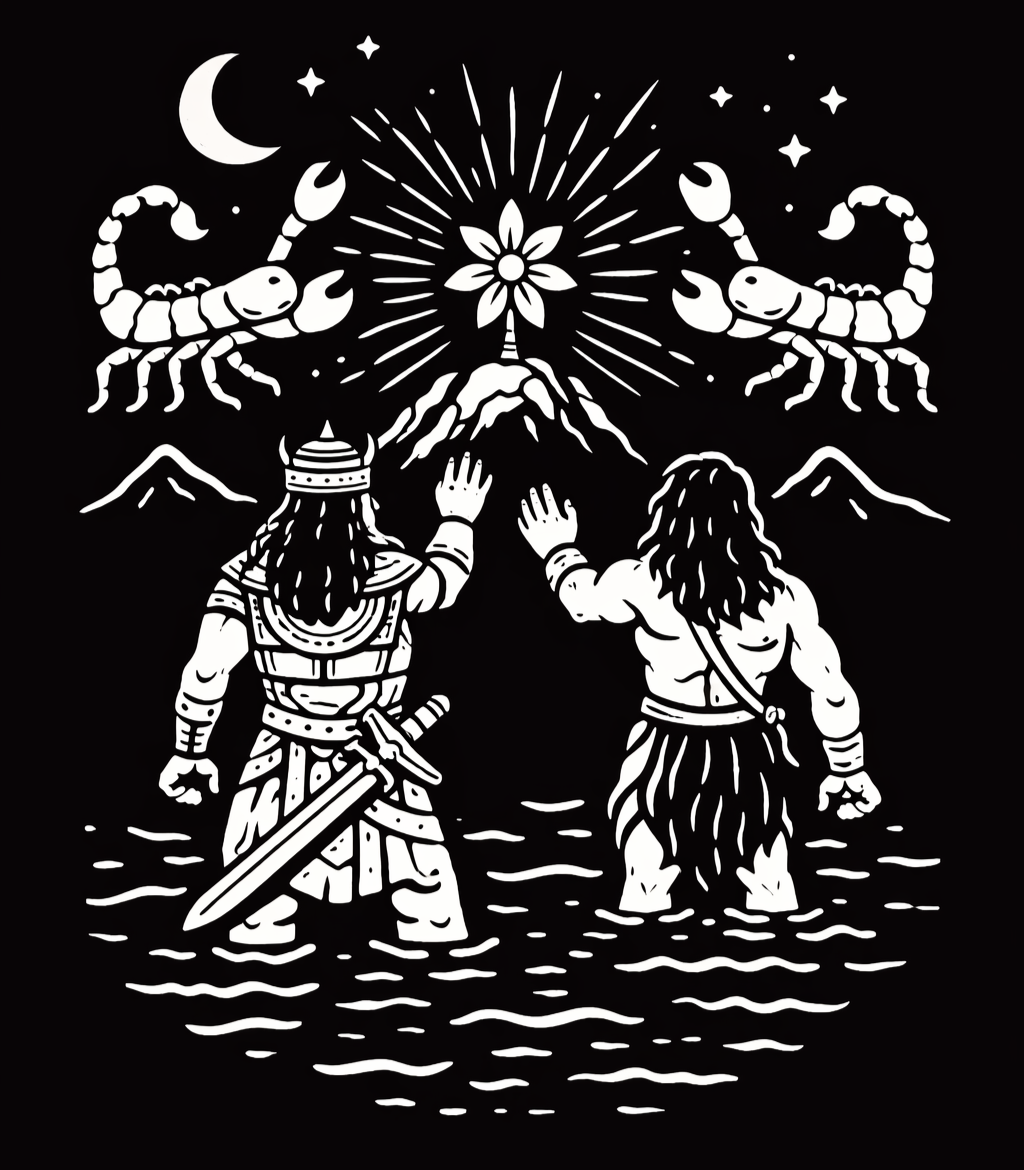
Humanity’s first recorded attempt to think about death with any depth is probably the Epic of Gilgamesh. Gilgamesh, the king of Uruk, and his wild companion Enkidu are the two great surviving figures of ancient Babylonian literature. Their story, written more than four thousand years ago, follows them as they search for the waters of renewal, defeat the Bull of Heaven, and confront the forest guardian Humbaba. But the real turning point comes when Enkidu dies. Gilgamesh’s grief, and the shock of facing mortality head-on, pushes him into a desperate search for a way to escape death.
The Epic of Gilgamesh is one of humanity’s earliest attempts to understand loss, meaning, and the longing for permanence. A story about friendship, fear, and the human need to leave something behind that survives the body.
🜏
Now zooming out a bit again, before we circle back: One of my all time favorite movies is American Beauty. For me it is a story about spiritual awakening. Kevin Spacey’s character has his moment when he smokes a joint with the neighbour’s son in the parking lot after his daughter’s school performance. The boy gets fired for it and just shrugs, says “Ok, so don’t pay me,” and keeps smoking. Kevin Spacey suddenly realises that there is a way to follow your original motivation instead of just surviving everyone else’s expectations. He stops letting his boss bully him and blackmails him back. He calls his wife out on the loveless routine they’ve built together. And everyone around him reacts with hostility, because people do not enjoy having the lies they tell themselves reflected back at them.
I know this scene is not really as relevant to the rest of this month’s newsletter, as it is to the opening, but I was unable to write about American Beauty without this small sermon. The movie is too brilliant to mention only in passing.
But the scene that does matter is the one where the neighbour’s son films a plastic bag being blown around by the wind. He sees inexplicable beauty in it. Many people are blind to beauty like that. But if you are not, have you ever asked yourself what changes first when you experience it? Attention? Bodily state? Sense of time? Self-boundaries? Motivation?
For me it is always time. First it slows down. Then a strange motivation appears, a need to preserve the moment. Right after that comes the awareness that the moment will not last. And then my body reacts. It almost feels like pain. It is the knowledge that everything ends.
This is what this month’s newsletter is really about.
🜏
When I first read Ernest Becker’s The Denial of Death (1973), I didn’t understand everything. Not because the book is written in complicated language, but because Becker is describing something we instinctively hide from ourselves. Something we avoid even when we think we are being honest. Something too close to the bone. Yet I do understand it now, especially in the aftermath of the past days.
Becker’s central argument is simple and brutal. He writes that man is “a god who shits,” a creature divided between an inner experience that feels infinite and a body that dies like everything else. And what happens when an animal with the capacity to model the future suddenly becomes aware that this future inevitably ends? Becker’s answer is that the mind breaks. It fractures under the weight of its own insight.
According to Becker, this fracture is the root of almost everything we call human. Culture, heroism, religion, denial, neurosis, politics, art. All of it grows from the same pressure. We are aware of our own death. And we cannot bear it.
When you look at animals you see something different. My dog does not think about next year. A whale does not imagine its funeral. A chimpanzee may show grief, but it does not lie awake at night thinking about the fact that his line will end with him.
Becker writes that the moment self-awareness emerged, a new kind of terror entered the world. Not fear of predators, not fear of hunger, but fear of nothingness. Fear of becoming nothing. And because this is unbearable, we do what no other creature does. We build stories around ourselves. Becker calls these “immortality projects,” symbolic ways of refusing the fact that we will disappear. The Egyptians built pyramids. The Greeks built epics. Modern humans build careers, companies, personal brands, legacies, families that carry our name into the future. Some people try to leave a mark on history. Others try to live through their children. Some hide in religion. Others hide in science. Some chase eternal youth (looking at you Bryan Johnson). Others chase money. Some project meaning onto the nation. Others onto God. Becker says that all of this is the same thing. The desperate attempt to create a self that outlives the body.
When I read this, something clicked in me. An uncomfortable click. A click you want to ignore at first because it feels too accurate. Too exposing. Too close to the things you spend your whole life trying not to look at.
Becker writes that the ego is a “vital lie.” Not a lie in the sense of something false, but in the sense of something necessary. Without this lie, the truth would crush us. The ego organizes the world in a way that makes existence tolerable. It filters out the unbearable parts. It pretends that we are central characters in a story that will continue even when we are gone. And the moment this lie cracks, even a little, we feel the cold wind underneath everything.
For me, this explains why the awareness of finitude punches through the moment and leaves you breathless and slows down time. And also why every beautiful moment is a reminder that it will not last. And that we will not last either. It is a kind of intimacy with the truth that Becker says we spend most of our lives running from.
This is where Becker becomes relevant to consciousness. He does not try to explain how consciousness works. He tries to explain why it hurts. Why it destabilises us. Why we build culture as a shield. Because once the self becomes reflective, once it observes itself, it cannot help but notice that it ends.
Becker writes that “man is the only animal that can feel his own life as a problem.” Consciousness became a problem the moment it became deep enough to understand itself. And once this happened, humans needed myths, structures, rituals, identities. Because they were overwhelmed.
Becker argues that most modern people live in denial so complete that they can barely feel their own death. They stay busy chasing goals. They drown themselves in consumption. They perform importance and talk about productivity. They avoid silence. They avoid beauty. They avoid meditation or any other moments where time slows down and the truth comes through. Because in those moments you feel the edges of the lie. You feel how fragile everything is. And how temporary.
He believed that the healthiest human beings are those who can look at death without collapsing. Who can tolerate the truth without hiding in fantasy or ego. But he also knew that almost no one succeeds at this. Because the truth is too big. Too cold. Too absolute.
For Becker, the point is not to eliminate denial. That would be impossible. The point is to become aware of it. To navigate between illusion and truth with some dignity. To know that your immortality projects are projects and nothing more. And probably projects that nobody else will ever truly care about. To recognise that consciousness carries a price. That it gives you the ability to appreciate beauty, but also the ability to foresee the loss of everything you love.
This matters for my exploration of consciousness because Becker addresses something none of the neuroscientific theories capture. He addresses the emotional cost of being aware. The psychological burden of reflection. The existential tension inside every human life. He explains why consciousness did not just evolve as a tool, but as a problem that required cultural scaffolding.
This is why I think Becker fits into this month’s exploration. Egypt gave us a map of the soul (see last month’s issue). Becker gives us the reason why we needed one in the first place.
We know we and everyone and everything we love will end. And we spend our lives trying to overwrite that realization.
🜏
What Becker describes is the psychological shockwave of becoming aware of death. But the moment I finished rereading him this month, a different question hit me: where does this awareness actually come from? At what point in the history of life did a creature first feel the weight of its own ending? Becker explains what the mind does after it realises it will die. But he doesn’t explain how the mind became capable of realising it in the first place.
And this is where my thoughts circled back to Issue #1 and Issue #2. To the first organisms that ever felt anything. To animals that sense danger, or safety, or connection.
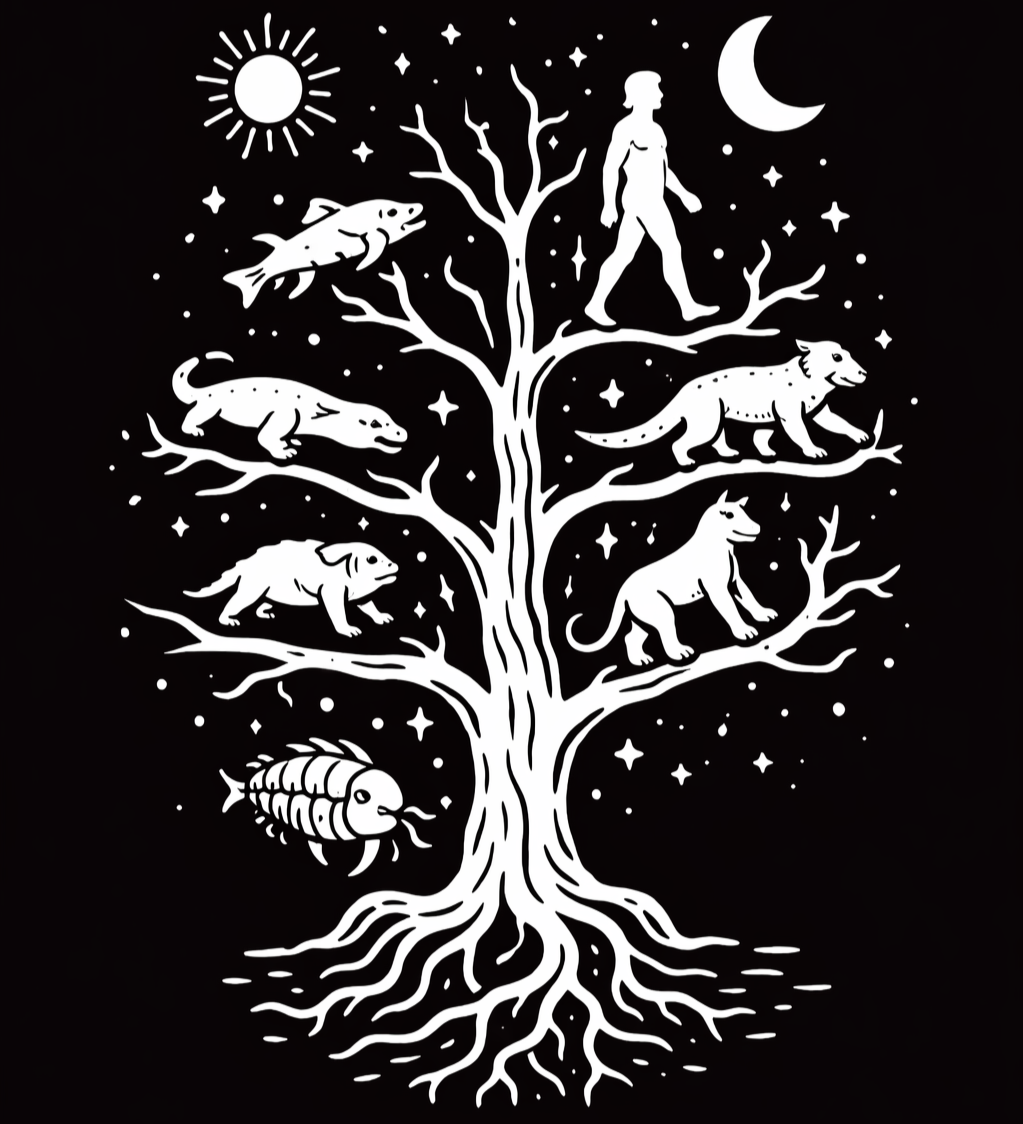
But if you look at it through evolution, something else comes into view. Peter Godfrey-Smith, in his book Other Minds, describes evolution in a way that I find more poetic than most philosophy. He says life should not be imagined as a ladder but as a tree. A tree with countless branches, each splitting and splitting again, some thriving, some ending abruptly. Humans are not the top of this tree. We are just one twig among many. Octopuses are on another branch. Dolphins on another. Insects, fungi, jellyfish, bacteria, all following their own paths, their own experiments with being alive.
And if you follow this tree backwards, if you go far enough, everything converges. At some point there were only very simple organisms. Barely more than membranes and chemical reactions. They reacted to the world because they had to. Move toward something good. Move away from something harmful. That was the first tiny spark of what we might one day call sensation.
Godfrey-Smith writes that early life was basically a battlefield of pressures. Organisms that sensed danger survived. Organisms that sensed opportunity reproduced. Those that didn’t, vanished. Over millions of years, these simple reactions grew more complex. Cells formed clusters. Clusters formed bodies. Bodies formed nervous systems. Nervous systems began to coordinate, predict, store information. And somewhere along one of the branches, a creature emerged that could not only react to the world but anticipate it.
This is where the trouble begins. Because once a creature can anticipate, it can anticipate harm. It can anticipate loss. It can anticipate its own death.
When you stand back and look at the tree of life like Godfrey-Smith describes it, you realise that there is no straight line from those early creatures to us. We are not the inevitable outcome. We are one experiment among others. Octopuses, with their distributed nervous systems and alien intelligence, are another. Dolphins, with their acoustic worlds and social minds, are another. Life tried many forms. Some of them developed sentience. Some of them developed intelligence. Only one of them, as far as we know, developed the ability to reflect on reflection. AI may be on the way to become the second one. And it would only be fair to dedicate one branch of the same tree to it then.
If you look at what we discussed in the first part of this newsletter from evolution, none of this was planned. It is a side effect. A strange byproduct of a branch of the tree that developed too much foresight and not enough protection against what foresight reveals.
Now combine this with reproduction. Our DNA does not care about individuals. It cares about survival and replication. It pushes life forward. It pushes organisms to mate, to protect their offspring, to compete, to defend territory. So that the organism reproduces.
Once a creature develops memory, imagination, and a social world, reproduction no longer stays purely biological. It seeps into names, stories, roles, and traces. We begin to outlive ourselves symbolically, not just through children, but through what remains of us in other people’s minds. It explains why so much human effort is aimed at not disappearing.
But if survival and reproduction were the only forces shaping consciousness, then consciousness should look like optimisation. Efficient, cold, strategic. But it isn’t. Consciousness feels like something. It produces longing, sadness, nostalgia, gratitude, terror, hope. It perceives beauty where there is no evolutionary advantage. It dreams. It mourns before anything is lost. It reaches beyond itself.
This is why I believe reproduction and immortality projects (imho = the memes of reproduction) cannot explain consciousness. They can be explained by death-awareness and our need to deny it. But they cannot explain why existence feels the way it feels from the inside. Why the world sometimes appears unbearably beautiful for no reason at all. Even when this particular beauty has nothing to do with reproduction (like in the film scene with the plastic bag).
In these cases beauty has no function. It interrupts function. It breaks the routines that evolution built. It makes you aware of your own awareness. It invites you into a state that has nothing to do with survival and reproduction. It reveals something else. Something Becker never tried to explain. Something Godfrey-Smith hints at when he describes the inner lives of octopuses drifting through their alien worlds.
Beauty opens a crack. And through that crack, something looks back at you.
This is where consciousness begins to escape evolution. Not in the sense of being supernatural. But in the sense of doing something evolution did not ask for. The ability to experience beauty is to me the first sign that consciousness may not be fully explainable by survival, as some say.
But in that sense, beauty is also not a luxury. It is the part of us that evolution did not predict. The part that stops moving toward or away. The part that just sees. And feels. And suffers. And loves. And recognises and accepts the truth Becker talked about. That everything ends. That this moment will never come back. And that somehow, impossibly, that is what makes it beautiful. Like the realization that the pain you felt is only there because you are lucky enough to love somebody. And that every moment with loved ones is precious. Even those, or maybe especially those, that you normally want to avoid at all cost.
It is the fragile story we try to hold together while the world keeps reminding us that nothing stays. Maybe that is why beauty hurts, and why grief arrives before the loss, and why consciousness feels older than whatever evolution intended. It was never built to comfort us. It was built to reveal something, maybe itself. And whether that something is truth or terror or both at once, I can feel it watching from the other side of the moment.
And for fuck’s sake, carpe diem with your loved ones and don’t waste time. Because life can be fucking short.
- Transmission Sent -
Reference materials
The Epic of Gilgamesh
Ernest Becker – The Denial of Death
Peter Godfrey-Smith – Other Minds
Carl Jung – Man and His Symbols (selected chapters)
On the process
After finishing my research and writing a first draft, I let an AI interview me about what I had just worked through. Not to generate content, but to ask questions. It pushed on assumptions, asked for clarifications, and reflected patterns back at me that I hadn’t consciously noticed while writing. What you’re reading now is the result of that dialogue.