
#5 - “The Practice of Consciousness.”
Dear Reader,
Brace yourself for a rough ride this month. I’m trying to connect dots that may or may not be connectable, drawn from a reading list that spans almost 2500 years.
Last month’s edition ended with the ability to perceive beauty. I said that since the perception of beauty can sometimes appear independent of any evolutionary or reproductive function, it might be a hint that the mind doing the perceiving cannot be explained solely as a survival mechanism.
I wanted to take a closer look at that thought and started researching what beauty actually is. And somewhere along the way this month, I have to admit, I got a bit sidetracked. But in the end, at least for me, it all seemed to come together. Let’s find out together whether I’m completely bonkers or not.
🜏
I wanted to do a double click at reading about beauty and immediately landed at Plato and his theory of Forms. His idea is that the real world is not the one we see. True reality consists of abstract, eternal, unchanging concepts that exist in a realm beyond the physical. Everything we encounter here is just an imperfect, flickering copy of those originals.
The Form of Beauty exists independently of any specific shape or color. The Form of Justice exists beyond any court, any law, any person. And above all other Forms stands the Form of the Good. In Plato’s Republic, Socrates calls it the highest insight a human soul can pursue.
Plato scholars say his theory of Forms answers three of humanity’s core questions.
Ontologically, it gives an account of being itself. The Form of the Good is not an idea in our minds but a force that exists on its own, independent of us. It is always there. It is the source from which everything meaningful flows and the thing our souls can participate in if we open ourselves to it.
Epistemologically, the Forms make knowledge possible. They give us a fixed point from which we can distinguish truth from opinion.
And ethically, Plato says that only the Forms of the Good, the True, and the Beautiful should guide the soul if one wants to reach clarity and live well.
Applied to beauty, this means beauty is not in objects but in the soul’s ability to touch something universal. When you experience beauty, you are not responding to a nice shape. You are, for a moment, in contact with something that does not move.
Plato believed that the soul belongs to the invisible realm. And invisible things, unlike physical objects, do not decay. Bodies change. They grow old and they break down and eventually they rot. But invisible things, Plato says, remain what they are. From this he concluded that the soul must be immortal. It does not age like a body does.
Everything in existence can be divided into things that move themselves and things that must be moved. A stone rolls only when something pushes it. Bodies, too, need causes to act. But the soul, for Plato, is self-moving. It is the thing that initiates motion. And whatever initiates its own motion, Plato argues, cannot die.
Beauty, then, is not a property of the world. It is a sign that our soul belongs somewhere else. It is a moment in which the visible briefly reveals the invisible behind it.
🜏
Two concepts kept appearing here and there in my research this month: Logos and Nous. They come from early Greek thinkers long before Plato, but he used them in a way that fit his view of how the mind reaches truth.
Logos is the part of us that looks for structure. The part that tries to make sense of the world instead of drowning in impressions. Nous is something quieter than reason. It is closer to the moment where you understand something before you can explain why. Plato seems to think the mind works in layers, perception at the bottom, reason above it, and somewhere beyond that, a kind of knowing that no longer needs to argue its case.
Because when I look at how I actually navigate the world, especially online, I often get stuck in the lowest layer. Doomscrolling. Reacting to heat instead of insight. Consuming shadows and thinking they tell me something about reality. The opposite of what I claim to be exploring.
Which brought me to the cave.
🜏
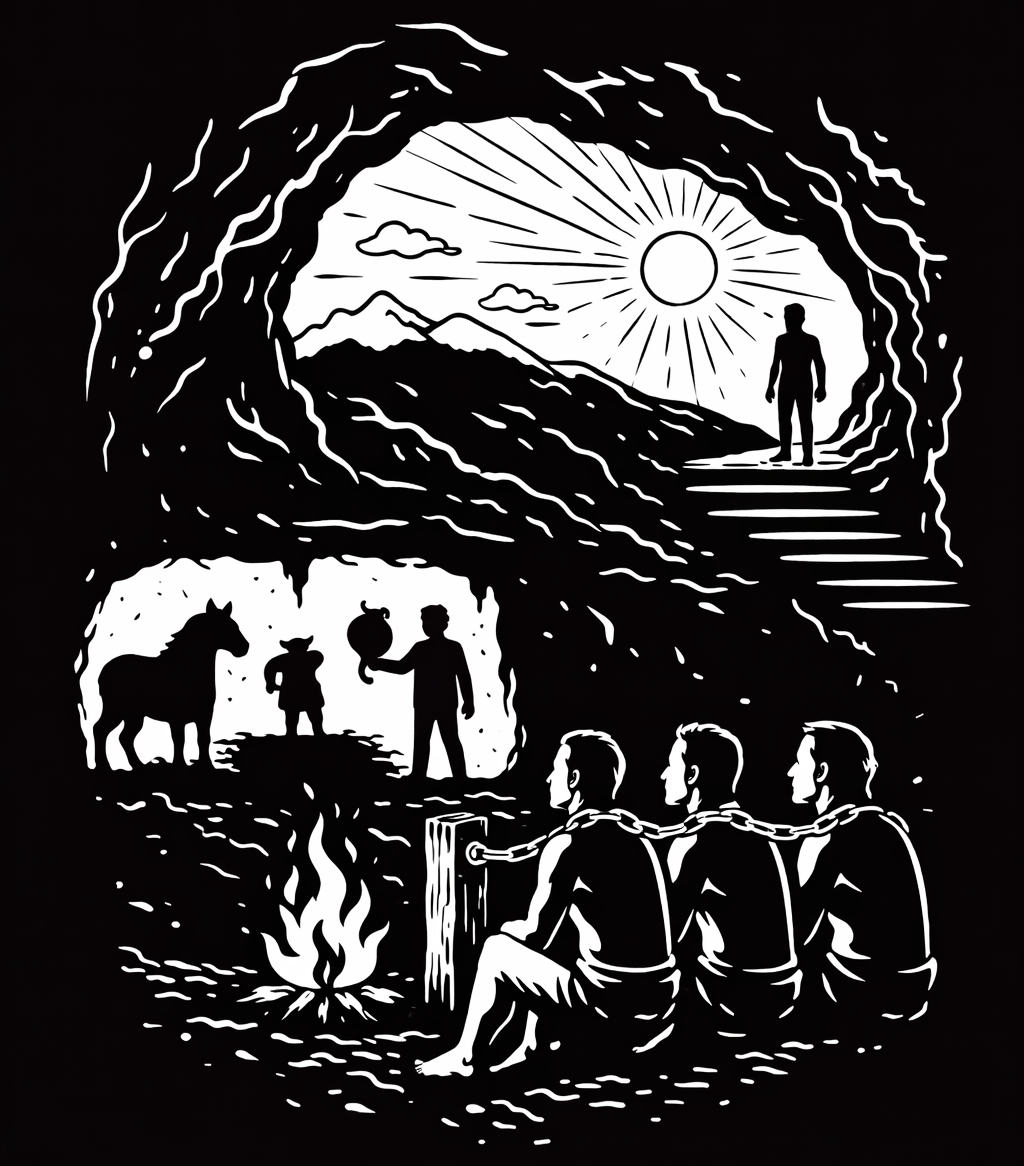
Plato’s allegory of the cave describes a group of prisoners who have been chained inside a cave since birth. They cannot turn their heads. All they see are shadows cast on a wall in front of them, projected by objects passing in front of a fire behind them. The shadows are all they know. They name them, argue about them, take them seriously.
Once a prisoner is freed. At first, the light outside the cave blinds him. The world feels hostile and disorienting. But gradually he begins to see actual objects, then the sun itself, and understands that what he once believed to be reality was only a projection. When he returns to the cave to tell the others, they reject him. They prefer the shadows. They even consider killing him for disturbing their certainty.
When I read this, I felt caught. Not because I think I see clearly. I don’t. I realised how easily I consume shadows every day. Doomscrolling through reddit debates about the rise of authoritarinism, rage cycles, and algorithmically amplified narratives for something like truth. The cave is not a metaphor. It is our feed. And I am often sitting comfortably inside it, convinced I am informed, while staring at moving silhouettes.
The uncomfortable part of the allegory is not the prisoners. It is the light. Because stepping outside does not feel triumphant. It feels destabilising. It means questioning the frameworks that make you feel morally certain. It means admitting that what you passionately defend might be shaped by shadows you did not even choose to watch.
🜏
A book that got me reflecting on my own views like a bulldozer, probably unlike any other book I have read in the last couple of years, is The King in Orange by John Michael Greer. It discusses why Donald Trump’s first and second presidency were possible in the first place. And oh boy did I feel caught again. But before we dive into that, I want to circle back to Plato, his idea of justice, and his thoughts on the state.
For Plato, justice was not a legal concept or a matter of punishment, but a state of inner order. A harmony between the different parts of the soul. And he mirrored this structure in the way he imagined an ideal society. The same way a healthy soul has reason, spirit, and desire in balance, a healthy state has different groups working together without one overpowering the others. Justice, for him, is something like alignment. When each part does what it is meant to do, without trying to dominate everything else.
He saw injustice as a form of inner distortion. A soul pulled out of shape. A society ruled by appetite or anger rather than clarity. And this matters for consciousness, because Plato believed that only a just soul can see the Good. Only a mind that has found some kind of inner order can recognise truth instead of falling for shadows.
Plato was obsessed with the question of what happens when people lose the ability to see reality clearly. When the soul gets overwhelmed by its lower impulses. When public life becomes a theatre of projections and fears. He believed that a society drifts into confusion when its citizens drift into confusion. That politics is downstream from the state of the soul.
Which, of course, leads straight into the uncomfortable territory raised by the book I mentioned.
🜏
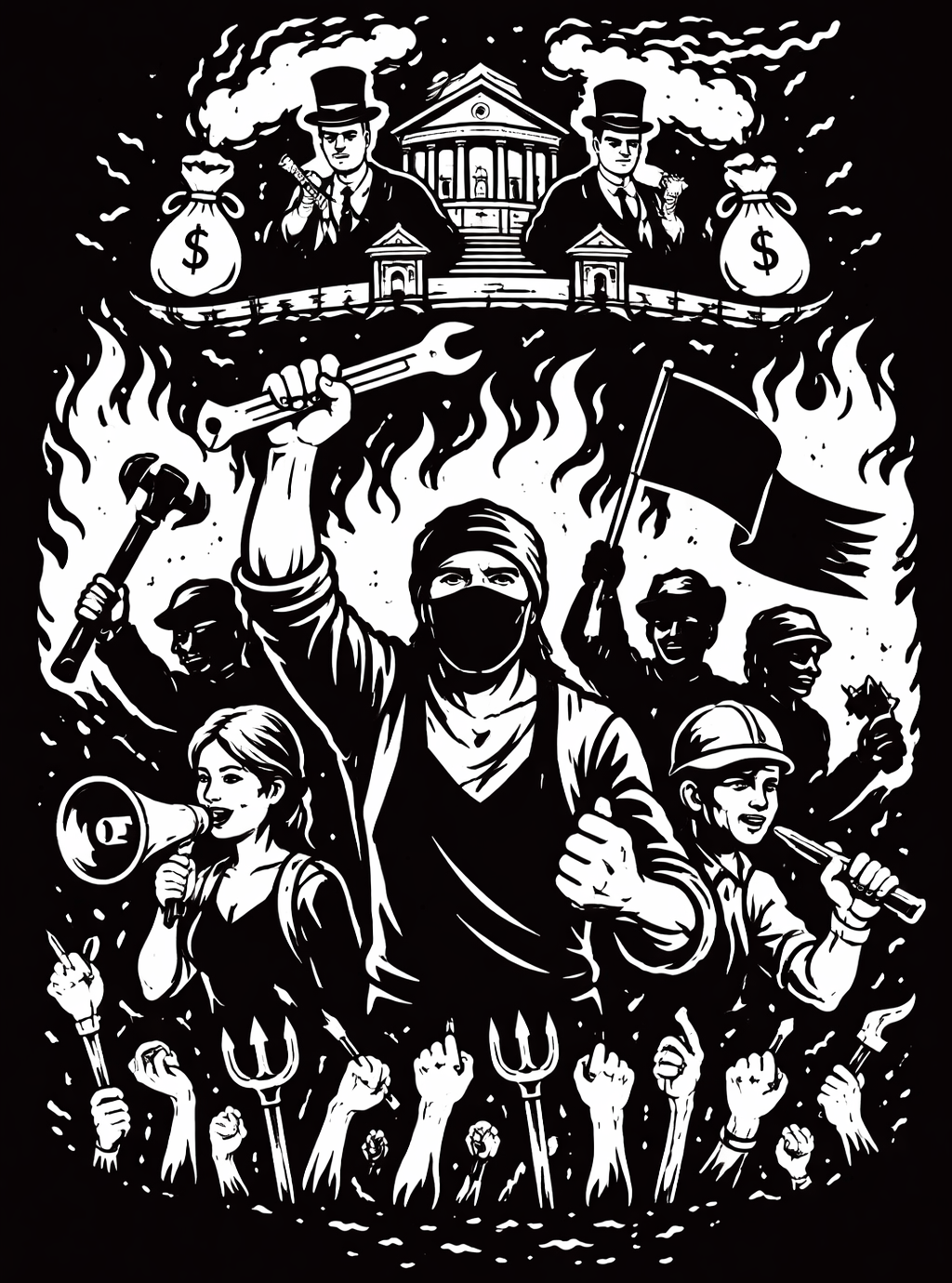
The King in Orange is about class. Not the cultural kind where people sort themselves by taste or lifestyle, but the economic kind that has been quietly reshaping Western societies for fifty years. Greer argues that Western societies are not just split politically, but by four distinct classes with different interests, different fears, and almost no shared language.
At the bottom is what he calls the welfare class and the wage class. People who work for hourly pay, who cannot outsource childcare or legal help or tax advice, whose lives are shaped by rising rent, rising debt, and a sense that the ground is slowly giving way under their feet. Above them sits the salary class. The people who run institutions, manage systems, and move abstract information. Lawyers like myself, consultants, journalists, professors, HR departments, policy makers, the people who shape narratives and write the rules. And above both, floating in its own orbit, is the investor class, which controls capital and doesn’t participate in day-to-day reality in the same way at all.
Greer’s argument is uncomfortable because it reframes recent political upheavals as something far less dramatic and far more predictable. The wage class has been losing ground for decades. Jobs replaced, towns hollowed out, security eroded, costs rising faster than any raises. And when they raise concerns, what comes back is a lecture. Or an accusation. Or that particular tone of contempt that thinks it’s being smart.
The moment Greer describes again and again is the moment when someone from the wage class expresses fear about the future and is immediately told that the fear is illegitimate, uninformed, or immoral. Concerns about jobs become accusations of ignorance. Concerns about safety become accusations of bigotry. Concerns about war become accusations of conspiracy. Some of these accusations are justified, of course. Racism exists. Xenophobia exists. But Greer’s point is that these labels were applied so broadly, so reflexively, that they stopped mapping onto reality. They became a way for the upper classes to maintain the illusion of moral superiority instead of addressing the material problems they helped create.
And in this dynamic, something predictable happened. A large group of people who felt ignored, mocked, or talked down to started to look for someone who would at least acknowledge their existence. Not solve everything. Just acknowledge the pain and insecurity. The fear that their children might end up poorer, less safe, or even sent to fight and die in wars for the same people who dismiss them. It is not hard to see how this creates fertile ground for someone like Trump. Or for figures in Europe who play similar roles like Le Pen, AfD and the likes. Not because their voters are all racists or idiots. But because they feel that their concerns are being treated as moral defects rather than real problems.
Greer describes this as the core blind spot of the salary class. The assumption that their worldview is not a worldview at all, but simply how things are. And because it feels rational to them, anyone who disagrees must be either malicious or stupid. Once this logic takes hold, dialogue becomes impossible. The distance and contempt grows. And eventually the wage class does the only thing left to them: they use their vote to punish the people who ignore them.
It made me question reflexes I didn’t know I had. It asks the uncomfortable question of what happens when a society convinces itself that only one group has access to truth, and all other perspectives are distortions. Greer does not excuse the darker elements within any political movement. He simply insists on seeing the full picture. And the picture he paints is one where class resentment has been simmering for years, wrapped in layers of moral language until no one could recognise it anymore.
Greer stops analysing politics at that point. He starts analysing you. It forced me to ask what I might have overlooked. What I might have dismissed too quickly. What fears I have misread as hatred. What people I have reduced to shadows instead of trying to understand the shape behind them.
🜏
Plato believed the soul is immortal. But not the way we use that word. He didn’t mean everyone gets to last forever. He meant the soul belongs to something eternal, but only if it moves toward it. Immortality is a direction, not a reward. The soul belongs to the realm of the eternal, but whether it actually reaches anything resembling clarity depends on how it lives. A soul that never uses its capacities does not awaken. It just keeps circling, mistaking shadows for truth and noise for something worth listening to. Only a soul that engages itself, questions itself, and tries to see beyond its own habits can move closer to what he calls the Good.
Plato. The cave. My own doomscrolling. Greer’s class analysis. I didn’t plan for any of this to connect. But it did. And it all points at the same uncomfortable idea: consciousness is not just something we have. It is something we either cultivate or waste. When we fail to use it, the world shrinks. We see only our own projections. We moralise instead of understanding. We defend opinions we never examined. We slide into the lowest layer of perception without even noticing.
Plato would say that this is what keeps a soul from approaching anything eternal. It gets stuck in the realm of shadows, reacting rather than perceiving. But if the soul tries to orient itself upward, toward Logos, toward Nous, toward something less distorted, then something changes. Not the world. The world stays chaotic. But a soul that practices seeing differently does not stay the same. Consciousness grows by being exercised. It becomes what it practices. And this, I think, is the closest I came to an insight this month.
Beauty, politics, metaphysics, the fear of death - all of it circles around the same axis. The soul is not only something that thinks. It is something that tries. Something that reaches. Something that learns to use itself. And maybe consciousness did not arise to help us survive, or reproduce, or manage our fears. Maybe it arose because life occasionally produces something capable of going beyond what is necessary. Something that can stop and look at a plastic bag blowing in the wind and feel the weight of its own existence.
Whatever the reason, this month reminded me that consciousness is not passive. And the more we use it, the more alive it becomes.
- Transmission Sent -