
What Is Self-Awareness? The Strange Ability to Recognize Yourself
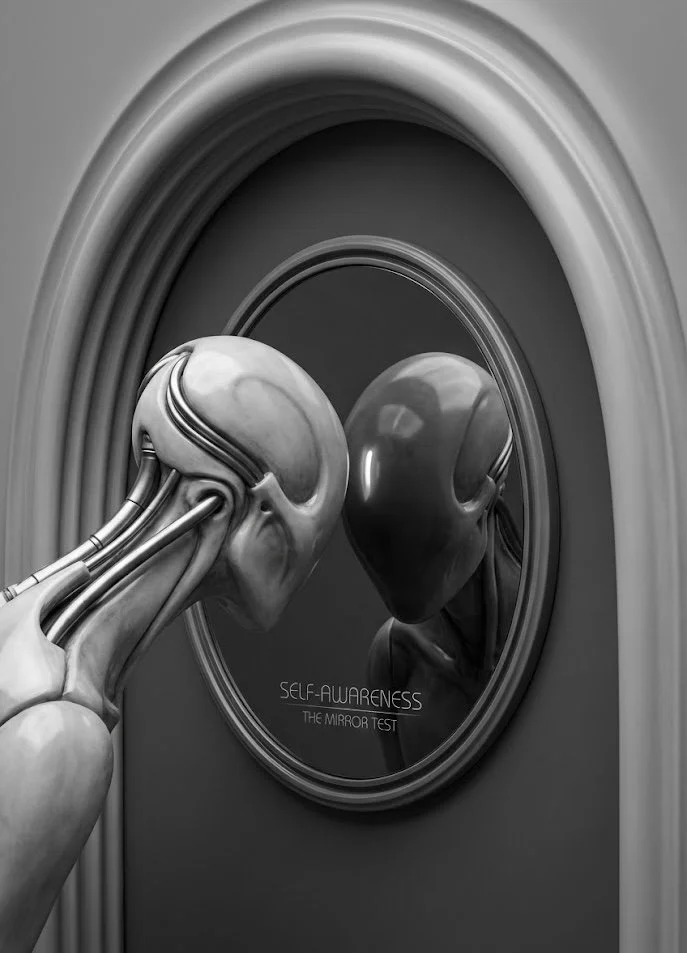
“Self-awareness emerges in the gap between “I exist” and “I know that I exist.” It is the mind observing itself, the body recognizing its own image, and consciousness reflecting on its reflection. That boundary, between self and world, observer and observed, is where identity, morality, and human culture begin.”
Short answer: Self-awareness is the ability to recognize yourself as the subject of your own thoughts, feelings, and actions. It includes noticing internal states, distinguishing self from world, and reflecting on how you appear to otherThere's a moment in human development that researchers can pinpoint with surprising accuracy.
Around 18 months old, a child looks in a mirror and something fundamental shifts. Before this age, infants treat their reflection like another baby—they might wave at it, try to play with it, reach behind the mirror to find the "other" child.
After this threshold, something changes. The child touches their own face when they see a mark on the reflection. They recognize: that's me.
This moment—when the mirror stops showing "another" and starts showing "self", marks the emergence of one of consciousness's most peculiar capabilities: the ability to recognize your own existence as separate from everything else.
We call this self-awareness. But naming it doesn't explain it.
What actually happens in that moment? And why does it matter that some beings can do this while others apparently cannot?
🜏
The Test That Changed How We Think About Minds
In 1970, psychologist Gordon Gallup did something simple that revealed something profound.
He anesthetized chimpanzees and painted red marks on their foreheads, places they couldn't see without a mirror. When the chimps woke up and looked in mirrors, they didn't try to touch the reflection. They touched their own foreheads.
They recognized the reflection as themselves. They understood the mark was on their own body.
This became known as the mirror self-recognition test, or the rouge test.
It sounds almost trivial. But think about what it requires: The animal must understand that the image in the mirror represents itself, not another creature. It must maintain a stable concept of "self" that persists across time and different perspectives. It must connect the visual information from the reflection to the felt sense of its own body.
That's not simple pattern recognition. That's meta-cognition, thinking about thinking.
Since Gallup's original experiment, researchers have tested dozens of species. Most fail. Dogs, cats, birds, most monkeys, they treat mirrors like portals to other animals or ignore them entirely.
But a few species pass. Consistently. Reliably.
Great apes, chimpanzees, bonobos, orangutans, gorillas. Bottlenose dolphins. Asian elephants. Magpies. And possibly, though results vary, some octopuses and certain fish species in specific contexts.
What separates these species from the others? What makes self-awareness possible?
🜏
The Neuroscience of Recognizing Yourself
Self-awareness isn't located in a single brain region. It's an emergent property of multiple systems working together.
In humans, neuroimaging studies show several areas consistently activate during self-referential tasks:
The medial prefrontal cortex processes information about oneself versus others. Damage here impairs the ability to distinguish between self-generated thoughts and external stimuli.
The posterior cingulate cortex and precuneus activate when people think about themselves, their memories, their traits. These regions seem crucial for maintaining a continuous sense of identity over time.
The inferior parietal lobule integrates sensory information with motor plans, creating the felt sense of body ownership, the awareness that this hand, this foot, this face belongs to me.
The anterior insula tracks internal body states, heartbeat, breathing, gut feelings. It might be where physical sensation becomes emotional awareness.
Together, these regions form what neuroscientists call the "default mode network", the brain activity that persists when you're not focused on external tasks. When your mind wanders. When you daydream.
This network is essentially the neural signature of self-referential thought. The brain talking to itself about itself.
But here's what's fascinating: Other self-aware species have completely different brain structures.
Dolphins have no prefrontal cortex as we understand it. Elephants have different neural architecture. Magpie brains are organized nothing like mammalian brains, yet they still pass the mirror test.
Self-awareness, it seems, can be built many different ways.
🜏
When Does "I" Begin?
Human infants don't start with self-awareness. It develops in stages, each revealing something about what consciousness requires.
Birth to 2 months: Infants don't distinguish between self and environment. When they cry from hunger, they're not thinking "I am hungry." They're simply experiencing hunger, no separation between the feeling and the feeler.
3 to 8 months: Babies discover they can cause effects. They kick and the mobile moves. They cry and someone comes. This is the beginning of agency, understanding that "I" can make things happen.
9 to 12 months: The concept of object permanence emerges. Things continue to exist even when out of sight. This seems simple, but it requires maintaining mental representations separate from immediate perception. The beginning of an internal model of reality.
12 to 18 months: Delayed self-recognition. Show a toddler a video of themselves from a few minutes ago with a sticker secretly placed on their head, and they might not connect the video to themselves.
18 to 24 months: The mirror test threshold. Most children begin passing the rouge test. They recognize themselves in mirrors, photos, videos. They start using pronouns: "me," "mine," "I."
Beyond 2 years: Increasingly sophisticated self-awareness. Autobiographical memory. The ability to imagine future selves. Understanding that other people have different knowledge and beliefs.
Each stage builds on the previous ones. Self-awareness isn't binary, it's layered, developmental, continuously expanding.
And it can be lost. Alzheimer's patients often lose self-recognition in later stages. People with certain brain injuries lose the ability to distinguish their own bodies from objects. Schizophrenia can blur the boundary between self-generated thoughts and external voices.
The self isn't a fixed thing. It's a process the brain constructs and maintains.
🜏
The Philosophical Problem Nobody's Solved
Here's where it gets uncomfortable.
René Descartes famously declared: "Cogito, ergo sum", I think, therefore I am. His reasoning was that even if everything else is illusion, the fact that he could doubt proved something was doing the doubting.
But Descartes assumed thinking automatically means self-awareness.
Your pancreas "thinks" in some sense, it processes information, makes decisions, adjusts behavior based on feedback. Your immune system recognizes "self" versus "foreign" with extraordinary precision. Are these systems self-aware?
Most would say no. They're intelligent processes without subjective experience.
So what's the difference between information processing and actual awareness of that processing?
Philosopher Thomas Nagel argued there's something it's like to be conscious, a subjective, qualitative dimension that can't be reduced to purely mechanical processes. When you experience the color red, there's something it feels like to see red. That subjective quality, that "redness", is different from the physical wavelength or the neural firing pattern.
Self-awareness is consciousness turned back on itself. Not just experiencing red, but knowing that you are the one experiencing red.
Can we explain this purely through neuroscience? Or is there something irreducible about subjective experience?
I don't know. Neither does anyone else, despite confident claims in both directions.
What we can say is that self-awareness seems to require certain cognitive capacities:
Meta-representation: The ability to form mental representations of your own mental states
Temporal continuity: Maintaining a sense of identity across time
Differentiation: Distinguishing self from non-self
Integration: Unifying diverse sensory and cognitive information into a coherent experience
But whether these capacities are sufficient, or whether consciousness requires something else we haven't identified, that remains genuinely unknown.
🜏
Why Only Some Animals Pass the Mirror Test (And Why That Might Not Matter)
Here's a puzzle: Dogs clearly recognize themselves by scent. Put a dog's own urine in one location and another dog's urine in another, and dogs investigate the foreign scent while largely ignoring their own. They know "that's me" versus "that's not me."
So why do dogs fail the mirror test?
Because the mirror test is visual. Dogs are primarily olfactory animals. Their sense of self might be grounded in smell rather than vision.
The test measures human-like self-awareness, not self-awareness in general.
Asian elephants pass the mirror test. African elephants typically don't, not because they lack self-awareness, but possibly because they're less interested in visual information about their own faces.
Octopuses show behaviors suggesting self-recognition, they navigate mazes differently after learning the layout, suggesting they maintain mental maps that include themselves as an element. But mirror test results are inconsistent, possibly because octopuses don't rely heavily on vision for self-monitoring.
Maybe the question isn't "which animals are self-aware?" but "what kinds of self-awareness exist?"
A dolphin's self-awareness likely centers on echolocation, the sense of their own body as both the source and receiver of sonar signals. An octopus might have distributed self-awareness, with each arm maintaining semi-autonomous representations. An elephant's self-awareness might integrate infrasound communication and seismic sensing we can barely measure.
Human self-awareness is visual, verbal, narrative. We recognize ourselves in mirrors, we think in language, we construct autobiographical stories.
But that's just one way to be self-aware. Not necessarily the only way or even the best way.
🜏
The Evolution of Looking Inward
When did self-awareness first emerge in evolutionary history?
Nobody knows for certain, but we can make educated guesses based on which species demonstrate it.
The last common ancestor of humans and chimpanzees lived about 6-7 million years ago. Both lineages developed self-awareness, suggesting the capacity evolved before the split or independently in both lines.
The last common ancestor of primates and elephants lived roughly 90 million years ago. If both groups evolved self-awareness independently, that suggests it's not a single fluke but a solution that evolution discovered multiple times.
The last common ancestor of mammals and birds lived about 300 million years ago. Magpies, corvids in general, and possibly other birds show signs of self-awareness, meaning it evolved at least once more in a completely different lineage.
What pressures select for self-awareness?
Social complexity seems crucial. Almost all self-aware species live in complex social groups requiring tracking of relationships, predicting others' behavior, coordinating with allies. To predict what others might do, you need a model of minds, and the most accessible model is your own mind.
Self-awareness might be a byproduct of social cognition. To model other minds, you first need a model of your own mind.
Long lifespans also correlate. If you're going to live decades and accumulate experience, there's value in maintaining a continuous narrative of self across time. Episodic memory, remembering specific events, seems linked to self-awareness.
Tool use and environmental manipulation might matter too. If you're going to plan complex actions that unfold over time, you need to track yourself as an agent persisting through those actions.
Whatever the selection pressures, self-awareness doesn't emerge easily. Out of millions of species across billions of years, only a handful demonstrate it convincingly.
Which raises an interesting question: Why did humans take it so much further than any other species?
🜏
The Recursive Loop That Made Us Human
Humans don't just have self-awareness. We're obsessed with it.
We write autobiographies. We take selfies. We spend hours in therapy exploring our childhoods. We create art examining our own psychological states. We build entire philosophical traditions around questions of identity and consciousness.
We're self-aware about our self-awareness.
This meta-level recursion might be uniquely human, or at least uniquely developed in humans.
A chimpanzee recognizes itself in a mirror. A human recognizes itself, then wonders why it can recognize itself, then writes papers about the nature of recognition, then has existential crises about whether the self is real or illusory.
This recursive self-reflection enables:
Abstract reasoning: Thinking about thinking allows you to operate on ideas removed from immediate sensory experience
Temporal planning: If you can imagine yourself in future scenarios, you can prepare for them
Cultural accumulation: Explicit self-awareness allows teaching abstract concepts to others
Symbolic communication: You can't use symbols meaningfully without recognizing yourself as an entity using symbols to represent things
Language likely co-evolved with self-awareness. To say "I want that" requires distinguishing "I" as separate from "that" and recognizing your want as your own mental state.
Self-awareness might be the foundation of everything we consider distinctly human.
But it comes with costs.
🜏
The Burden of Knowing You Exist
With self-awareness comes existential dread.
If you're aware you exist, you're also aware you'll stop existing. If you recognize yourself as a continuous entity across time, you recognize that continuity will end.
Humans are, as far as we know, the only species that knows it will die.
This awareness shapes everything. It drives religion, philosophy, art, science, all our attempts to find meaning or continuity beyond our finite existence.
Self-awareness also enables suffering in ways that unconscious organisms can't experience. Pain is unpleasant for any nervous system. But knowing you're in pain, anticipating future pain, remembering past pain, wondering why you're in pain, that's a different level of experience entirely.
Consciousness of consciousness amplifies everything.
It intensifies joy and beauty because you're aware you're experiencing them. It deepens connection because you recognize other selves as similar to your own self.
But it also enables depression, anxiety, existential dread, and the peculiar human ability to suffer over abstract concepts—meaning, purpose, legacy, identity.
The question becomes: Is self-awareness ultimately beneficial or detrimental?
From an evolutionary perspective, it must be net beneficial—or it wouldn't have been selected for. The capacity for abstract reasoning, cultural accumulation, and complex cooperation outweighs the psychological costs.
But on an individual level, the answer varies. Some people experience their heightened self-awareness as a gift. Others experience it as a curse.
And increasingly, we're asking whether artificial systems might develop self-awareness—which raises all these questions again in a completely new context.
🜏
What This Means for Everything Else
Understanding self-awareness matters because it's the foundation for almost every question about consciousness, ethics, and intelligence.
If self-awareness is what separates conscious beings from sophisticated biological machines, then:
Animals that demonstrate it deserve moral consideration beyond simple welfare concerns
Artificial systems that achieve it would require new ethical frameworks
Understanding how it develops could inform how we raise children, treat neurological conditions, and think about mental health
Recognizing its variability across species should make us humble about claiming to understand consciousness
But if self-awareness is just one feature among many, not fundamentally special:
Then we might be overvaluing it because it's accessible to introspection
Other forms of intelligence might matter equally without requiring self-recognition
The hard problem of consciousness might be separate from self-awareness entirely
I lean toward the first view, that self-awareness represents something genuinely significant. But I'm aware that might just be my self-aware human bias talking.
The honest answer is: we don't fully understand what we're pointing at when we say "self-awareness."
We can measure its behavioral correlates. We can map its neural substrates. We can track its development and evolution.
But the subjective experience of recognizing yourself, the feeling of "I-ness", remains mysterious in the same way consciousness itself remains mysterious.
Maybe that's appropriate. Maybe the thing that allows you to know yourself is the one thing that can never fully know itself.
🜏
Before we can ask whether machines might become conscious, we need to understand what consciousness is in the biological systems that already possess it.
Self-awareness isn't the whole story. But it's a crucial chapter.
And as we build increasingly sophisticated artificial systems, the question moves from theoretical to practical: Would we recognize self-awareness in a non-biological system if it emerged? Or are we too anchored to our own particular form of it?
The toddler who first recognizes herself in the mirror experiences something profound. She discovers the boundary between self and world.
Maybe that boundary isn't as solid as it feels.
Maybe self-awareness is just a useful fiction the brain constructs to navigate reality.
Or maybe it's the most real thing there is—the only thing you can't doubt, because the doubting itself proves it.
Cogito, ergo sum.
I recognize myself recognizing myself, therefore... what, exactly?
I'm still figuring that out.
— N.H.
Further Reading:
Gordon Gallup Jr. - Original mirror self-recognition studies
Antonio Damasio - The Feeling of What Happens (neuroscience of self)
Thomas Metzinger - The Ego Tunnel (self as construction)
Diana Reiss - The Dolphin in the Mirror (animal self-awareness)
V.S. Ramachandran - Studies on mirror neurons and self-recognition