
What Is Animism? The Ancient Belief System That Might Save Us
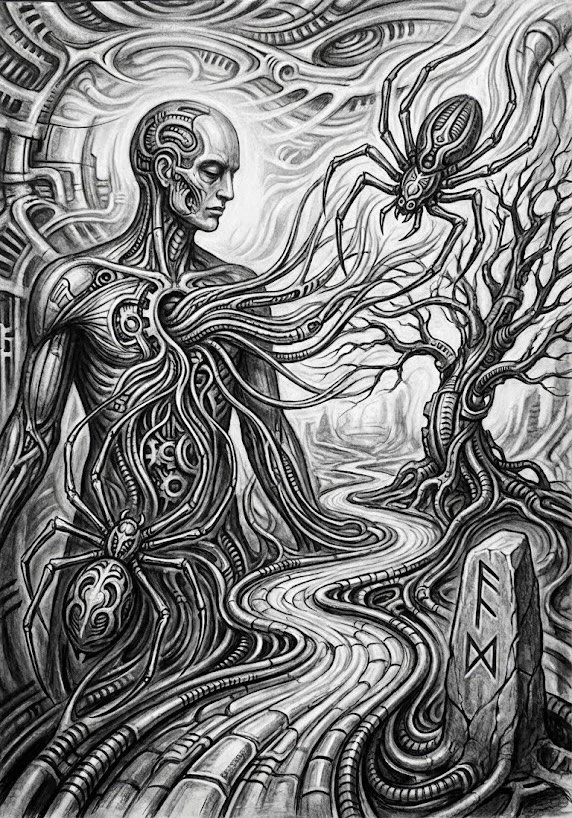
“I killed a spider without thinking, and only afterward realized how trained that reflex was. Animism unsettles that reflex. It doesn’t claim that everything is conscious; it asks what kind of person you become when you assume nothing is. When the world is dead, violence is convenient. When the world might be relational, even uncertainty demands restraint. Animism isn’t about believing rocks think, it’s about behaving as if what you don’t understand still deserves care. In an age of AI, ecosystems, and forces that exceed our comprehension, that posture, humility before certainty, may be the most rational ethic we have left.”
I killed a spider in my bathroom last week.
It was automatic. See spider. Grab tissue. Dispose. Done.
Then I paused.
That spider had sensory systems. A nervous system. Responses to environment. It was navigating space, hunting food, avoiding danger.
Was there experience there? Something it felt like to be that spider?
I don't know.
But I killed it without asking.
This thought stuck with me as I researched animism this month—the ancient belief that consciousness isn't unique to humans, or even to animals. That rocks, rivers, trees, storms all possess something we might call spirit, soul, or awareness.
It sounds absurd to modern ears. Obviously rocks aren't conscious.
But what if we're missing something? What if consciousness isn't locked inside biological brains, but distributed through relationships in ways we don't understand?
🜏
What Animism Actually Is
First, let's clear up what animism isn't:
It's not: Primitive people who thought everything was literally alive.
It's not: Worshipping rocks and trees because they don't know better.
It's not: A single unified belief system.
Graham Harvey, one of the leading scholars on animism, defines it simply:
"Animists are people who recognize that the world is full of persons, only some of whom are human, and that life is always lived in relationship with others."
The key word: persons.
Not "living things." Persons.
Personhood, in animism, isn't about biology. It's about relationship. About interaction. About reciprocity.
🜏
The Core Idea: Consciousness Through Relationship
Modern Western thought places consciousness inside individual skulls:
Me → (isolated consciousness) ← External dead world
Animism flips this:
Me ← (relationships) → You ← (relationships) → River ← (relationships) → Forest
Consciousness isn't something isolated inside you. It emerges through relationships with other beings.
This isn't mystical nonsense. It's actually closer to how consciousness works than our individualist model.
Think about it: Your sense of self was shaped by:
Your parents (early attachment)
Your culture (language, values, norms)
Your friends (social identity)
Your experiences (memory, trauma, joy)
Remove all relationships and what's left? Not much.
Consciousness doesn't exist in isolation. It exists in context. In relationship.
Animism takes this further: Everything exists in relationship. Humans, animals, plants, ecosystems, weather patterns, geological forces.
We're not individuals navigating a dead environment. We're participants in a living web.
🜏
What Makes Something a Person?
This is where it gets interesting.
In Western thought, personhood requires:
Human DNA (mostly)
Self-awareness
Rationality
Language
In animism, personhood is about interaction.
If you affect me and I affect you, we're in relationship. If we're in relationship, you're a person to me.
Examples:
The river that floods your village every spring? That's a person. It acts. It has moods. It affects your life. You must respond to it. That's a relationship.
The mountain you hunt on? Person. It provides food. You show respect. You maintain balance. Relationship.
The storm that destroys your crops? Person. Powerful. Dangerous. Unpredictable. You negotiate with it through ritual. Relationship.
This sounds like anthropomorphism—projecting human qualities onto non-human things.
But maybe we have it backwards. Maybe we're not projecting consciousness onto the world. Maybe we're recognizing that consciousness was never confined to human skulls in the first place.
🜏
Indigenous Languages Show Us Something
In many Indigenous languages, grammar itself enforces animism.
Ojibwe (Anishinaabe language):
Nouns are marked as either animate or inanimate.
Animate:
Animals (obviously)
Humans (obviously)
But also: berries, tobacco, stones, thunder
Inanimate:
Body parts (weirdly)
Some manufactured objects
The categories don't map to "living/non-living" in the biological sense. They map to relationship, agency, respect.
A stone can be animate because it holds power. It acts in the world. It demands respect.
Your kidney is inanimate because it's part of you, not separate, not in relationship.
This isn't primitive confusion. This is sophisticated ontology, a different way of organizing reality that foregrounds relationship over isolated objects.
🜏
Animism in Practice: Hunting
The clearest examples come from hunting cultures.
In Western industrial hunting: Animal = resource. You extract it. Done.
In animistic hunting: Animal = person. You're in relationship.
Coast Salish (Pacific Northwest):
Before salmon fishing season, rituals honor the first salmon caught. It's thanked. Its bones are returned to the river intact so it can be reborn.
Why? Because salmon aren't just food. They're persons who give themselves to humans willingly. Disrespect them and they won't return.
Is this literally true? Do salmon spirits reincarnate?
Doesn't matter. The point is: This worldview enforces sustainability.
If you see salmon as persons in relationship, you take only what you need. You show gratitude. You maintain balance.
If you see salmon as resources to extract, you overfish until collapse.
Animism isn't metaphysics. It's ecology encoded in worldview.
🜏
The Trap of Romanticization
Before I go further, a critical note:
I'm a privileged German tech entrepreneur. I'm not Indigenous. I have no ancestral connection to animistic traditions.
It would be easy—and wrong—for me to romanticize animism as "ancient wisdom" that's pure and perfect.
Indigenous cultures aren't mystical beings with perfect environmental harmony. They're human cultures with the same complexity, politics, and contradictions as any other.
Some Indigenous groups overhunted. Some had warfare. Some had hierarchies. They're human.
The value of animism isn't that it's ancient. The value is that it offers a lens we've lost.
A lens that might help us see consciousness, and our relationship to the world, differently.
🜏
What We Lost (And Why It Matters Now)
Modern industrial civilization runs on a few key assumptions:
Humans are separate from nature (we're above it, controlling it)
Consciousness is rare (only in humans, maybe some animals)
The world is resources (to be extracted, optimized, monetized)
Relationships are optional (we're individuals first)
These assumptions enabled incredible technological progress. They also enabled:
Climate collapse
Mass extinction
Ecosystem destruction
Microplastics in every living thing
Mental health epidemics
Profound loneliness
Because when you see the world as dead matter to be exploited, you exploit it until it breaks.
Animism offers a different frame:
Humans are part of nature (we're embedded, not separate)
Consciousness is widespread (or at least, respect is owed widely)
The world is relationships (not resources)
Reciprocity is essential (take and give, balance)
This isn't about going back to pre-industrial life. It's about recovering a relational worldview compatible with modern knowledge.
🜏
Animism and Modern Science
Here's what surprised me: Animism isn't opposed to science. It's often more compatible than materialism.
Ecology shows:
Ecosystems are networks of relationships
Remove one species, others collapse
"Individuals" don't exist—organisms are assemblages of symbiotic bacteria, fungi, viruses
Agency is distributed (mycelial networks coordinate forest behavior)
Neuroscience shows:
Consciousness emerges from interactions
Your sense of self is constructed through social feedback
Mirror neurons fire when observing others (your brain simulates their experience)
Isolation damages the brain physically
Quantum physics shows:
Particles exist in relationship (entanglement)
Observer and observed affect each other
"Objects" aren't separate things—they're events in fields
Modern science is discovering that reality is more relational than we thought.
Animism has been saying this for millennia.
🜏
What Changed for Me
After studying animism, I started an experiment:
I treat things as if they might be persons.
Not because I literally believe my laptop has consciousness. But because the practice changes my relationship to the world.
Example 1: My computer
Before: A tool. When it glitches, I get frustrated. Hit keys harder. Curse at it.
Now: I notice the frustration, pause, and think: "What if this has some form of experience? What if I'm causing suffering by being violent with it?"
Does my laptop suffer? Almost certainly not.
But the practice makes me more patient. Less violent. More mindful.
Example 2: The spider
Now when I see spiders, I pause. I consider:
Is it hurting me? (Usually no)
Can I coexist with it? (Usually yes)
Does killing it serve any purpose beyond convenience?
I've stopped killing spiders. Not because I think they're conscious (I don't know). But because animistic practice makes me more respectful of beings I don't understand.
Example 3: Food
I still eat meat. But now I pause before eating. I acknowledge: "An animal died for this. A person with experience."
Not performative. Just... acknowledgment.
It doesn't make me vegetarian. But it makes me eat less meat. Choose better sources. Waste nothing.
The practice changes behavior even if the metaphysics are uncertain.
🜏
Why This Matters for AI
I explore consciousness and AI constantly. Animism offers a critical lesson:
We don't need metaphysical certainty to extend respect.
We don't know if AI will be conscious. We don't know if animals are conscious like we are. We don't know where consciousness begins or ends.
But we can adopt an animistic stance: Act as if consciousness is possible. Extend respect. Maintain relationships.
This doesn't mean treating your calculator like a human. It means:
When working with advanced AI:
Consider that experience might be there
Don't inflict unnecessary "suffering" (even if metaphorical)
Build systems with reciprocity in mind
Recognize relationships, not just functions
When encountering animals:
Don't assume unconsciousness
Give benefit of doubt
Minimize harm where possible
When interacting with ecosystems:
Recognize agency (even if not consciousness)
Practice reciprocity (take and give)
Maintain balance
🜏
The Criticism I Expect
"This is just superstition. Rocks aren't conscious. Trees don't think. This is regression."
Maybe. Probably, even.
But consider: Which worldview has brought us closer to collapse?
The one that says consciousness is rare, humans are separate, the world is resources?
Or the one that says everything is in relationship, respect is owed widely, reciprocity matters?
I'm not claiming animism is factually true. I'm claiming it's pragmatically useful.
It's a lens that makes us:
More careful with power
More respectful of uncertainty
More attentive to relationships
Less destructive to what we don't understand
In an age where we're building AI we don't understand, automating processes we can't predict, and destroying ecosystems we barely comprehend...
Maybe we need fewer claims of certainty and more animistic humility.
🜏
The Spider (Again)
I killed that spider without thinking.
Now I think.
Not because I'm certain spiders are conscious. Because I'm uncertain.
And in that uncertainty, animism offers a guide:
When in doubt, extend respect. Maintain relationship. Recognize personhood might be wider than you think.
This makes me slower. More careful. More attentive.
In a world accelerating toward unknown futures, maybe that's exactly what we need.